Executive summary An automatic strapping machine for panel and board stacks straps each bundle on the conveyor as one online section of a board packaging line. We choose PET or PP strap by bundle weight, storage time and edge condition; a 1,200 × 600 mm bundle with two straps takes about 9.4 m of strap including a 20 % margin. For an illustrative 40 bundles per hour the takt is 90 s, and each station is configured per project.
Table of Contents
- What the clip shows, in order
- The strapping station in a board line
- PET or PP strap: how we choose
- Strap length formula and strap spacing
- The strapping head and the conveyor
- Bundle takt and line balance
- Selection checklist for a board strapping machine
- Controls and safety
- Engineering FAQ
- Next step
- Related reading
- Sources
What the clip shows, in order
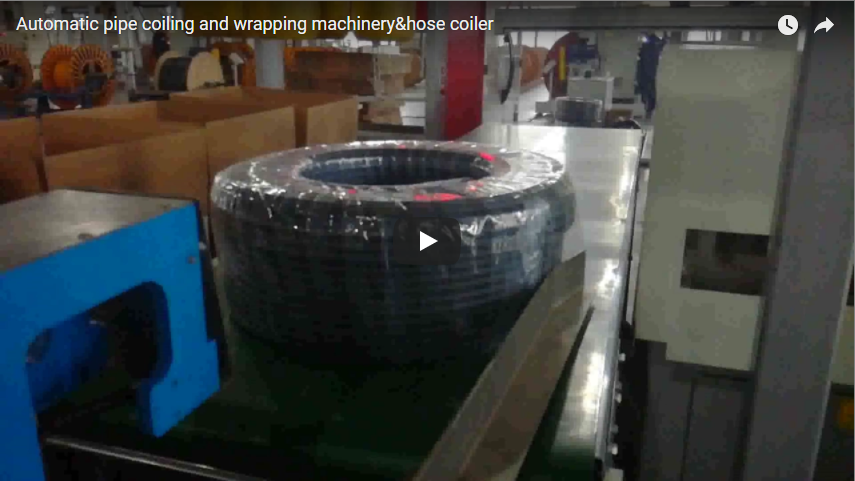
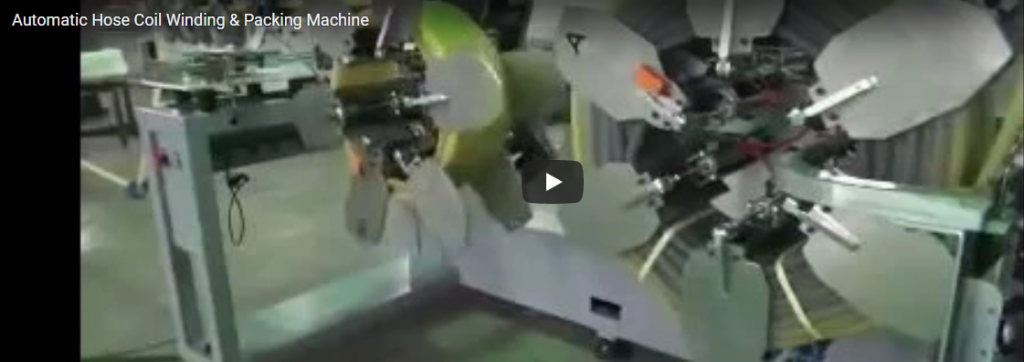
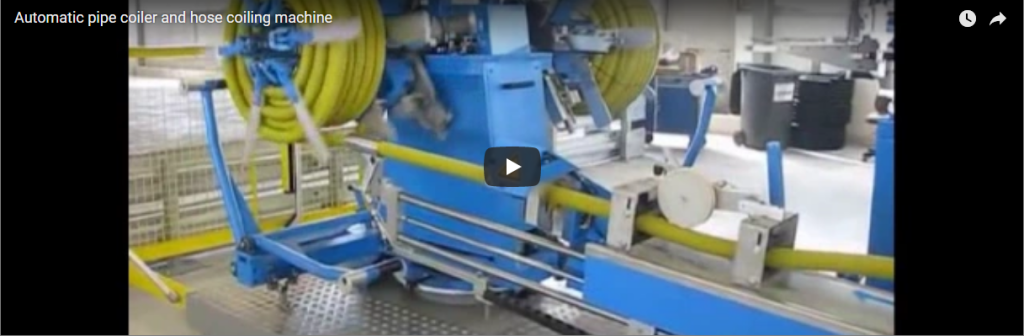
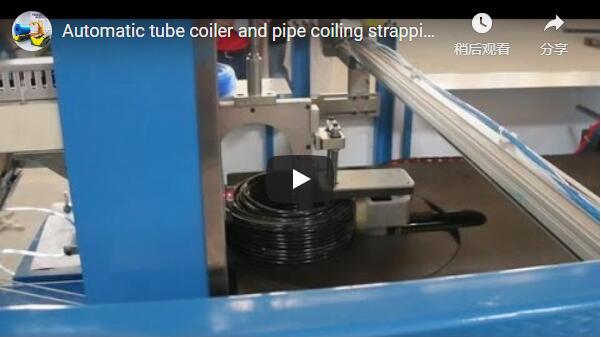
The clip shows the strapping station from three camera setups, in this order.
First, a close side view of a film-wrapped board stack under a white frame while the head works down and back up. Second, a wider angle with green belts already around the stack on a roller conveyor. Third, a view with a yellow access ladder and a second machine frame at the side.
Between the setups the order is the same: the stack is strapped under the arch frame, then the conveyor moves it on. Operators stay outside the frame while the head and conveyor run; work at the stack is done only with the station stopped, isolated and locked out.
The strapping station in a board line
An automatic board strapping machine is an inline station that tensions, seals and cuts PET or PP straps around a board stack on the conveyor.
On our board packaging line the strapping section is specified for boards with PET or PP strapping belts. It is built online: the stack arrives on a conveyor, is strapped, and leaves on the same conveyor. Around it the line can carry a vacuum lifter, a stacker, a wrapping station or shrinking station and a palletiser. A similar online layout for pipes is shown in our pipe bundling and PP strapping line.
The strapping machine must therefore match the conveyor height on both sides and release each bundle on time. We size the head, strap and conveyor with the rest of the line.
PET or PP strap: how we choose
Both strap types are specified for this section. The choice is an engineering decision, not a price decision:
| Strap property | PET strap | PP strap | Practical effect on a board stack |
|---|---|---|---|
| Stretch under load | Low | High | PP relaxes more, so it needs a higher initial set |
| Tension held in storage | Better | Lower | PET holds a heavy stack tighter in storage |
| Edge behaviour | Better on sharp board corners | Cuts into sharp corners at high tension | PP normally needs corner protectors on cut boards |
Use PET for heavy bundles, long storage (months) or sharp edges, and PP for light stacks with protected edges and short storage. In both cases the board edge limits the tension, so we set it against the edge crush resistance and add corner protection where needed.
Strap length formula and strap spacing
Strap loop length is the perimeter of the bundle section, so it is set by bundle width and height, not length:
loop length per strap = 2 × (bundle width + bundle height)
strap length per bundle = (loop length + allowance) × number of straps
Worked example for a bundle 1,200 mm wide and 600 mm high:
| Item | Value |
|---|---|
| Loop length per strap, 2 × (1,200 + 600) | 3,600 mm |
| Number of straps | 2 |
| Allowance per strap (joint and corner protection) | 300 mm |
| Strap length per bundle, 2 × 3,600 + 2 × 300 | 7,800 mm |
| With a 20 % order margin, 7,800 mm × 1.2 | about 9.4 m per bundle |
As a starting point we put a strap near each end and space the rest so that no gap exceeds the bundle height; a bundle 2,400 mm long and 600 mm high gets five straps. The end straps stay clear of the corners and of the fork-lift lift points.
The strapping head and the conveyor
The head sits on an arch frame over the conveyor, and the conveyor indexes the bundle to each strap position. Three settings are made on site:
- Strap positions. Stored as a recipe, so a format change is a recipe change, not a mechanical rebuild.
- Head stroke. Down to the bundle top, tension, seal, cut and back up, set so the head never rests on the stack.
- Conveyor index. One strap pitch per move. Side guides and a stop adjustable for each board width keep the bundle centred, because an off-centre bundle is the most common cause of a failed strap.
Bundle takt and line balance
Takt comes from your output target. For an illustrative 40 bundles per hour, one bundle has to leave the station every 90 s:
| Item | Value |
|---|---|
| Output target (illustrative) | 40 bundles per hour |
| Takt, 3,600 ÷ 40 | 90 s per bundle |
| Straps per bundle (example) | 2 |
| Time budget per strap, 90 ÷ 2 | 45 s |
| Condition | Head stroke, strap feed, conveyor index and bundle transfer inside the budget |
The time per bundle is the sum of the strap cycles plus the index time between them. If that exceeds the takt, we add a second head, overlap the index with the strap cycle on a longer conveyor, or use fewer straps of a stronger strap.
Selection checklist for a board strapping machine
- Board type, single-board thickness and bundle size (width, height, length).
- Bundle weight range and how the bundle is lifted and stored.
- PET or PP strap, band width and tension, with corner protection where needed.
- Number of straps and their positions along the bundle.
- Conveyor height, roller pitch and centring at the station.
- Takt in bundles per hour, and the cycle times of neighbouring stations.
Controls and safety
The head travel and the conveyor movement are the danger zones. Keep everyone outside the frame and clear of the conveyor while the line runs. Stop, isolate and lock out the machine before clearing a jammed strap, changing a belt coil or adjusting a strap position.
The standards that apply depend on the destination market. For CE markets, ISO 12100 sets the risk-assessment method and EN 415-10 covers the general requirements for packaging machines, including guarding and interlocking between the head, strap feed and conveyor.
Engineering FAQ
Q: Should I use PET or PP strap for a board stack? A: Use PET when the bundle is heavy or stored for months, because PET stretches less and holds its tension longer than PP. Use PP for light stacks with protected edges, and add corner protection wherever the board edge is sharp.
Q: Can the strapping machine work inline with a wrapping station? A: Yes. Our board packaging line runs strapping as an online section between the stacker or wrapping section and the palletiser.
Q: Why does the bundle have to be centred before strapping? A: If the stack is off centre the strap lands on an edge instead of the face, so the conveyor uses side guides and an adjustable stop for each board width.
Next step
We size a board strapping station in three steps:
- Submit your layout drawing with the board stack sizes, bundle weights and required output, to info@fhopepack.com.
- Receive a proposal within 48 hours, including the strap choice, the strap positions and the takt check against the sections on both sides.
- Book a site survey so we confirm the conveyor height, the centring arrangement and the interface with the rest of the line.
Related reading
- Automatic board packaging line
- Gypsum board packaging line with orbital wrapper
- Automatic lumber bundle strapping packing line
- Automatic steel tube bundling and strapping machine
Sources
- Online strapping section with PET or PP strapping belts: Automatic board packaging line
- Strap length worked example: our own calculation from your bundle width and height, illustrative values
- Bundle timing: illustrative output target, checked against the strap strokes seen in the clip
- Machine in action: our video on YouTube
- Standards scope: ISO 12100:2010, EN 415-10:2014
Last reviewed: 2026-10-04