Executive summary A pillow flow wrapper turns a reel of flat film into a tube around each product, seals it along the bottom and closes it at both ends. Our automatic pillow flow wrapper does this in one continuous run on a belt conveyor, so each long product leaves in its own sealed, see-through pack. The film width follows from the product’s width and height, and the bag length from its length. Both are set per project to your product.
Table of Contents
- What the video shows
- How the pillow wrapper works
- Working out film width
- Working out bag length
- Controls and safety
- Selection checklist for a pillow flow wrapper
- Engineering FAQ
- Next step
- Related reading
- Sources
What the video shows
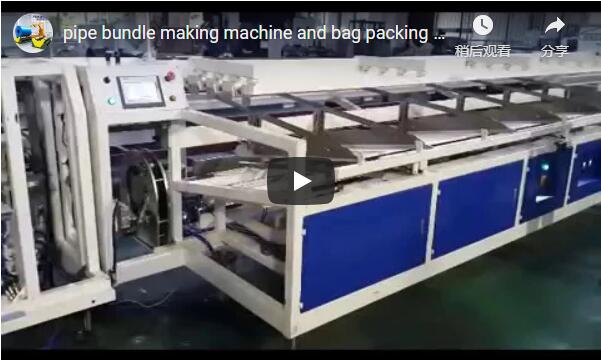
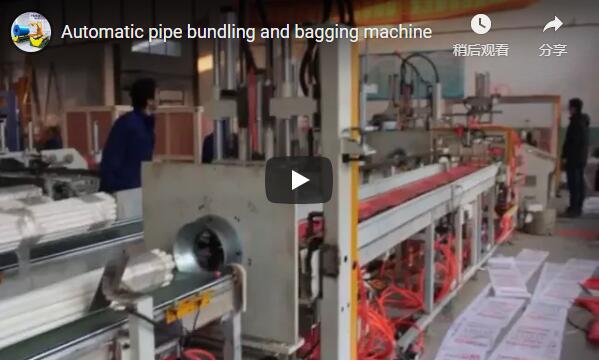
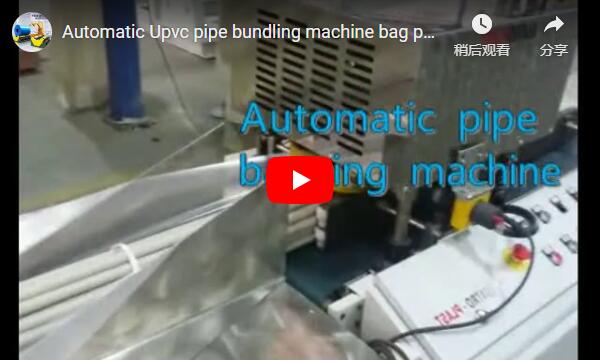
Long black products lie on the stainless infeed table of our white pillow wrapper. Each one is fed onto the green belt and into the sealing section behind the blue window, where the clear film closes around it. The finished packs leave at the far end and pile up on the floor. Each is in its own clear film pack, and a red tie holds the product inside.
The machine runs continuously: the product never stops while the film is formed, sealed and cut around it.
How the pillow wrapper works
| Step | What happens |
|---|---|
| Infeed | The product is placed on the infeed and carried in on the belt |
| Forming | The flat film is folded into a tube around the product |
| Long seal | The two film edges are sealed together under the product |
| End seal and cut | Sealing jaws close the tube between products and cut it |
| Discharge | The sealed pack leaves on the outfeed |
The long seal runs the full length of the pack, and the end seals close it at both ends. That gives a pack sealed on three sides from a single reel of film, with no pre-made bags.
Working out film width
The film has to wrap once round the product’s section, plus enough overlap to make the long seal. Illustrative example for a product 60 mm wide and 60 mm high, with 30 mm allowed for the long seal:
| Item | Value |
|---|---|
| Product width | 60 mm |
| Product height | 60 mm |
| Section perimeter, 2 × (60 + 60) | 240 mm |
| Long seal allowance (illustrative) | 30 mm |
| Film width, 240 + 30 | 270 mm |
A loose pack needs a little more film round the section, and a tight pack less. Printed film also needs a print mark on each pack length, so the sealing jaws cut between prints. Run a trial on your product before you order film in quantity.
Working out bag length
Each pack is the product length plus room for the two end seals. Illustrative example for a 700 mm product with 40 mm left at each end:
| Item | Value |
|---|---|
| Product length | 700 mm |
| End allowance, 2 × 40 mm | 80 mm |
| Pack length | 780 mm |
| Film per pack, 780 mm × 270 mm wide | 0.21 m² |
Long products need longer end allowances when they are soft or uneven at the ends, so the jaws do not catch them. Set the pack length per product in the program.
Controls and safety
The control panel on the side of the machine carries the run lights and settings. In the video, the sealing section sits behind a blue window. Keep hands out of the jaw area while the machine runs.
The standards that apply depend on the destination market. For CE markets, ISO 12100 sets the risk-assessment method and EN 415-10 sets general requirements for packaging machines.
Selection checklist for a pillow flow wrapper
- Product length, width and height, smallest to largest.
- Products per minute.
- Clear or printed film.
- Single products or small bundles per pack.
- How the products reach the infeed: by hand or by conveyor.
- Whether a shrink tunnel is needed after sealing.
Engineering FAQ
Q: What products suit a pillow flow wrapper? A: Products that can lie on a belt and travel through the machine one after another. Long rods and bars, like those in our video, work when the pack length is set to suit.
Q: How wide does the film need to be? A: About twice the product width plus twice its height, plus the long seal allowance. Our 60 × 60 mm example needs 270 mm film.
Q: How long is each pack? A: The product length plus both end allowances. Our 700 mm example makes a 780 mm pack.
Q: Does it need pre-made bags? A: No. It forms each pack from a single reel of flat film.
Q: Can it add a shrink tunnel? A: A shrink tunnel can be added after sealing for a tighter pack. Tell us if you need it.
Next step
We plan your pillow flow wrapper in three steps:
- Submit your layout drawing with product sizes and output to info@fhopepack.com.
- Receive a proposal within 48 hours, with the film width and pack plan.
- Book a site survey to check the infeed and floor space.
Related reading
- Flow wrapping and shrinking machine
- E300 horizontal stretch wrapper
- Video: automatic bagging machine for tube and pipe
Sources
- Machine content: FHOPE engineering team, 2026-10-04
- Film and pack examples: our worked examples, illustrative values
- Machine in action: our video on YouTube
- Standards scope: ISO 12100:2010, EN 415-10:2014
Last reviewed: 2026-10-04