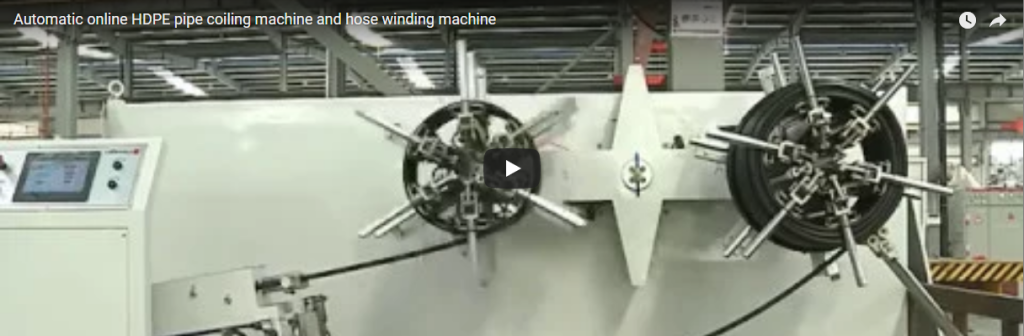
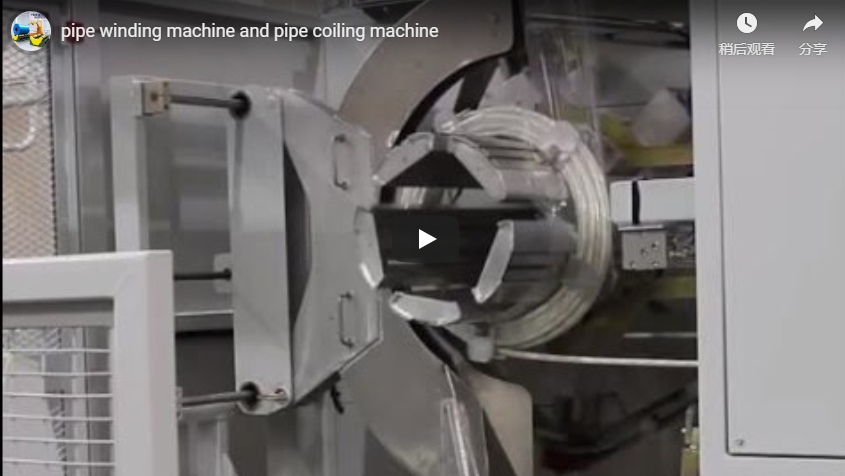
Executive summary Our pipe sleeve bagger works like a flow-pack machine stretched out for long products. It forms film into a tube around each pipe as the pipe runs through, seals it and cuts it to the pipe’s length, so every pipe leaves in its own sleeve. The sleeve stops scratches in transit and stops pipes rubbing against each other in the bundle. A shrink tunnel can follow for a tighter pack, but most customers bag without one.
Table of Contents
- How the sleeve bagger works
- Why sleeve each pipe
- Sleeve only or sleeve and shrink
- Sizing the film
- Matching the pipe mill speed
- Sleeve bagger or bundle bagger
- Selection checklist
- Engineering FAQ
- Next step
- Related reading
- Sources
How the sleeve bagger works
The pipe arrives on the infeed conveyor and runs into the forming section. Film from the reel is folded around the pipe into a tube, and a longitudinal seal closes it underneath. When the pipe end passes the cross-seal jaws, the jaws close behind it, seal the tube and cut it. The pipe leaves in a closed sleeve, and the next pipe is already entering the film.
We set the touch screen to variable-length bagging, as in our video. The machine detects the end of each pipe as it passes and places the cross seal behind it, so mixed lengths can run without a changeover. The same screen sets seal temperature and seal time, the two values to tune when changing film type or thickness. An emergency stop sits on the side of the machine body, within reach of the operator at the infeed.
Why sleeve each pipe
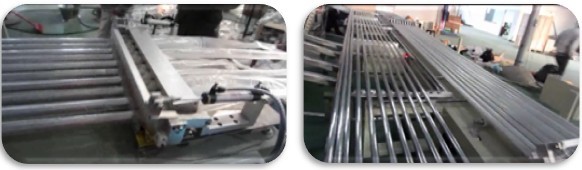
A bundle of bare steel or stainless pipes is packed metal on metal. During loading, trucking and unloading, the pipes slide against each other, and each movement can leave a scratch on a polished or coated surface. A strapped bundle also rubs against the next bundle, the truck bed and the slings.
A film sleeve on every pipe puts plastic between all of those surfaces. It does not need to be thick or tight to do that. It only has to stay on the pipe from the mill to the customer. That is why a bag alone is enough for most steel and stainless pipe.
Pack the pipes dry and cool. A sealed sleeve keeps out dirt, but on carbon steel it can also hold in moisture from a wet or warm pipe, which then condenses on the surface.
Sleeve only or sleeve and shrink
| Pack | What it adds | When to choose it |
|---|---|---|
| Sleeve only | Scratch protection, pipes kept apart in the bundle | Most steel and stainless pipe |
| Sleeve and shrink tunnel | Film pulled tight to the pipe, neater appearance | Retail or display pipe, where looks sell |
The shrink tunnel heats the sleeve after bagging so it contracts onto the pipe. It adds length to the line and energy use, so we add it only when the customer wants a tighter, neater pack. The protection against scratches is the same either way.
Sizing the film
The flat film width has to wrap the pipe and leave enough for the longitudinal seal. A simple rule:
Film width ≈ π × pipe OD + 2 × fin seal height + clearance
Illustrative example for a 48.3 mm OD pipe with a 10 mm fin and 10 mm clearance:
| Item | Value |
|---|---|
| Pipe OD (example) | 48.3 mm |
| Pipe perimeter, π × 48.3 | 151.7 mm |
| Fin seal, 2 × 10 mm | 20 mm |
| Clearance (example) | 10 mm |
| Film width | about 182 mm |
Film length per pipe is the pipe length plus the two sealed ends. A change to another pipe OD family needs a film reel of the matching width and a reset of the forming section around the new pipe size. A loose sleeve needs more clearance than a sleeve that will be shrunk, because the shrink tunnel pulls it tight afterwards.
Matching the pipe mill speed
The bagger must sleeve pipes at least as fast as the mill cuts them. Convert both to metres per minute. Illustrative example: a mill cutting a 6 m pipe every 10 s delivers 6 pipes per minute.
| Item | Value |
|---|---|
| Pipe length (example) | 6 m |
| Mill cycle (example) | 10 s per pipe |
| Pipes per minute | 6 |
| Pipe metres per minute, 6 × 6 m | 36 m/min |
Add the gap between pipes to that figure. The cross-seal jaws close in that gap, so the bagger runs faster than the mill to open it, and the film runs through the gap too. We size the bagger with spare speed above the mill output, so a short stop for a film reel change can be caught up.
Sleeve bagger or bundle bagger
| Machine | What goes in one bag | Typical use |
|---|---|---|
| Sleeve bagger, flow-pack style | One pipe | Steel and stainless pipe that must not scratch |
| Bundle bagger, B-series | 3, 6 or 10 pipes per time | Plastic pipe bundles, counted and bagged together |
The bundle bagger counts and aligns the pipes, makes the bag and fills it with the whole group. It protects the bundle from dirt but leaves the pipes touching inside. For metal pipe with a finished surface, sleeving each pipe is the better choice.
Selection checklist for a pipe sleeve bagger
- Pipe OD range, smallest to largest.
- Pipe lengths, and whether lengths are mixed.
- Mill output in pipes per minute.
- Surface finish: polished, coated or plain.
- Sleeve only, or sleeve and shrink tunnel.
- Film type and printing.
- Bundling or strapping after bagging.
Engineering FAQ
Q: Does every pipe get its own bag? A: Yes. The machine forms film around each pipe, seals it lengthwise and cuts it behind the pipe end.
Q: Do I need a shrink tunnel? A: Not for protection. A sleeve alone stops scratches and pipe-on-pipe rubbing; the tunnel only makes the pack tighter and neater.
Q: Can it bag mixed pipe lengths? A: Yes. In variable-length mode, it places the cross seal behind each pipe end, so no changeover is needed.
Q: How do I work out the film width? A: Pipe perimeter plus twice the fin seal height plus clearance. A 48.3 mm OD pipe needs about 182 mm with a 10 mm fin.
Q: What changes when we switch film or pipe size? A: A new film type or thickness needs new seal temperature and seal time on the touch screen. A new pipe OD family needs the matching film width and a forming reset.
Next step
We plan your pipe sleeve bagging line in three steps:
- Submit your layout drawing with pipe ODs, lengths and mill output to info@fhopepack.com.
- Receive a proposal within 48 hours, with the film size and line speed.
- Book a site survey to check the mill outfeed and the space for the bagger.
Related reading
- Automatic pipe bagging machine, B-series
- Pipe bag packing machine
- Video: PVC pipe bag packing machine
Sources
- Machine type, shrink tunnel option and protection purpose: FHOPE engineering team, 2026-10-04
- B-series bundle bagger (3/6/10 pipes per time): automatic pipe bagging machine page
- Machine in action: our pipe bagging video on YouTube
- Film width and speed examples: our worked examples, illustrative values
Last reviewed: 2026-10-04