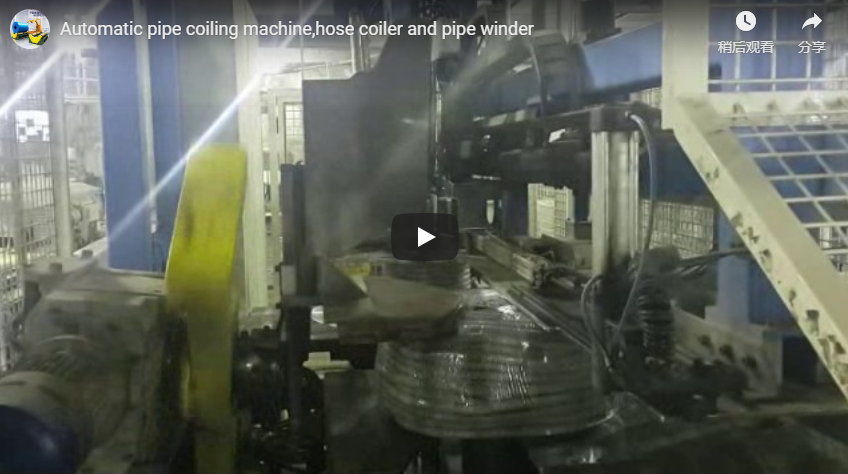
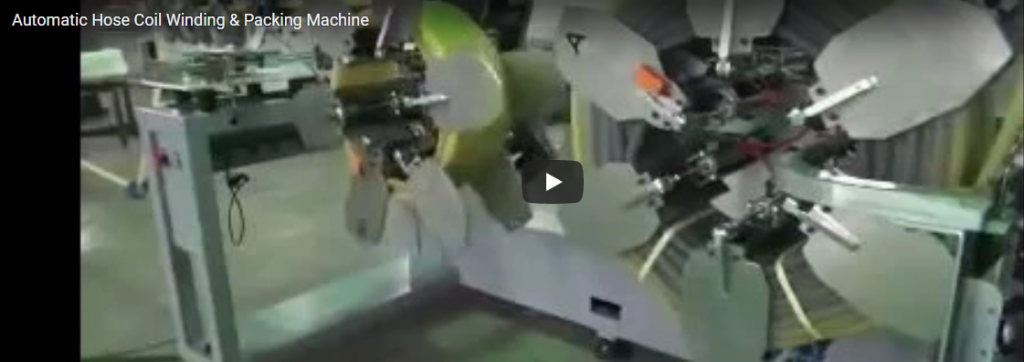
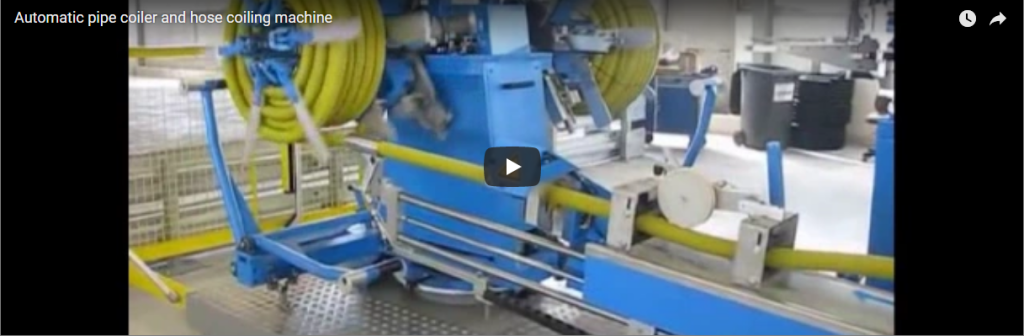
Executive summary This short clip shows our automatic pipe coiling cell working without an accumulator. White pipe feeds in from the line along the floor and the winder head turns inside a guarded cell, winding the coil as the pipe arrives. With no accumulator, the winder speed follows the line speed.
Table of Contents
- What the clip shows
- Why no accumulator
- Coiling time per coil
- What we set per coil
- Selection checklist
- Safety
- Engineering FAQ
- Next step
- Related reading
- Sources
What the clip shows
| Step | What you see |
|---|---|
| Feed | White pipe feeds in along the floor |
| Winding | The winder head turns inside the cell |
| Guarding | The cell is fenced with mesh panels |
| Screen | A panel screen beside the cell |
| Line | The workshop line runs behind |
Why no accumulator
- Less floor space. No accumulator loop before the winder.
- Speed follows the line. The winder matches pipe speed.
- Fewer parts. No buffer to maintain.
- Guarded. The winder turns inside a fenced cell.
Coiling time per coil
Worked example (illustrative).
| Item | Value |
|---|---|
| Pipe per coil (illustrative) | 100 m |
| Line speed (illustrative) | 20 m/min |
| Winding time, 100 ÷ 20 | 5 min |
| Coils per hour, winding time only, 60 ÷ 5 | 12 |
What we set per coil
| Setting | Depends on |
|---|---|
| Winder speed | Line speed |
| Coil size | Pipe diameter |
| Length | Metres per coil |
| Coil change | Line speed and coil size |
Selection checklist
- Pipe outer diameter.
- Line speed.
- Metres per coil.
- Coil size.
- Floor space.
- Coil change time.
Safety
- Stay outside the fence while the winder turns.
- Do not reach into the cell.
- Lock out before clearing a jam.
- For CE markets, the machine is designed to ISO 12100 and EN 415-10.
Engineering FAQ
Q: What does “without an accumulator” mean? A: The winder takes pipe straight from the line with no buffer loop.
Q: How long does a coil take? A: 5 min for 100 m at 20 m/min in the worked example.
Q: How many coils per hour? A: 12 in the worked example, counting winding time only; cut and coil change add to it.
Q: Is the winder guarded? A: Yes, it turns inside a fenced cell.
Q: How does the coil change work? A: Cut and coil change are timed to the line speed; the method is set per project.
Q: Which standards apply? A: For CE markets, ISO 12100 and EN 415-10.
Next step
We match a pipe coiling cell in three steps:
- Submit your layout drawing with pipe size, line speed and metres per coil, to info@fhopepack.com.
- Receive a proposal within 48 hours with the machine data and layout.
- Book a site survey so we confirm the extrusion line.
Related reading
- Automatic Pipe Coiling and Wrapping Machine
- Double Wall Corrugated Hose Coiling and Strapping
- Automatic Steel Wire Coiler for Winding and Strapping
- Automatic packing line
Sources
- Machine content: FHOPE engineering team, 2026-10-10
- Clip: the video on YouTube
- Coiling time: our worked example, illustrative values
- Standards scope: ISO 12100:2010; EN 415-10:2014
- Proposal timing: approved house CTA (proposal within 48 hours)
Last reviewed: 2026-10-10