Executive summary
Doors leave the plant either in a tight film shell that survives transit, or with scratched faces and torn corners. Door shrink wrapping closes each door in film on three sides, then shrinks the film tight in a hot-air tunnel, so every door is sealed the same way. This page compares the three sealer layouts we build, shows how to size the machine to your door widths, and covers film choice and line length.
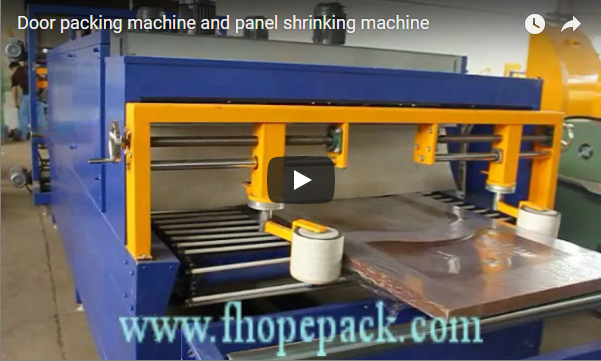
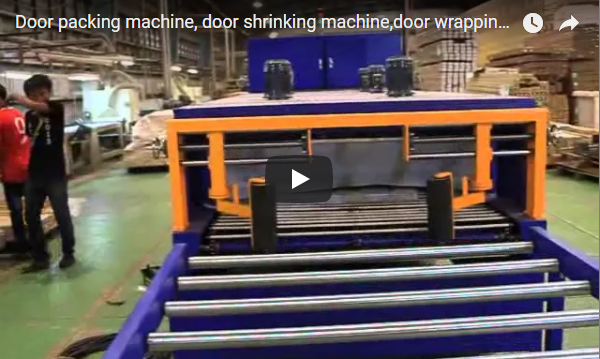
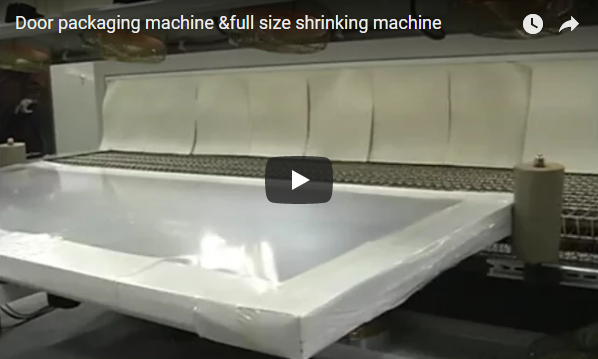
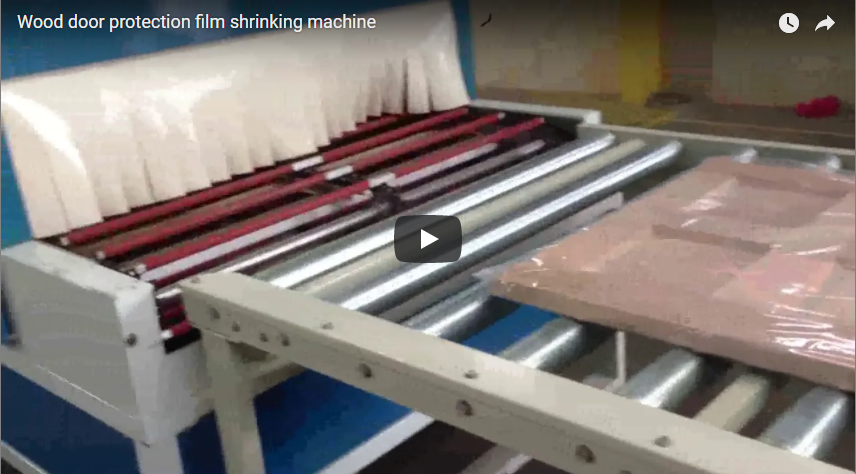
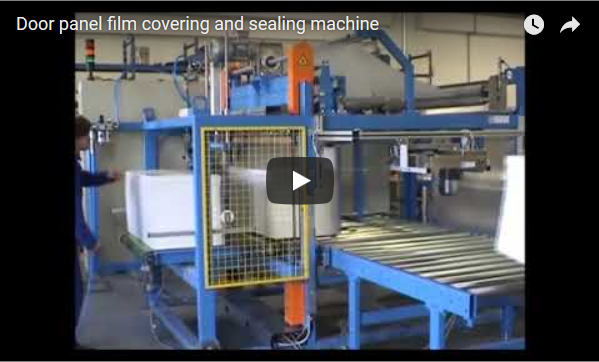
Two operators lay a door panel onto the green infeed table, where it runs into the sealing station and is closed in film, as on our panel sealing and shrinking machine. The sealed door then travels on the red roller conveyor of the shrink tunnel, which carries it through the hot air and out with the film pulled tight.
Table of Contents
- Why doors need a sealed shell
- How three-side sealing works
- Three sealer layouts
- Machine data
- Sizing to your door widths
- Selection checklist
- Safety
- Engineering FAQ
- Next step
- Related reading
- Sources
Why doors need a sealed shell
Doors are shipped by the stack and moved by hand on site. Painted and laminated faces scratch at the first contact, and corners chip. Cardboard corners help but leave the faces open. A shrink shell covers every face and corner, keeps out dust during storage and is fast to remove at installation.
How three-side sealing works
- Infeed: the door is placed on the infeed table between guide plates.
- Cover: upper and lower film meet in front of the door, and the door pushes into the film.
- Seal: each cycle makes three seams: the cross seal at the back edge and the two side seals along the long edges. The front is already closed where upper and lower film were joined in the previous cycle.
- Shrink: the door passes through the tunnel on a roller conveyor; hot air shrinks the film tight.
- Outfeed: the shrunk door cools on the outfeed rollers and is stacked.
Three sealer layouts
| Layout | How sides are closed | Best for |
|---|---|---|
| One sealer with two press devices | nip rollers press the side film | single doors, standard sizes |
| Three cutters | separate cutter on each side | stacked doors, large goods; smoother edges |
| Motion sealer | heat-sealing knives on both sides, guide plates on the conveyor | smooth-surfaced doors in varying sizes |
Machine data
| Item | FHOPE door shrink packing machine |
|---|---|
| Object length | 1,000–4,000 mm |
| Object width | up to 1,200 mm |
| Working table height | about 800 mm |
| Conveyor speed | about 4–9 m/min |
| Film | PE, POF or PVC with vent holes |
| Film thickness | 80–150 μm recommended; 200 μm available |
| Control | PLC and HMI |
Single-door thickness, stack height and wider doors are confirmed at quote.
Sizing to your door widths
Size the machine to the widest door you pack often, not the widest door you ever make. On one Australian project, doors were up to 1,500 mm wide, but 90% were under 1,200 mm. The customer also had limited floor space. A machine for 1,200 mm covered most of the output in a smaller footprint, and the few wider doors needed a separate solution.
Line length ≈ infeed + sealer + tunnel + cooling outfeed. The infeed and outfeed tables must be longer than your longest door; the sealer frame length depends on the sealing stroke.
Doors per hour ≈ conveyor speed × 60 ÷ (door length + gap). At 6 m/min with 2.1 m doors and a 0.4 m gap, that is about 6 × 60 ÷ 2.5 = 144 doors per hour (example only).
Selection checklist
- Minimum and maximum door length, width and height?
- Share of output by width?
- Single doors or stacks?
- Film type and thickness?
- Floor length available?
- Doors per hour?
Safety
We design shrink lines to EN ISO 12100:2010 for risk assessment, EN 415-10 for packaging machine safety and EN 60204-1 for electrical equipment. The sealing knives and hot tunnel are the main hazards; sensors control the sealing and the tunnel is guarded.
Engineering FAQ
Q: Shrink or stretch wrapping for doors? A: Shrink is faster, uses less material and has fewer size limits than a horizontal stretch wrapper, because it covers every face in one layer without spiral overlaps.
Q: Which layout gives the neatest edges? A: Three cutters or the motion sealer; cutters leave fewer wrinkles than nip rollers.
Q: Can it pack stacked doors? A: Yes, the three-cutter layout suits stacks.
Q: What do you need for a three-side quotation? A: Minimum and maximum length, width and height of the doors.
Next step
- Send your door sizes, output and floor plan to info@fhopepack.com.
- We choose the sealer layout and tunnel length.
- We reply within 24 hours with a proposal and quotation.
Related reading
- Automatic door shrinking machine (product)
- Door shrinking machine with motion sealer (product)
- Door panel sealing and shrinking machine (video)
- Door and panel shrink packaging machine (video)
Sources
- FHOPE product pages: automatic door shrinking machine; door shrinking machine with motion sealer
- FHOPE project correspondence on door shrink packing
- EN ISO 12100:2010; EN 415-10; EN 60204-1
- The door shrink wrapping line shown above
Last reviewed: 2026-10-20