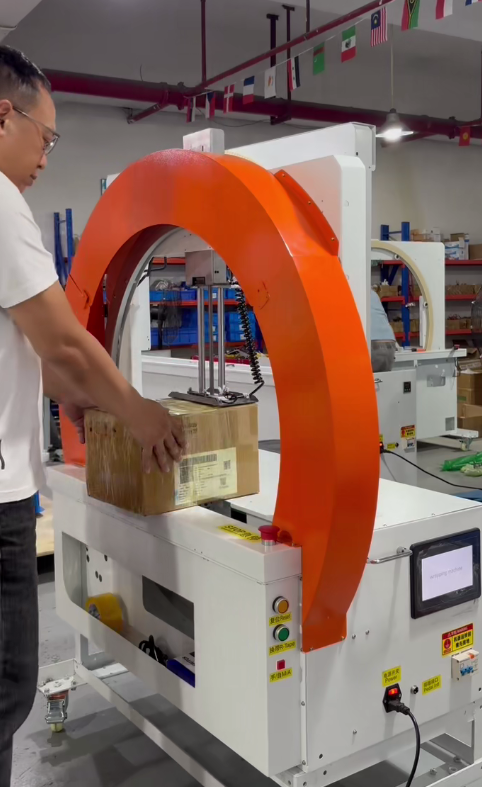
Executive summary Heavy or export cartons need tape all the way round, not just a strip over the top seam. Our box taping machine in this video runs wide orange tape round each carton from a dispenser inside a large ring, while the operator holds the box and presses a foot pedal. Tape use follows from the box size and the number of bands. We set both per project.
Table of Contents
- What the video shows
- How the box taping cycle works
- Tape use per box and roll yield
- Where full-wrap taping helps
- Controls and safety
- Selection checklist for a box taping machine
- Engineering FAQ
- Next step
- Related reading
- Sources
What the video shows
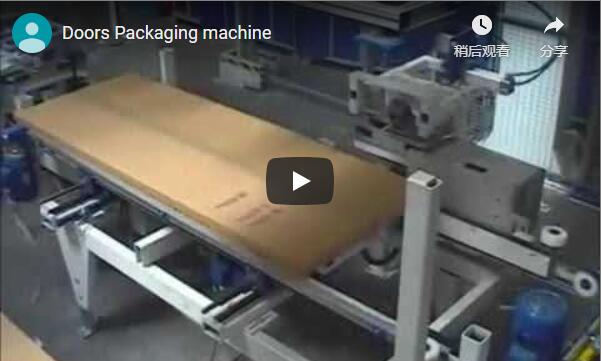
An operator feeds a brown carton into the central opening of our grey and silver machine. The tape dispenser inside the large ring turns round the box and lays wide orange tape over it while the operator holds it steady.
He takes the taped carton out, sets it on a stack, then feeds in a smaller orange carton, which is taped the same way. The finished cartons carry a cross of tape over the top and sides. A foot pedal stands on the floor to the right of the machine.
How the box taping cycle works
| Step | What happens |
|---|---|
| Feed | The operator sets the box in the ring opening |
| Start | A foot pedal starts the dispenser |
| Tape | The dispenser turns round the box and lays tape |
| Turn | The box is turned for the second band |
| Remove | The taped box goes onto the stack |
The box stays still while the tape travels, so one machine handles cartons of different sizes without changeover. For long profiles, the same idea drives our horizontal orbital ring stretch wrapper.
Tape use per box and roll yield
Illustrative example with two crossed bands:
| Item | Value |
|---|---|
| Box size (illustrative) | 400 × 300 × 300 mm |
| Band round length and height, 2 × (400 + 300) | 1,400 mm |
| Band round width and height, 2 × (300 + 300) | 1,200 mm |
| Tape per box before overlap, 1.4 + 1.2 | 2.6 m |
| Tape roll (illustrative) | 66 m |
| Boxes per roll | Below 66 ÷ 2.6, set by the overlap |
Check the overlap on trial with your tape, since it sets how many boxes a roll covers.
Where full-wrap taping helps
| Load | Why tape all round |
|---|---|
| Heavy cartons | Bands carry the weight across the flaps |
| Export cartons | Bands resist handling and stacking |
| Mixed box sizes | No changeover between sizes |
| Branded tape | Printed tape shows on every face |
For light cartons with only a top seam, a standard flap sealer is enough.
Controls and safety
The dispenser turns round the box inside the ring. Keep hands on the box only as shown, outside the ring’s path, and clear tape jams only with the machine stopped.
The standards that apply depend on the destination market. For CE markets, ISO 12100 sets the risk-assessment method and EN 415-10 sets general requirements for packaging machines.
Selection checklist for a box taping machine
- Largest and smallest box size.
- Box weight.
- Bands per box and pattern.
- Tape width and type.
- Boxes per hour.
- Manual or conveyor feed.
Engineering FAQ
Q: How is the cycle started? A: With a foot pedal, so both hands stay on the box.
Q: How is a cross of tape made? A: The machine lays the first band, the operator turns the box in the ring opening, and a second band goes on.
Q: How much tape does a box take? A: About 2.6 m for two crossed bands on a 400 × 300 × 300 mm box in our example, plus the overlap at each band end.
Q: How many boxes does a roll tape? A: Fewer than 66 ÷ 2.6 boxes from a 66 m roll in our example, depending on the overlap.
Q: Does it need changeover between box sizes? A: No. The tape travels round the box, so sizes inside the ring opening run without changeover.
Q: Can it take conveyor feed? A: Yes. We add infeed and outfeed conveyors when output calls for it.
Next step
We plan your box taping machine in three steps:
- Submit your layout drawing with box sizes, weights and output to info@fhopepack.com.
- Receive a proposal within 48 hours, with the band pattern and tape plan.
- Book a site survey to check manual or conveyor feed.
Related reading
- Orbital stretch wrapper
- Video: orbital wrapper for carton box bundles
- Video: combined machine for six-side wrapping
Sources
- Machine content: FHOPE engineering team, 2026-10-04
- Tape example: our worked example, illustrative values
- Machine in action: our video on YouTube
- Standards scope: ISO 12100:2010, EN 415-10:2014
Last reviewed: 2026-10-04