Executive summary An automatic light gauge steel packing line takes loose C and U profiles from a roll former and outputs labeled master stacks ready for logistics. The line counts profiles, feeds them into small bundles, orbitally wraps the contact points, applies labels, and stacks the bundles into master loads. The PLC-synchronized line runs on standard ratings such as a 2500 kg stack load and 15 to 25 m/min wrapping speed. This guide covers the workflow and the specification range.
Table of Contents
- What the line does
- How the line runs
- Partial wrapping advantage
- Labeling and traceability
- Master stacking and load protection
- Typical specification range
- Machine selection checklist
- Operation and safety basics
- Maintenance essentials
- Engineering FAQ
- Next step
- Related reading
- Sources and standards
What the line does
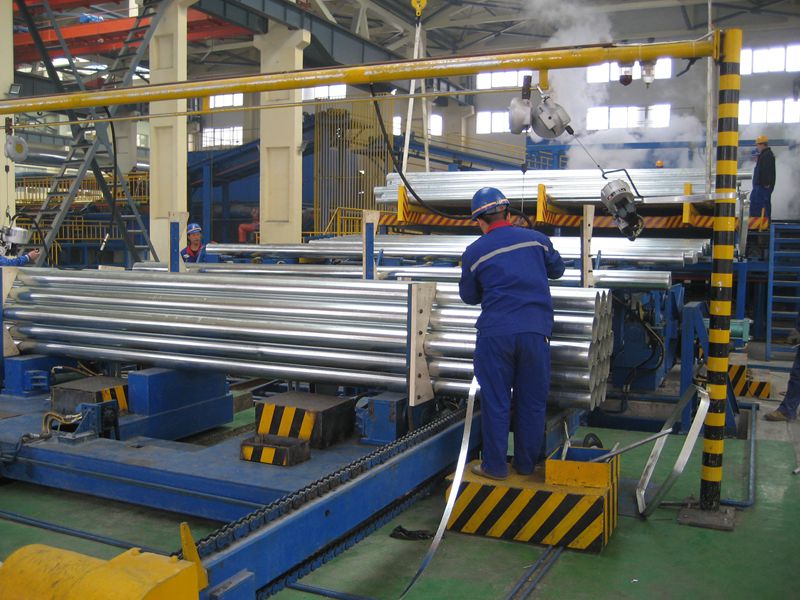
An automatic light gauge steel (LGS) bundling and wrapping packing line takes loose C-stud, U-track and LGS profiles from a cold roll forming line. It turns them into labeled master stacks ready for global logistics and construction site delivery.
The line synchronizes with the roll former, so the finished profile moves straight into counting, bundling and wrapping instead of building up at the machine outlet. That removes the post-forming bottleneck that decides total output in high-speed roll forming production.
How the line runs
The line follows six automated steps from profile output to unloading.
Precision sensors count the profiles and confirm the quantity of each small bundle against the preset parameters. A heavy-duty lateral transfer mechanism moves the profiles out of the roll former into the alignment zone. An orbital wrapping system then applies partial wrapping at the key contact points to hold the bundle together, and a real-time printer applies a barcode label on the top surface.
A specialized lifting device stacks the completed bundles into high-density master loads along the preset matrix, and a conveyor outputs the master stack to the unloading area for forklift pickup.
The whole sequence runs on PLC synchronization across the stations, coordinated by a Siemens PLC with an HMI touchscreen that times counting, transfer, wrapping, labeling and stacking with the roll former. The HMI also holds the tuning points that decide bundle quality. Calibrating the partial wrapping tension reaches maximum bundling strength without deforming the thin-walled LGS profiles, which removes the risk of loose bundles in transit without adding film.
Partial wrapping advantage
The bundles are reinforced where the profiles touch, rather than covered edge to edge. The orbital wrapping system targets the key contact points, so the bundle stays stable in transit while film consumption stays low.
Targeted wrapping is what protects the zinc coating: the film keeps the profile faces from rubbing and picks up less dust and moisture than full coverage needs. Because orbital film wrapping replaces strapping here, thin-walled profiles travel without a steel band pressing into their edges.
Master stacking and load protection
Completed small bundles are built into master loads by an automatic master elevator system, which stacks each bundle along a preset matrix so the finished load is dense and stable.
The elevator places every bundle in line, so the weight spreads across the load. The lower profiles are not deformed by heavy pressure. The result is a uniform rectangular load that shrinks the footprint in the warehouse and keeps its shape through stacking and transit.
Labeling and traceability
Each bundle carries a barcode label printed and applied in real time on its top surface, so the identity, grade and quantity of every bundle travel with it to the construction site.
That closes the loop between roll forming data and the finished load. With counts confirmed by sensors at the infeed and labels applied automatically, the manual entry errors that usually appear in large construction projects are removed from the material flow.
Typical specification range
The values below are the published standard ratings of this line. Confirm the exact numbers against your roll former output per project.
| Item | Specification |
|---|---|
| Applicable material | light gauge steel, C-stud, U-track and LGS profiles |
| Max stacking load | 2500 kg |
| Wrapping speed | 15 to 25 m/min |
| Max stacking height | 1200 mm |
| Control core | Siemens PLC with HMI touchscreen |
| Rated power / supply | 12.5 kW / 380 V, 50 Hz, 3-phase |
| Air pressure | 0.6 to 0.8 MPa |
Machine selection checklist
Work through these points before you ask for a quote, and we confirm the rest against your roll former output per project.
| Item | What to confirm per project |
|---|---|
| Profiles | C and U sizes, gauge and bundle spec |
| Infeed | roll former outlet height and pitch |
| Bundle | count and wrap points, covering only the contact points |
| Labeling | barcode content and label stock |
| Master load | stack matrix and max height |
| Utility | power, air pressure and floor capacity |
| Site | layout, guarding clearance and outfeed |
Operation and safety basics
The processing zone around the transfer, wrapping and stacking stations is enclosed by protective guarding, and a warning beacon cycles while the line runs. Operators stay clear of the guarded stations during automatic cycles and confirm the master load is clear of the outfeed before unloading.
Before a run, confirm the preset spec of the current profile size, the label stock and the film reel. Any change to the profile or bundle spec is entered on the HMI before the next bundle set, and servicing inside the guarding follows the lockout procedure in the manual.
Maintenance essentials
Run the daily checks before the first shift. Confirm the counting sensors are clean and reading every profile, the film path is free of debris, and the label printer has stock and no ribbon faults.
Keep the transfer mechanism guides, the elevator chain and the conveyor drives lubricated per the manual, and check the air line pressure against the rating before high-volume runs. Watch the PLC alarm screen for sensor and drive faults and clear them before restarting.
Engineering FAQ
Q: What profiles does the line handle? A: Light gauge steel profiles, including C-stud, U-track and LGS profiles, at the machine’s published stack ratings.
Q: How fast does the line wrap? A: The published wrapping speed is 15 to 25 m/min, with the counting, labeling and stacking steps synchronized by PLC.
Q: Is every bundle wrapped completely? A: No. The orbital system applies partial wrapping at the key contact points, which stabilizes the bundle with low film consumption.
Q: How are bundles identified? A: A barcode label is printed and applied in real time on the top surface of each bundle for full traceability.
Q: What happens to the completed bundles? A: An automatic master elevator stacks them into high-density master loads along a preset matrix, and a conveyor outputs the load for forklift pickup.
Next step
- Email us at info@fhopepack.com with your roll former output, profile sizes and bundle spec.
- We send a layout drawing and a packing line proposal within 48 hours.
- We arrange a site survey to confirm the infeed, air and power before installation.
Related reading
- Coil and roll stretch wrapping machine
- Automatic horizontal orbital wrapping for one-pass full coverage
- Automated steel coil packaging system payback analysis
- Steel sheet strapping machine
- FHOPE packaging machinery product lines
Sources and standards
- ISO 12100:2010 — Safety of machinery. General principles for design, risk assessment and risk reduction
- EN 415-10:2014 — Safety of packaging machines. General requirements
- EN ISO 13849-1:2023 — Safety of machinery. Safety-related parts of control systems
- FHOPE automatic light gauge steel bundling and wrapping packing line demonstration video, YouTube.
Last reviewed: 2026-10-09