Executive summary
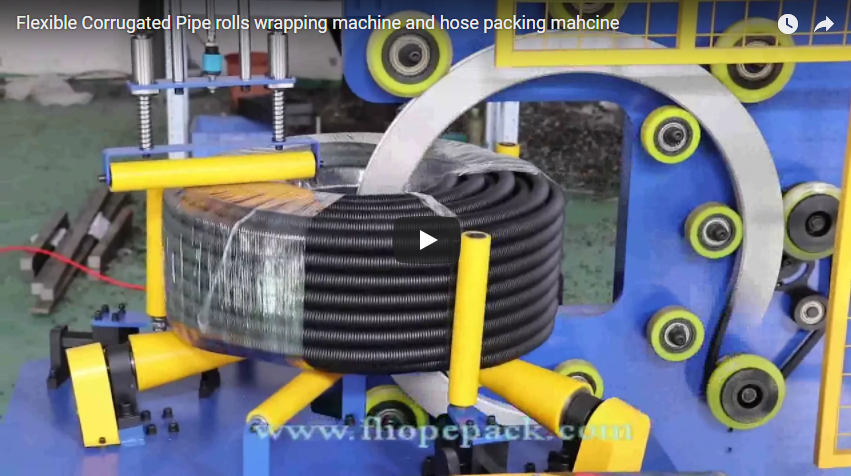
Corrugated plastic pipe and electrical conduit leave the extruder as soft coils. Our horizontal coil wrapper packs each coil lying flat, eye vertical: a ring carries film or paper through the coil eye while the coil turns, so the pipe ends cannot spring out and the coil stays clean. Our FPCA-200H takes coils of 200–350 mm ID, 500–650 mm OD, 150–300 mm wide and 10–50 kg.
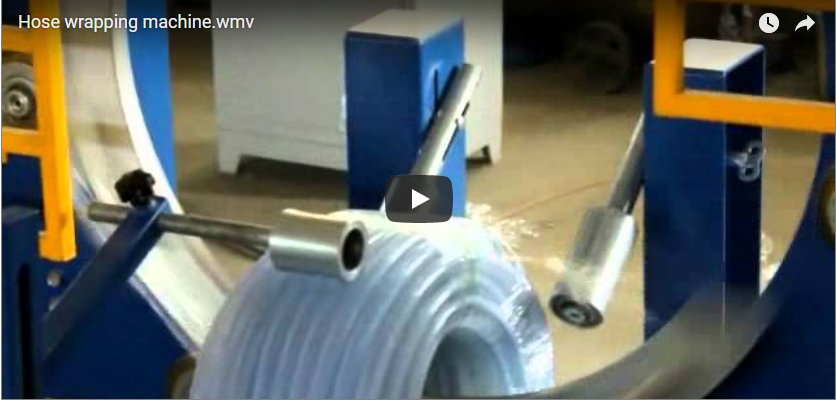
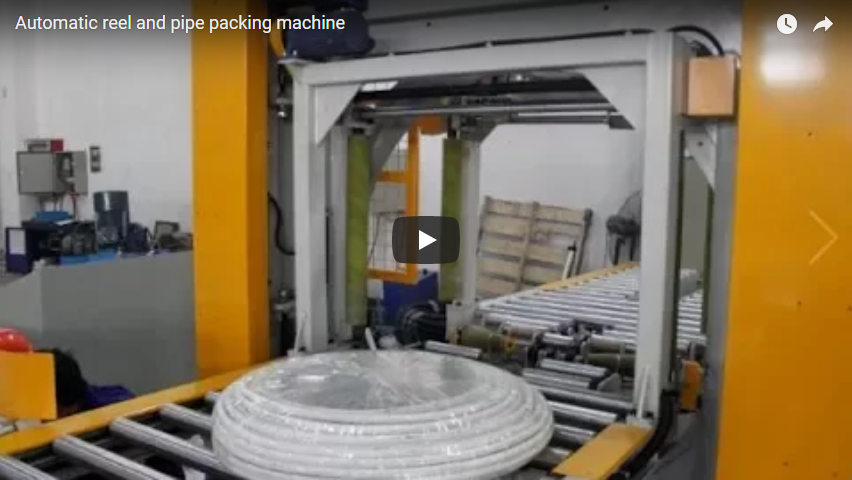
The coil here is white corrugated conduit, tied at a few points after coiling. The operator sets it flat on the roller bed of the blue machine frame, and the coil is wrapped in place before it moves on.
Table of Contents
- Why corrugated pipe coils are wrapped
- Operation step by step
- Why the coil lies flat
- Specifications (FPCA-200H)
- Worked example: film and time per coil
- Applications
- Selection checklist
- Safety: EN 415-10 and ISO 12100
- Engineering FAQ
- Next step
- Related reading
- Sources
Why corrugated pipe coils are wrapped
A corrugated pipe coil is held together only by a few ties after coiling. In transport the outer turns loosen, the ends spring out, and dust gets into the corrugations and the bore. A full wrap through the eye closes the coil on all sides. It holds every turn in place, keeps the pipe clean, and gives a smooth surface for labels and stacking.
Operation step by step
- Load. The coil is placed flat on the roller bed, by hand for light coils or from a coiler in line.
- Start. The operator starts the cycle, and the ring begins to turn through the coil eye.
- Wrap. Each ring turn lays one band of film around the coil section. The rollers turn the coil slowly, so each band lands next to the last one with the set overlap.
- Finish. After one full coil turn plus a short overwrap, the ring stops, and the film is cut and pressed down.
- Unload. The wrapped coil rolls out on the conveyor to labelling or stacking.
The ratio between ring speed and coil speed sets the overlap, and we set both on the control panel for each coil size. A vertical guide above the roller bed keeps a light coil located, so film tension cannot lift or shift it while the ring turns.
Why the coil lies flat
A soft plastic coil stood on edge sags and goes oval, and the ring then cannot keep an even wrap. Lying flat, the whole coil is supported by the roller bed. This is why our FPCA-200H is built for horizontal packing of soft coils: the support prevents deformation while the film goes on.
Specifications (FPCA-200H)
| Item | Figure |
|---|---|
| Coil ID | 200–350 mm |
| Coil OD | 500–650 mm |
| Coil width | 150–300 mm |
| Coil weight | 10–50 kg |
| Film roll | OD 100–140 mm, core 50 mm, width 90 mm |
| Paper roll (option) | OD 100–450 mm, core 50 mm, width 90 mm |
| Power supply | 380 V 60 Hz 3 ph |
| Power consumption | 2.0 kW |
| Ring speed, cycle time | confirmed at quote |
For coils outside this range, our FPH-200 hose coil wrapper covers 300–600 mm ID, 400–900 mm OD and 50–200 mm width, with a ring speed of 20–90 r/min.
Worked example: film and time per coil
Take a conduit coil of 600 mm OD, 250 mm ID and 200 mm wide, wrapped with 90 mm film at 50% overlap. The overlap is set at the bore, where the circumference is smallest.
| Step | Calculation | Result |
|---|---|---|
| Bore circumference | π × 250 | about 785 mm |
| Advance per ring turn | 90 × (1 − 50%) | 45 mm |
| Ring turns per coil | 785 ÷ 45 = 17.4 | 18 |
| Film per ring turn | 2 × radial wall (600 − 250) ÷ 2 + 2 × width 200 | 750 mm |
| Film on the coil | 18 × 0.75 m | about 13.5 m |
| Wrapping time at 60 r/min (illustrative) | 18 ÷ 60 | 0.3 min, about 18 s |
Result. About 18 ring turns and 13.5 m of film close this coil in one layer, plus a short overwrap. Actual ring speed and cycle time are confirmed at quote.
Applications
- Corrugated electrical conduit and cable protection pipe.
- PE and PVC hose coils; see HDPE pipe coil packing.
- Small plastic tube coils from an extrusion line; see PERT pipe coil wrapping.
- Soft coils that would deform if wrapped standing up.
Selection checklist
- Coil ID, OD, width and weight.
- Coils per hour from the extruder or coiler.
- Film, paper, or both.
- Manual loading, or in line with a coiler and conveyor.
- Power supply on site.
Safety: EN 415-10 and ISO 12100
Coil wrappers are packaging machines other than pallet wrappers, so they are covered by EN 415-10, with the risk assessment to ISO 12100:2010. The turning ring and the drive rollers are the main hazards. The ring turns only after the operator’s hands are clear of the coil. An emergency stop is within reach, and guarding and CE documents are agreed per project.
Engineering FAQ
Q: Does the film cover the bore of the coil? A: Yes. The ring passes through the eye, so every band covers the bore, both faces and the outer face.
Q: Can it wrap with paper? A: Yes. A paper roll of 100–450 mm OD and 90 mm width is an option.
Q: How heavy can the coil be? A: Up to 50 kg on the FPCA-200H.
Q: Can it run in line with the extruder? A: Yes. The coil can be fed from a coiler by conveyor and leave on a conveyor to stacking.
Next step
- Send your coil ID, OD, width and weight to info@fhopepack.com.
- We match the ring size and film to your coil.
- We reply within 24 hours with a proposal and quotation.
Related reading
- Coil wrapper FPCA-200H (product)
- Hose coil wrapper FPH-200 (product)
- Hose coiling and strapping machine (product)
- Full wrapping through-the-eye packaging machine
Sources
- FHOPE product pages: FPCA-200H coil wrapper, FPH-200 hose coil wrapper
- EN 415-10; ISO 12100:2010
- Our horizontal coil wrapper shown above
Last reviewed: 2026-10-19