Executive summary
Corrugated hose and plastic pipe leave the extruder without a stop, so the coiler must keep pace, give every coil the right length and close it before it ships. Our automatic coiler counts the length, cuts the pipe, winds the coil, straps it and moves it out, with two coiling stations so one winds while the other unloads. It runs at 1–60 m/min for coils of 500–800 mm OD. This page covers the process, the data, how to match line speed and what to send for a quote.
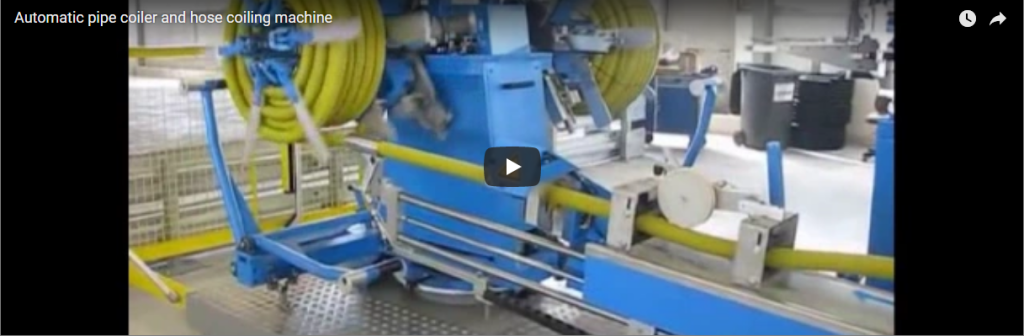
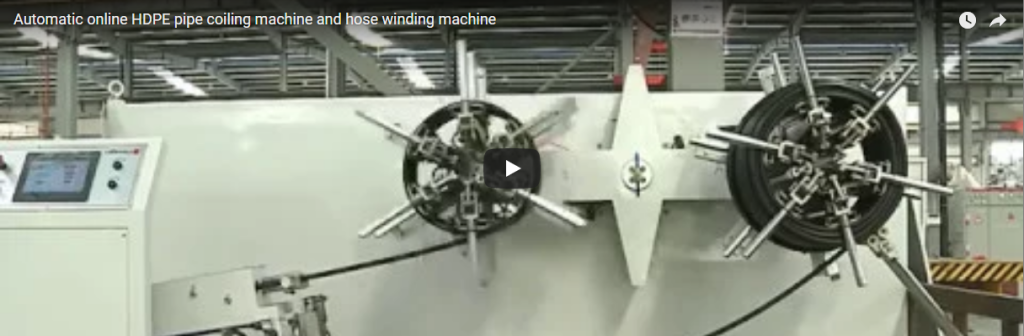
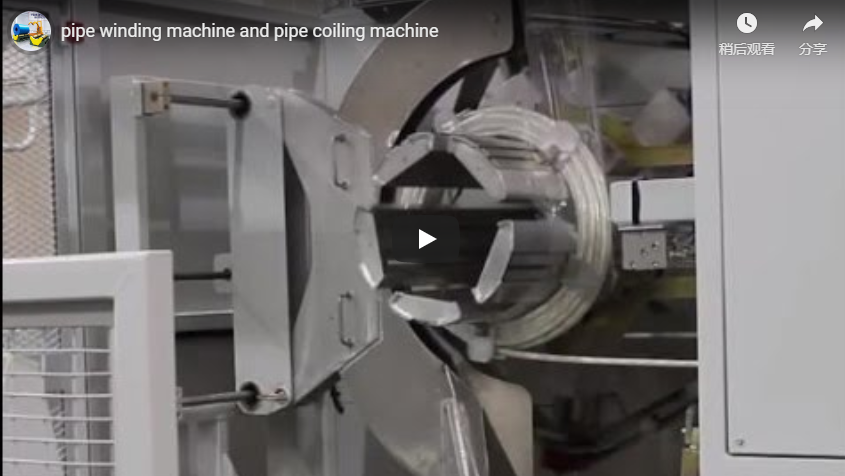
Here the coiler winds red corrugated hose. The hose enters from the left, and guide arms and clamps lay it evenly on the central winding shaft. The finished coil is set down on the conveyor on the right and carried away.
Table of Contents
- Why an automatic coiler
- How the coiler works
- Coiler data
- Matching line speed
- Selection checklist
- Safety
- Engineering FAQ
- Next step
- Related reading
- Sources
Why an automatic coiler
At line speed, a manual coiling team must catch every length, cut it and tie the coil before the next one arrives. Corrugated hose also springs back, so a loose coil opens up on the pallet. An automatic coiler sets the length on the PLC, keeps the lay even and straps the coil while it is still held on the station. Coils come out the same size and stack well.
How the coiler works
- Count: an encoder measures the pipe length as it arrives.
- Wind: the pipe is guided onto the active station and wound into a coil; the traverse lays the turns evenly.
- Cut: at the set length the pipe is cut, and the next length is switched to the second station.
- Strap: the coil is strapped on the winding station, with radial straps passed through the coil eye.
- Unload: the strapped coil is moved onto the outfeed conveyor.
- Repeat: the empty station is ready while the other winds.
Coiler data
| Item | Hose coiling and strapping machine |
|---|---|
| Coil ID | 350–550 mm |
| Coil OD | 500–800 mm |
| Coil width | 150–300 mm |
| Coil weight | 5–35 kg |
| Coiling speed | 1–60 m/min (high and low) |
| Coiling stations | 2 |
| Power | 4.5 kW, 380 V, 60 Hz, 3 phase |
| Strap | 0.6–0.75 mm thick, 12–13 mm wide |
Pipe diameter range and coil length are set per project and confirmed at quote.
Matching line speed
Wind time per coil (min) = coil length (m) ÷ line speed (m/min).
The coiler keeps up if strap + unload + reset time < wind time on the other station.
Strap time per coil = number of straps × time per strap. Strap time and station switching time depend on the strapping head and are confirmed at quote.
Example only: a 50 m coil at 20 m/min winds in 50 ÷ 20 = 2.5 min. The idle station then has 2.5 min to strap, unload and reset, which gives a good buffer for strapping and discharge. At the top speed of 60 m/min, the same coil winds in under 1 min, so the strap and unload time must be checked.
Selection checklist
- Pipe or hose OD and material?
- Coil length, ID, OD and width?
- Extrusion line speed?
- Number of straps per coil?
- Film wrapping or bagging after strapping?
- Coils per hour and stacking method?
Safety
We design coilers to EN ISO 12100:2010 for risk assessment, EN 415-10 for packaging machine safety and EN 60204-1 for electrical equipment. The winding stations are guarded, and the line stops on an alarm.
Engineering FAQ
Q: Why two stations? A: The extrusion line does not stop. While one station winds, the other is strapped and unloaded, and at cut-off the pipe is switched to the empty station.
Q: Does it handle HDPE pipe? A: Yes. HDPE, PE, PVC and corrugated hose within the coil range.
Q: Can the coil length change? A: Yes, it is set in the PLC program.
Q: What strap is used? A: Plastic strap, 12–13 mm wide and 0.6–0.75 mm thick.
Next step
- Send your pipe size, coil length and line speed to info@fhopepack.com.
- We confirm the coiler and strapping layout.
- We reply within 24 hours with a proposal and quotation.
Related reading
- Hose coiling and strapping machine (product)
- Automatic pipe winding machine FCL-800 (product)
- Double-wall corrugated hose coiling and strapping machine (video)
- Automatic hose coiler with strapping machine (video)
- Automatic plastic pipe coiler and strapping machine (video)
Sources
- FHOPE product page: hose coiling and strapping machine
- EN ISO 12100:2010; EN 415-10; EN 60204-1
- The corrugated hose coiler shown above
Last reviewed: 2026-10-20