Executive summary
Flexible gas hose is sold by the coil, and each coil must hold an exact length, a neat round shape and a band that keeps it closed, which hand coiling cannot deliver. An automatic coiling and banding machine meters the hose, winds it on a turning table, bands the coil and moves it out. Our equivalent solution covers small coils of 200–450 mm OD up to 5 kg. This page covers the process, sizing, length maths and what to send for a quote.
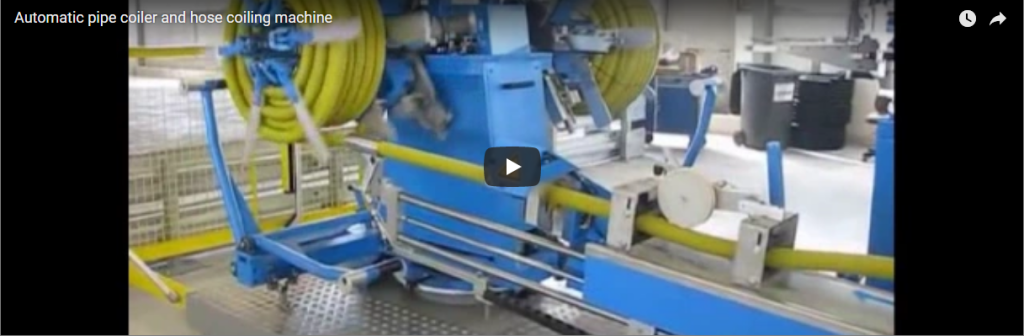
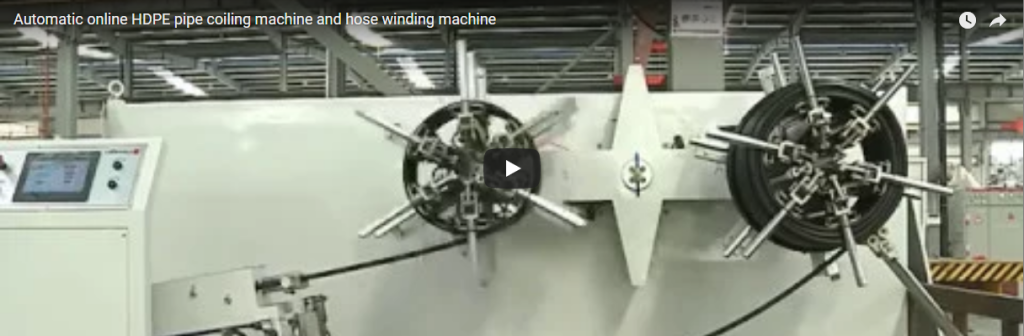
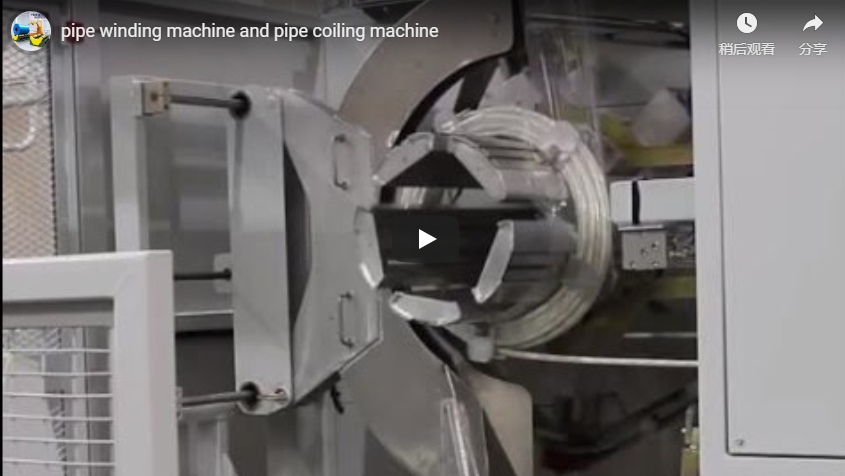
The machine shown has a grey metal frame in an L-shaped layout with a round turning table in the centre. Yellow gas hose feeds in from the right onto a pin mandrel, and clamp arms with blue air lines hold and guide it while the table winds a coil of roughly 20–30 cm across.
A pneumatic gripper then transfers the coil to the tying station and on to an output track, and the panel above has green start and red E-stop buttons.
Table of Contents
- Why automate gas hose coiling
- How the machine works
- Coil range
- Length and coil size maths
- Selection checklist
- Safety
- Engineering FAQ
- Next step
- Related reading
- Sources
Why automate gas hose coiling
Gas hose is a safety product, and buyers expect each coil to carry the stated length. Over-length gives product away, and under-length leads to complaints. Hand winding also twists the hose, and a twisted hose kinks when it is unwound. A powered coiler counts the length, keeps the tension steady and lays the turns flat, and the band holds the coil closed through shipping.
How the machine works
- Feed: hose comes from the extrusion line or a pay-off, through a tension or dancer unit.
- Meter: an encoder counts the set length.
- Clamp: a clamp arm fixes the hose start on the turning table.
- Coil: the table turns and winds the hose into a round coil; guide arms keep the turns even.
- Cut and transfer: the hose is cut at length, the mandrel pins release the coil and a pneumatic gripper lifts it off.
- Tie and output: twist ties close the coil at two opposite points, and the coil goes to the output track while the next coil winds.
Coil range
Data for our equivalent solution, the automatic cable coiling and tying machine:
| Item | Range |
|---|---|
| Coil ID | 120–200 mm |
| Coil OD | 200–450 mm |
| Coil height | 50–200 mm |
| Coil weight | up to 5 kg |
Hose diameter, line speed and band type are confirmed at quote.
Length and coil size maths
Turns per coil ≈ coil length ÷ (π × mean coil diameter).
Mean coil diameter = (ID + OD) ÷ 2.
Turns per layer ≈ coil height ÷ hose OD; layers ≈ (OD − ID) ÷ (2 × hose OD).
Example only: a 10 m coil with ID 150 mm and OD 250 mm has a mean diameter of 0.2 m, so about 10 ÷ (π × 0.2) ≈ 16 turns. With a 10 mm hose, there are (250 − 150) ÷ (2 × 10) = 5 layers, so about 3–4 turns per layer and a coil height of roughly 30–40 mm. Check that this sits inside the coil range above.
Selection checklist
- Hose OD and material?
- Coil length, ID, OD and height?
- Line speed of the extrusion line?
- Tie or band type and number of tie points?
- Coils per hour?
- Labelling or bagging after banding?
Safety
We design coiling machines to EN ISO 12100:2010 for risk assessment, EN 415-10 for packaging machine safety and EN 60204-1 for electrical equipment. The turning table is guarded and the E-stop is on the panel.
Engineering FAQ
Q: Will the hose twist? A: No. The table winds the hose flat under set tension, so it unwinds without kinks.
Q: Can it run inline with extrusion? A: Yes, with an accumulator to store hose during cut and coil change.
Q: Can the coil length change? A: Yes. Length is set on the HMI.
Q: What band can it use? A: Plastic-coated twist ties as shown; tape banding is an option confirmed at quote.
Next step
- Send your hose size, coil length and output to info@fhopepack.com.
- We confirm the coiler and band type.
- We reply within 24 hours with a proposal and quotation.
Related reading
- Automatic cable coiling and tying machine (product)
- Hose coiling and strapping machine (product)
- Automatic hose packing machine (video)
- Pipe coiling and wrapping machine for hose and plastic tubes (video)
- Double-wall corrugated hose coiling and strapping machine (video)
Sources
- FHOPE product page: automatic cable coiling and tying machine
- EN ISO 12100:2010; EN 415-10; EN 60204-1
- The gas pipe coiling machine shown above
Last reviewed: 2026-10-20