Executive summary A tilting feed rack lets one load of coils go onto the line without a crane lift for each coil. In our line in this video, coils roll from a tilting roller rack onto the conveyor, and an arm comes down at the eye to position each coil. Coil weight follows from the coil dimensions and steel density, and it sets the rack and conveyor rating.
Table of Contents
- What the video shows
- How coils move from the rack to the station
- Coil weight from the dimensions
- Controls and safety
- Selection checklist for a coil line with a tilting feed rack
- Engineering FAQ
- Next step
- Related reading
- Sources
What the video shows
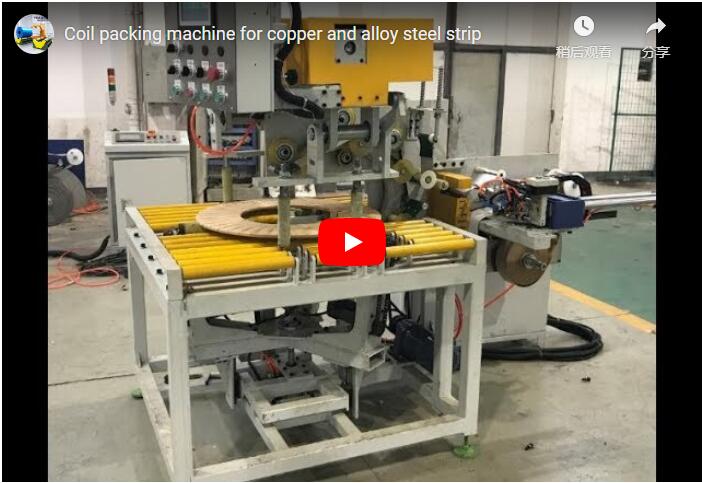
Steel coils, eye horizontal, sit in a roller rack at the head of the line. The rack tilts about its lower pivot and the coils roll down onto the conveyor below.
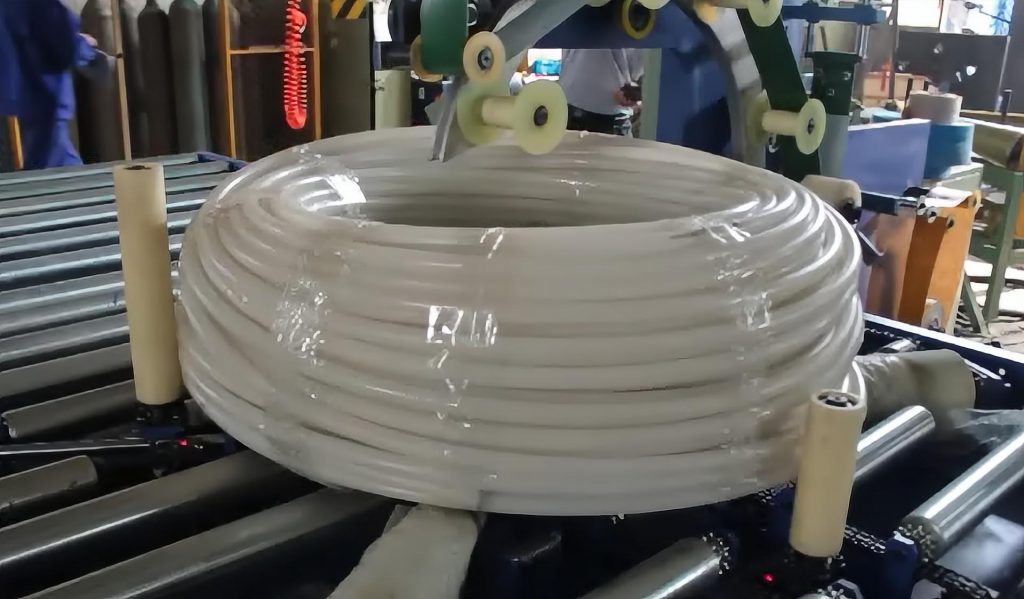
The conveyor carries a coil to the centre station, where an arm comes down to the eye to hold and position it, then rises again for the next coil. An emergency stop and start buttons are mounted on the side of the rack, a control cabinet with a touchscreen stands to the left, and yellow floor lines mark the work area. FHOPE GROUP shows in the video.
How coils move from the rack to the station
Times are read from the video timestamps.
| Step | What happens | Video time |
|---|---|---|
| Load | Coils are placed in the roller rack | about 0–6 s |
| Tilt | The rack tilts and coils roll onto the conveyor | about 12–18 s |
| Convey | The conveyor brings a coil to the station | about 20–22 s |
| Position | The arm comes down at the eye, then rises | about 24–28 s |
One rack load feeds several coils, so the crane is needed only to fill the rack.
Coil weight from the dimensions
Illustrative example:
| Item | Value |
|---|---|
| Outer diameter (illustrative) | 1,200 mm |
| Inner diameter (illustrative) | 508 mm |
| Width (illustrative) | 300 mm |
| Steel volume, π ÷ 4 × (1.2² − 0.508²) × 0.3 | about 0.279 m³ |
| Weight at 7,850 kg/m³ | about 2,190 kg |
The heaviest coil, multiplied by the number of coils in the rack, sets the rack rating.
Controls and safety
The rack tilts a full load of coils and the arm comes down with force. Keep people clear of the rack and the conveyor while the line runs, use the emergency stop on the rack if needed, and work at the rack only with the line stopped and isolated.
The standards that apply depend on the destination market. For CE markets, ISO 12100 sets the risk-assessment method and EN 415-10 sets general requirements for packaging machines.
Selection checklist for a coil line with a tilting feed rack
- Coil outer and inner diameter and width.
- Heaviest coil and coils per rack load.
- How the rack is filled.
- What the station does after positioning.
- Coils per shift.
- Floor space at the line head.
Engineering FAQ
Q: What does the tilting rack do? A: It holds several coils and tilts so they roll onto the conveyor one after another.
Q: How do the dimensions give the coil weight? A: Steel volume times density: about 0.279 m³ × 7,850 kg/m³ gives about 2,190 kg in our example.
Q: Why lower the arm to the eye? A: It holds the coil at the eye so the coil is positioned the same way each time.
Q: Where are the controls? A: A red emergency stop and start buttons are on the rack; the touchscreen is on the cabinet.
Q: Can the rack take my coil sizes? A: Send the coil dimensions and weights and we size the rack and conveyor.
Next step
We plan your steel coil packing line in three steps:
- Submit your layout drawing with coil dimensions and weights to info@fhopepack.com.
- Receive a proposal within 48 hours, with coils per rack load and per shift.
- Book a site survey to check packing steps after positioning.
Related reading
- Automatic coil packing line
- Video: multipurpose automatic coil tilter with slide table
- Video: master steel coil stretch wrapper with paper
Sources
- Line content: FHOPE engineering team, 2026-10-04
- Steel density: standard value for carbon steel, 7,850 kg/m³
- Weight example: our worked example, illustrative values
- Machine in action: our video on YouTube
- Standards scope: ISO 12100:2010, EN 415-10:2014
Last reviewed: 2026-10-04