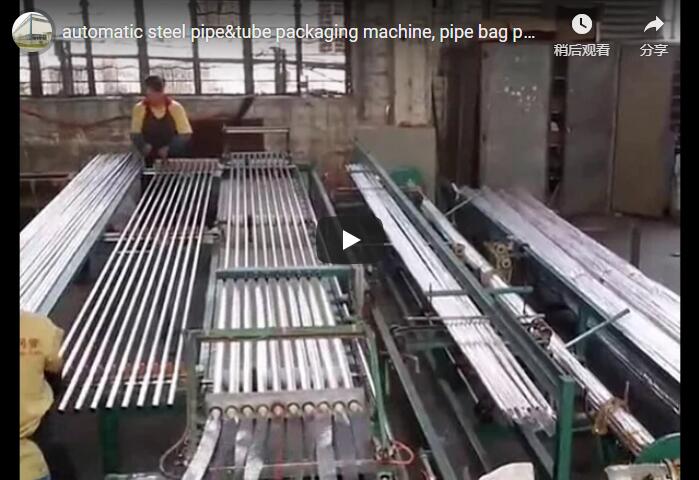
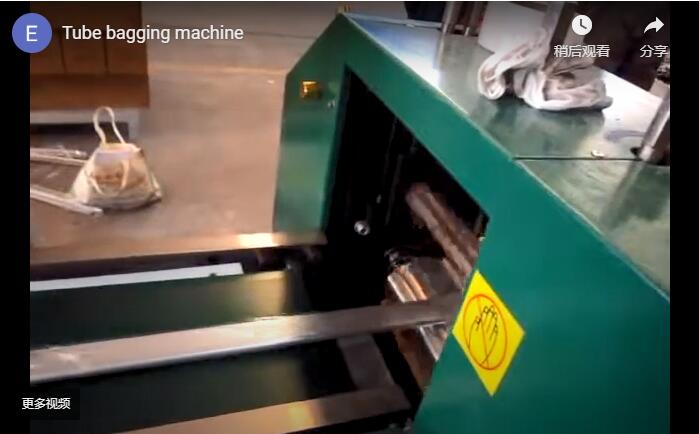
Executive summary This clip shows our PPR and PVC pipe packing line. Pipe bundles are strapped with film, pushed into printed woven bags, and a sewing head closes each bag mouth with thread. The bagged bundles leave the line ready to stack. Our woven bag packing machine takes straight PVC, PPR and PE pipes of 100–300 mm diameter, and pipe length is set by servo adjustment.
Table of Contents
- What the clip shows
- Why woven bags with a sewn mouth
- Woven bag packing machine data
- Bag length per bundle
- Selection checklist
- Safety
- Engineering FAQ
- Next step
- Related reading
- Sources
What the clip shows
| Part of the clip | What you see |
|---|---|
| Line overview | The pipe line with its storage section and a roll of printed green woven bag |
| Bagged bundles | Pipe bundles in green printed woven bags lie at the line end |
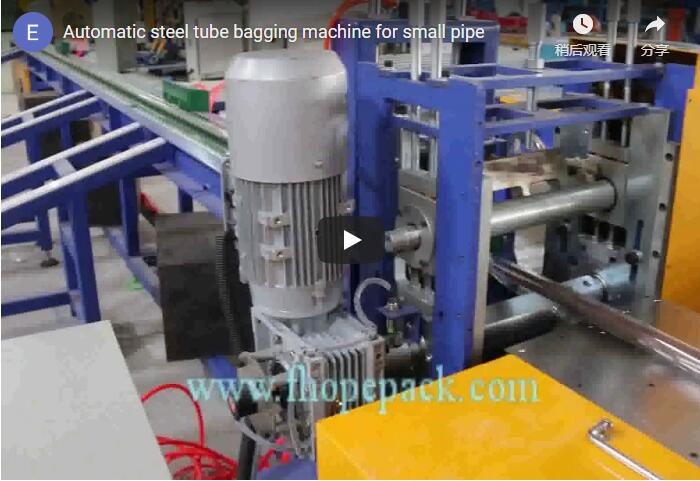
| Bagging station | A yellow-guarded bagging section with a long conveyor and touch screen |
| Sewing | Close-ups of the sewing head and its control panel at the bag mouth |
| Result | Bagged, sewn bundles on the floor, ready to stack and ship |
Why woven bags with a sewn mouth
- Tough cover. Woven bags resist tearing when bundles are handled and stacked.
- Printed branding. The bag carries the pipe maker’s print and product data.
- Sewn closure. Thread at the bag mouth gives a firm seal that does not open in transport.
- Tight bag. A clamp holds the bag steady at 0.15 MPa while the bundle goes in, so the bag does not slip.
Woven bag packing machine data
Our published data for the woven bag pipe packing machine:
| Item | Published value |
|---|---|
| Pipes | Straight PVC, PPR and PE pipes |
| Pipe diameter | 100–300 mm |
| Working width | 1,000 mm |
| Bag clamping | Holds the woven bag under 0.15 MPa air pressure |
| Bag closing | Sewing thread at the bag mouth |
| Pipe length | Stepless servo adjustment for different lengths |
| Extruders | Matched to single, double or four-strand extrusion |
Each line is customized, so storage height, bag size and strapping are matched to your pipes.
Bag length per bundle
Worked example (illustrative).
| Item | Value |
|---|---|
| Pipe length (illustrative) | 4,000 mm |
| Allowance for the sewn mouth (illustrative) | 150 mm |
| Bag length per bundle, 4,000 + 150 | 4,150 mm |
| Bags per 1,000 m of bag roll, 1,000 ÷ 4.15 | about 240 bags |
Selection checklist
- Pipe diameter and length.
- Pipes per bundle.
- Number of extrusion strands feeding the line.
- Bag size and print.
- Film strapping before bagging or not.
- Bundles per hour.
Safety
- Keep clear of the pusher while it fills the bag.
- Keep hands away from the sewing head and needle.
- Stop the line before clearing a bag or thread jam.
- For CE markets, the line is designed to ISO 12100 and EN 415-10.
Engineering FAQ
Q: Which pipes can the line bag? A: Straight PVC, PPR and PE pipes of 100–300 mm diameter.
Q: How is the bag closed? A: A sewing head stitches the bag mouth shut with thread, so the closure stays shut in transport.
Q: How is the bag held while it fills? A: A clamp holds the woven bag under 0.15 MPa air pressure, so it does not come loose.
Q: Can it handle different pipe lengths? A: Yes, by stepless servo adjustment.
Q: How much bag does one bundle use? A: About 4,150 mm for a 4 m pipe bundle with a 150 mm allowance in the worked example.
Q: Can it follow several extruders? A: Yes, we match it to single, double or four-strand extrusion.
Q: What kind of bag does it use? A: Woven bags, with or without print, sized to your bundle.
Q: Which standards apply? A: For CE markets, ISO 12100 and EN 415-10.
Next step
We size a pipe bagging line in three steps:
- Submit your layout drawing with pipe sizes, lengths, pipes per bundle and extruder output, to info@fhopepack.com.
- Receive a proposal within 48 hours with the machine data and layout.
- Book a site survey so we confirm the extruder interface.
Related reading
- Online Plastic Pipe Counting and Film Bundling Line
- Automatic Pipe Bagging and Shrinking Machine
- Horizontal Orbital Wrapping Machine for Pipes
- Woven bag pipe packing machine data
Sources
- Clip: the video on YouTube
- Pipe range, width, bag clamping, sewing, servo length and extruder matching: woven bag pipe packing machine data
- Bag length: our worked example, illustrative values
- Standards scope: ISO 12100:2010; EN 415-10:2014
- Proposal timing: approved house CTA (proposal within 48 hours)
Last reviewed: 2026-10-10