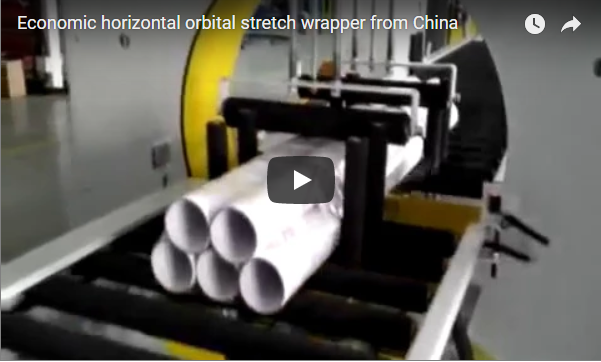
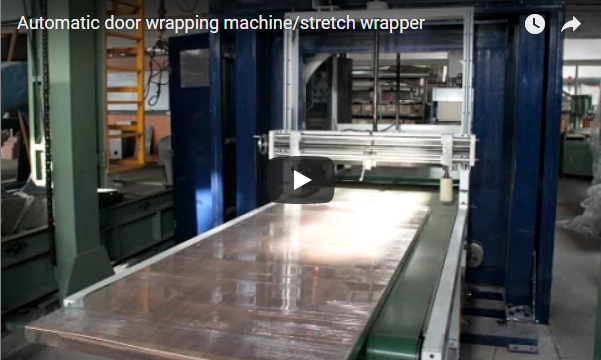
> **Executive summary**
> **The automatic orbital stretch wrapper applies a protective bubble film layer and an orbital stretch film wrap to door panels and long furniture loads in one pass.** The product stays stationary while the film carriage orbits it, with ring speed from 20 to 60 RPM over a 5 to 15 m/min conveyor. This guide covers the process stages, the parameter table, and the film layering points.
Table of Contents
- What the wrapper does
- Why orbital for door panels
- Wrapping process
- Product and performance
- Film layers and pre-stretch
- Control, power and certification
- Applications
- Machine selection checklist
- Safety, options and maintenance
- Engineering FAQ
- Next step
- Related reading
- Sources and standards
What the wrapper does
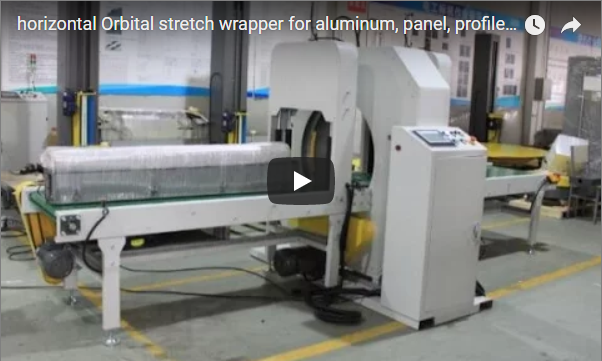
The machine wraps flat, elongated products such as door panels with a cushioning bubble layer and a stretch film containment layer, without the load rotating. Door panels pass through the ring on a conveyor while the film carriage orbits them, so long panels come out uniformly wrapped and ready for transit.
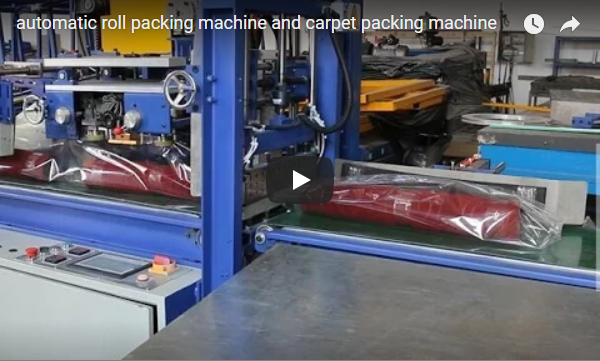
The dual dispenser carries both films, which is what this wrapper does that a standard orbital unit does not. For finished panels we apply the bubble layer first, then the orbital stretch wraps, so the finished surface never touches the stretch film directly.
Why orbital for door panels
A turntable wrapper rotates the load, which suits palletized boxes but not long flat panels. An orbital wrapper keeps the product stationary and rotates the film carriage around it, which is the workable layout for door panels, window frames, aluminium profiles and furniture components.
For door panels over 2 m long, the orbital layout is the practical option. The ring creates the aperture the load passes through, and the conveyor carries the load through it, so length is not limited by a rotating platform.
Wrapping process
The cycle runs the panel through seven stages under one PLC control.
| Step | Stage | Function |
| :--- | :--- | :--- |
| 1 | Infeed | panels conveyed into the wrapping zone with automatic indexing |
| 2 | Product sensing | photo-eyes detect leading and trailing edges to start the cycle |
| 3 | Bubble layer | secondary dispenser applies the cushioning layer first |
| 4 | Orbital wrap | ring orbits the panel as it moves through the aperture |
| 5 | Overlap control | ring speed synchronized with conveyor speed |
| 6 | Cut and seal | automated clamping, cutting and tail sealing for the next cycle |
| 7 | Outfeed | wrapped panel conveyed to staging |
Product and performance
The wrapper is sized by the product envelope, not the panel type.
| Parameter | Range |
| :--- | :--- |
| Maximum length | unlimited in practice, depending on the conveyor setup |
| Maximum width | up to 1200 mm (aperture determined) |
| Maximum pass-through height | up to 2400 mm (sets the ring aperture) |
| Product weight | up to 500 kg, frame construction dependent |
| Ring speed | 20 to 60 RPM, variable |
| Conveyor speed | 5 to 15 m/min, adjustable |
| Throughput | 30 to 80 panels per hour, depending on length and wrap pattern |
| Pre-stretch | 250 to 300% |
Film layers and pre-stretch
Two films run through the dual dispenser and are set independently.
| Layer | Material and size |
| :--- | :--- |
| Stretch film | LLDPE, 15 to 23 µm |
| Bubble film | PE, 3 to 10 mm bubble height |
| Stretch film width | 500 mm standard |
| Bubble film width | 500 to 1000 mm |
| Film roll core | 76 mm (3-inch) standard |
| Max roll outside diameter | 300 mm to reduce changeover frequency |
| Tension control | electronic, servo-driven |
The 250 to 300% pre-stretch stretches the film before it reaches the panel, so more coverage comes from each roll. The exact film saving per pack depends on your wrap pattern, and is confirmed per project.
Control, power and certification
The wrapper runs on a PLC with a 10-inch touchscreen HMI and stores 50 or more wrap programs for quick changeover between SKUs. The frame is C45 carbon steel, powder coated.
| Requirement | Standard configuration |
| :--- | :--- |
| PLC | Siemens S7-1200 or Allen-Bradley |
| HMI | 10-inch touchscreen, diagnostics |
| Electrical | 480 V 3-phase 60 Hz or 400 V 3-phase 50 Hz |
| Compressed air | 6 to 8 bar, 200 L/min consumption |
| Machine weight | 2500 to 4000 kg, depending on size |
| Certification | CE, ISO 13849-1 PLd |
Applications
| Industry | Products | Film configuration |
| :--- | :--- | :--- |
| Furniture | door panels, cabinet frames, tabletops | bubble + stretch |
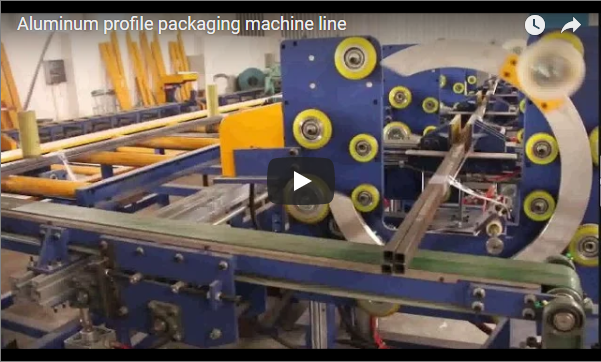
| Building materials | windows, aluminium profiles, PVC extrusions | stretch only |
| Automotive | bumpers, trim pieces, glass racks | foam + stretch |
| Metal fabrication | steel tubes, pipes, bars up to 6 m | VCI + stretch |
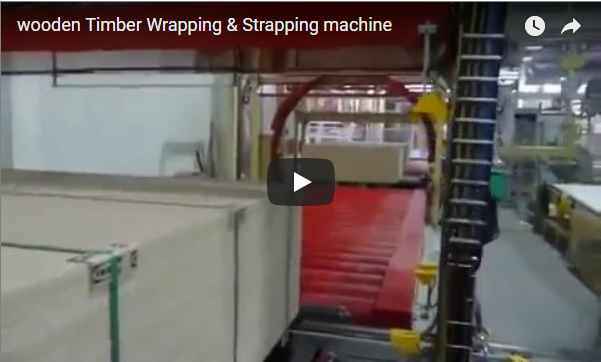
| Wood products | flooring planks, moulding, lumber bundles | kraft + stretch |
Film and layer selection is set per project, matched to the transit distance and how sensitive the finished surface is. Confirm the wrap count and layer order with us before the line ships.
Machine selection checklist
| Item | What to confirm per project |
| :--- | :--- |
| Panel envelope | width, height and length on the conveyor |
| Weight | within the 500 kg frame rating |
| Films | bubble height and stretch micron for your panels |
| Speed target | panels per hour and wrap pattern |
| Utility | voltage, frequency, air supply on site |
| Safety accessories | fencing and additional guarding |
| Integration | PLC protocol and plant data |
Safety, options and maintenance
Standard equipment covers light curtains and emergency stops, with safety fencing as an option, all laid out to CE machinery requirements. Optional add-ons include a top sheet dispenser, an integrated weighing system and a remote diagnostics module for predictive maintenance.
Maintenance is light: weekly, clean the photo-eyes and sensors; monthly, lubricate the ring bearings; quarterly, inspect the film carriage belts; annually, back up and calibrate the PLC. With that routine the expected service life exceeds 10 years.
Engineering FAQ
Q: What is the difference between orbital and turntable wrappers?
A: Orbital wrappers keep the product stationary and rotate the film carriage around it, which suits long flat items. Turntable wrappers rotate the load on a platform and suit palletized loads. For door panels over 2 m, orbital is the practical option.
Q: Can bubble film and stretch film run at the same time?
A: Yes. The dual dispenser applies bubble film first as a longitudinal cushioning layer, then the stretch film in 3 to 5 spiral wraps.
Q: What is the throughput?
A: 30 to 80 panels per hour depending on panel length, wrap pattern and conveyor speed. A 2 m panel with a 5-layer wrap typically completes in 45 to 60 seconds.
Q: Is the machine CE certified for Europe?
A: CE certification covers the EU Machinery Directive, including safety fencing, light curtains and emergency stops. We provide the certification documents, and verifiable copies ship before import.
Q: How much film does pre-stretch save?
A: Powered pre-stretch at 250 to 300% stretches the film before application, which lowers film use per pack compared with no pre-stretch. The exact saving per project depends on the wrap pattern and is confirmed with a site trial.
Next step
1. Email us at info@fhopepack.com with your panel sizes, weights and target rate.
2. We send a layout drawing and orbital wrapper proposal within 48 hours.
3. We arrange a site survey to confirm the envelope, utility supply and conveyor layout.
Related reading
- [Automatic bag making and shrining machine](https://www.fhopepack.com/videos/automatic-bag-making-shrining-machine/)
- [Automatic tape binding machine for box](https://www.fhopepack.com/videos/automatic-tape-binding-machine-for-box/)
- [Semi-automatic aluminium profile packing machine](https://www.fhopepack.com/videos/semi-automatic-aluminum-profile-packing-machine-wrapping-machine/)
- [Automatic square tube bundle making and strapping machine](https://www.fhopepack.com/videos/automatic-square-tube-bundle-making-and-strapping-machine/)
- [FHOPE packaging machinery product lines](https://www.fhopepack.com/Products/)
Sources and standards
- [ISO 12100:2010 — Safety of machinery. General principles for design, risk assessment and risk reduction](https://www.iso.org/standard/51528.html)
- [EN 415-10:2014 — Safety of packaging machines. General requirements](https://www.nen.nl/en/nen-en-415-10-2014-en-191845)
- [ISO 13849-1:2023 — Safety of machinery. Safety-related parts of control systems](https://www.iso.org/standard/83615.html)
- FHOPE automatic orbital stretch wrapper with bubble film covering demonstration video, YouTube.
Last reviewed: 2026-10-09