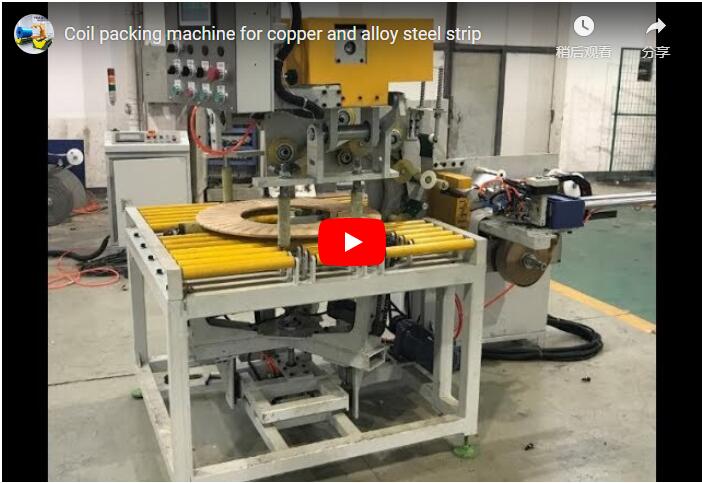
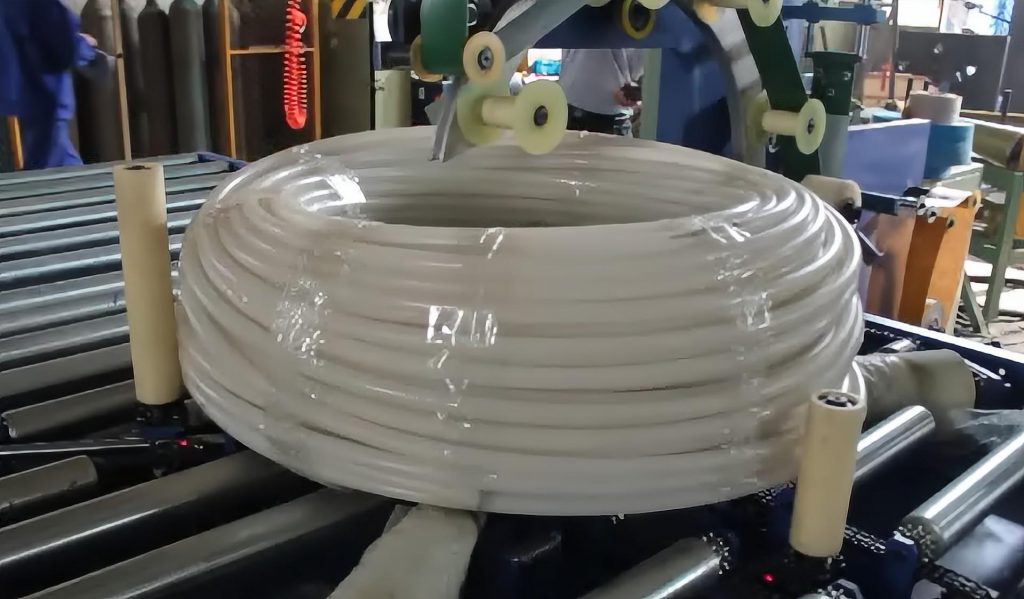
Executive summary This clip, about 65 s long, follows coils through one of our blue-and-yellow packing lines: narrow film-wrapped coils at an overhead station, a coil wrapped through its eye by a rotating ring, and a stacker that sets the wrapped coil on timber runners. Aluminum marks easily, so on a line like this every transfer is a possible surface defect. Below we walk through the stations in the clip, show where the coil touches the machine, and list what to fix before a line is built.
Table of Contents
- What the clip shows
- Where an aluminum coil touches the line
- Strapping: holding the wraps without marking them
- Eye-through wrapping
- Coil sizes our slit coil wrappers take
- Stacking on timber runners
- Selection checklist for an aluminum coil line
- Controls and safety
- Engineering FAQ
- Next step
- Related reading
- Sources
What the clip shows
| Clip time | What is on screen |
|---|---|
| 0–6 s | An operator beside stacks of narrow, white film-wrapped coils lying flat on rollers under a blue frame |
| about 16–24 s | A green-wrapped coil lies flat on yellow rollers under an overhead station with a control cabinet beside it |
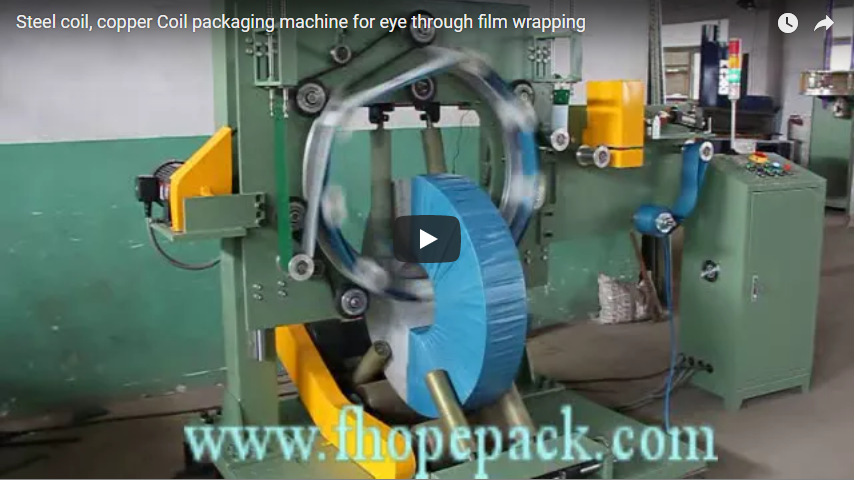
| about 28–40 s | A yellow ring carries blue film through the coil eye and round the section while the rollers turn the coil |
| about 44–52 s | A blue frame lowers a top pad onto the wrapped coil while two staff watch |
| about 56–64 s | An overhead stacker with clamp arms lowers a blue-wrapped coil onto timber runners on the conveyor |
Times come from frames taken every 2 s. Picture-in-picture windows show the control panel and other stations of the same line.
Where an aluminum coil touches the line
Aluminum is softer than steel, and its finished surface shows every scuff. Most packing damage happens when the coil is moved, not when it is wrapped. On the line in the clip, the coil meets the machine at five points:
| Contact point | Risk | What we check in the design |
|---|---|---|
| Conveyor rollers | Sliding marks on the bottom face | Centring before the coil moves; speed match between roller sections |
| Strapping head | Strap edge cutting into the outer wraps | Tension set per coil type in the PLC |
| Wrapping ring | Film pulled too tight across the edges | Wrapping tension and overlap set per program |
| Press pad | Point load on the top face | Pad size against the coil face |
| Stacker clamps | Pressure on the outer diameter | Clamp position on the wrapped coil, not on bare metal |
The rule we follow: wrap first, then let clamps and pads touch only the film.
Strapping: holding the wraps without marking them
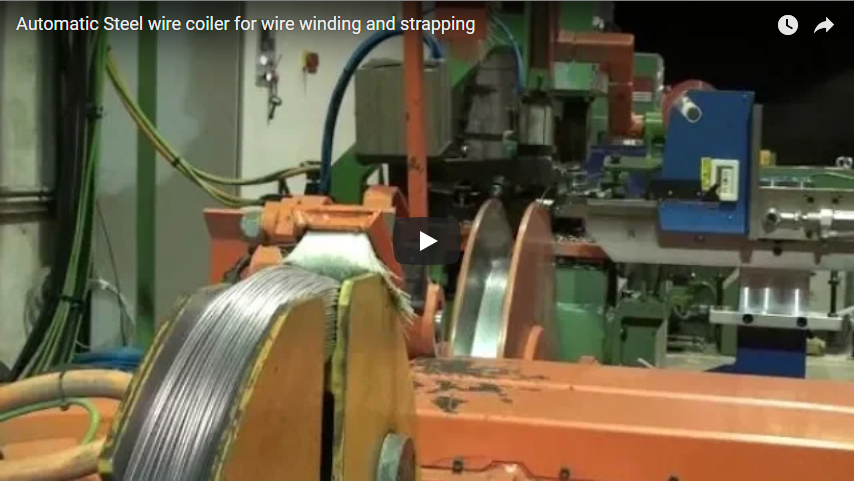
Narrow slit coils, like the stacks at the start of the clip, tend to spring loose or telescope if they are not held. Our coil packing lines strap with PET or steel strap.
- PET strap: does not rust, so it leaves no rust marks on a bright aluminum surface.
- Steel strap: higher strength, for heavy coils and long transport.
The PLC and HMI hold a preset program for each coil type, so centring and strap position repeat from coil to coil.
Eye-through wrapping
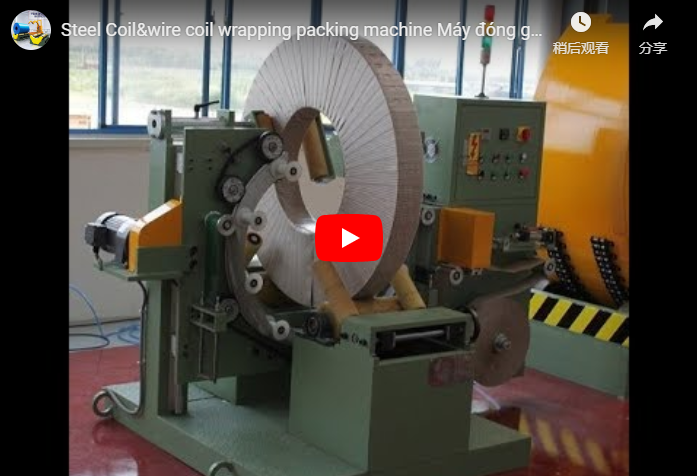
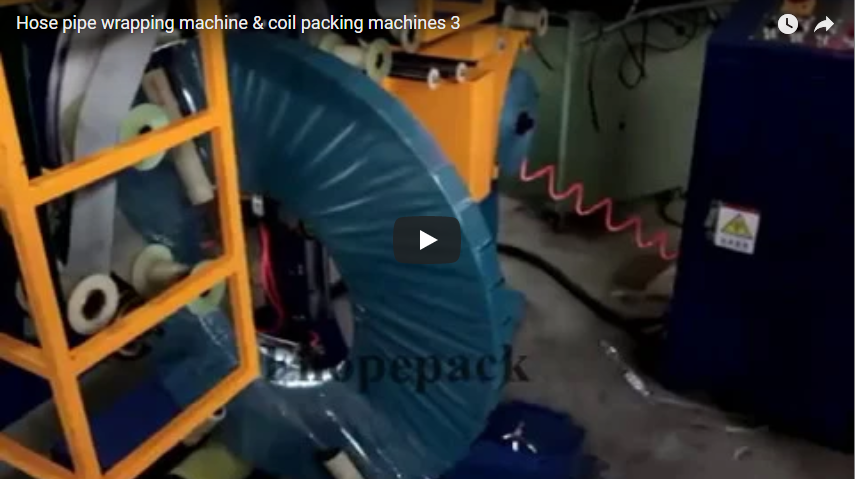
In the middle of the clip the coil lies flat while a ring carries the film through the eye and round the section. The rollers turn the coil, so each pass overlaps the last one.
Three settings decide the quality of the wrap:
- Centring, so the ring does not rub the inner diameter.
- Wrapping tension, high enough to seal, low enough not to crush the edges.
- Overlap rate, which sets how many layers cover each point.
On our automatic coil packing line the PLC and HMI adjust all three from preset programs. The wrap can be film, paper or woven material; for aluminum, the choice usually comes down to how long the coil will be stored and how humid the route is.
Coil sizes our slit coil wrappers take
Two conveyor-fed slit coil models from our coil wrapping machine range:
| Model | Coil ID | Coil OD | Coil width | Max weight |
|---|---|---|---|---|
| FPCA-1000 | 508 / 610 mm | 700–1600 mm | 20–400 mm | 2000 kg |
| FPCA-1200 | 508–610 mm | 800–1400 mm | 20–500 mm | 2500 kg |
Each machine is built to the coil range of the project, so these figures can change.
Stacking on timber runners
At the end of the clip the stacker places the wrapped coil on timber runners. The runners keep the coil off the floor and leave a gap for forklift forks, so nothing scrapes the coil when the stack is moved.
Our automatic coil packing line stacks up to 6 coils per stack, with the coils eye to sky or eye to wall. The coil in the clip is stacked eye to sky; an eye-to-wall package needs a coil tilter in the layout to turn the coil between horizontal and vertical. For aluminum, we agree the stack height with you against coil weight and how the stack will be lifted.
Selection checklist for an aluminum coil line
- Coil ID, OD, width and weight range, including the narrowest slit coil.
- Surface finish: mill, coated or painted.
- Strap material and pattern.
- Wrap material and number of layers.
- Stack height, orientation and runner layout.
- Labelling and data link to your ERP or MES.
Controls and safety
The standards that apply depend on the destination market. For CE markets, ISO 12100 sets the risk-assessment method and EN 415-10 covers general requirements for packaging machines, which fixes guarding and the emergency-stop arrangement.
The wrapping ring, the press pad and the stacker all move above or around the coil. Guarding and access to each station are fixed in the risk assessment for each layout.
Engineering FAQ
Q: Can the same line pack aluminum and steel coils? A: Yes. Our automatic coil packing line handles aluminum, copper, stainless, cold-rolled and galvanized coils, with a preset program for each type.
Q: Which strap suits finished aluminum coils? A: PET strap, because it does not rust and leaves no rust marks. Steel strap is kept for heavy coils and long transport.
Q: What sets the wrap quality? A: Centring, wrapping tension and overlap rate, all adjusted by the PLC and HMI from preset programs.
Q: How narrow a slit coil can be wrapped? A: Our FPCA-1000 and FPCA-1200 take coil widths from 20 mm.
Q: How does the stacker avoid clamp marks on bare metal? A: The coil is wrapped before it reaches the stacker, so the clamps grip the film layer, not bare aluminum.
Q: How high can the coils be stacked? A: Up to 6 coils per stack, eye to sky or eye to wall.
Q: How does coil data reach the label? A: The labelling station can be linked to your ERP or MES, so each label carries the data of its coil.
Next step
We plan an aluminum coil packing line in three steps:
- Submit your layout drawing with coil range, surface finish and stack pattern, to info@fhopepack.com.
- Receive a proposal within 48 hours, with strapping, wrapping and stacking stations and the conveyor layout.
- Book a site survey so we confirm floor space, runner storage and forklift routes.
Related reading
- Copper Strip Coil Packing Line: Upending, Eye-Through Wrapping and Stacking Without Surface Damage
- Two-Stage Copper Coil Packing Line: Eye-Through Wrapping, Then Stacking on Timber Runners
- Slit Coil Stretch Wrapping and Stacking Line: Eye-Through Ring to Gantry Stacker
- Automatic coil packing line
Sources
- Machine in action: the video on YouTube (about 65 s)
- Coil types incl. aluminum, PLC/HMI preset programs for centring, tension and overlap, PET or steel strap, film/paper/woven wrap, up to 6 coils per stack, eye to sky / eye to wall, labelling with ERP/MES: Automatic coil packing line
- FPCA-1000 and FPCA-1200 coil ranges: Steel coil wrapping machine
- Tilting between horizontal and vertical: Coil upender
- Standards scope: ISO 12100:2010; EN 415-10:2014
- Proposal timing: approved house CTA (proposal within 48 hours)
Last reviewed: 2026-10-06