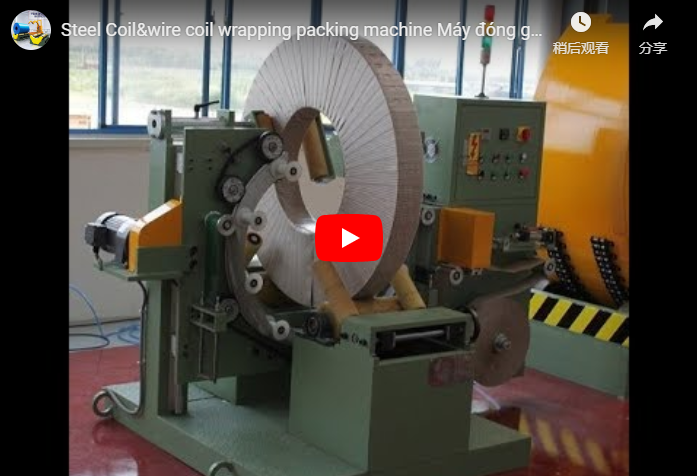
Executive summary Bright metal coils mark easily, so one layer of film is often not enough for long transport. Our line in this video turns each coil flat, wraps it in stretch film in two passes and stacks the wrapped coils on pallets. The film cover follows from the coil OD and the overlap per stage. We set both per project.
Table of Contents
- What the video shows
- How the two-stage line works
- Film layer and overlap calculation
- Stacking wrapped coils
- Controls and safety
- Selection checklist for a coil wrapping and stacking line
- Engineering FAQ
- Next step
- Related reading
- Sources
What the video shows
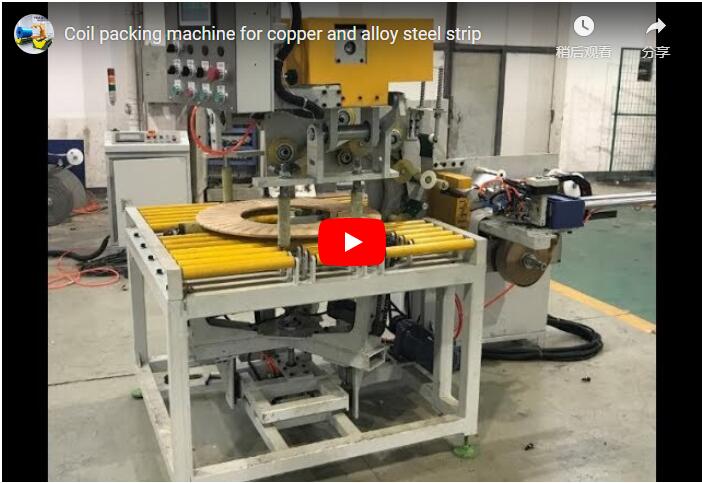
Coils stand on horizontal spindles at the handling station behind yellow railings. An inclined roller conveyor tilts a coil up and lays it flat on a rotating platform on the yellow roller line, and an overhead arm assembly moves over it.
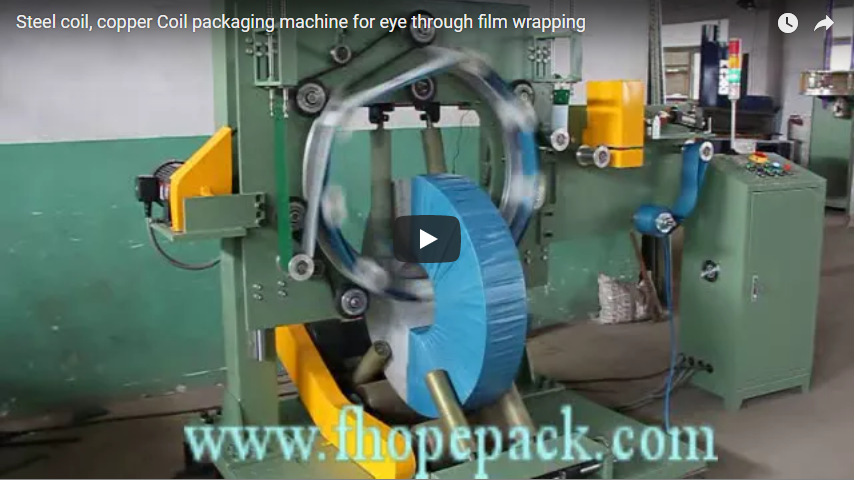
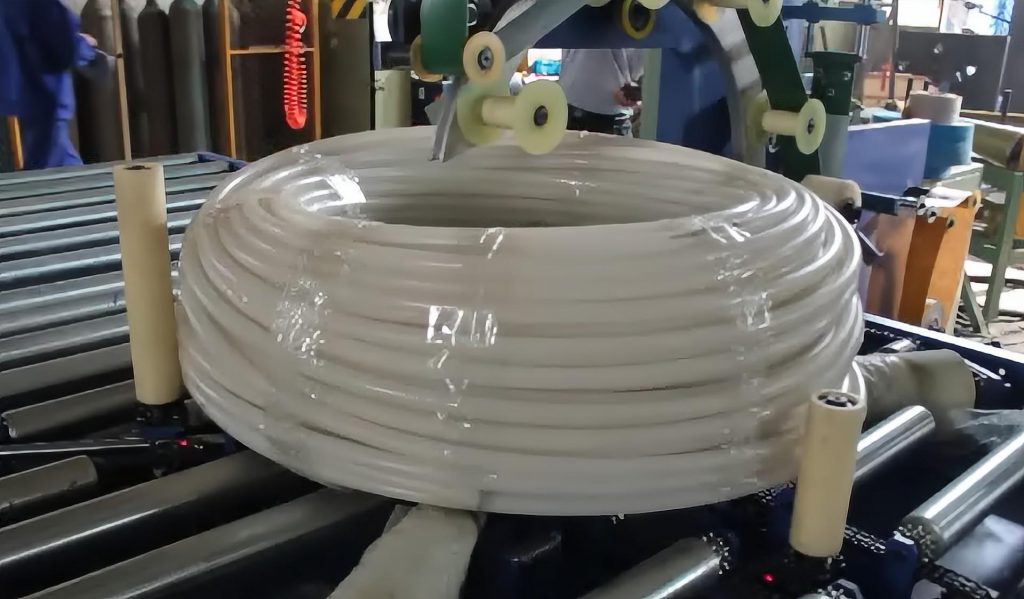
Clear stretch film goes round the turning coil on the first pass. The wrapping unit then comes down again for a second pass. The wrapped coil runs on to a section with silver rollers, where an overhead arm lifts it onto a stack of wrapped coils on a wooden pallet.
How the two-stage line works
| Step | What happens |
|---|---|
| Load | Coils wait on spindles at the handling station |
| Lay flat | The inclined conveyor turns the coil onto the platform |
| First wrap | Film goes round the coil while it turns |
| Second wrap | The unit comes down again for a second pass |
| Stack | An overhead arm sets the coil on the pallet stack |
A second pass doubles the film cover while the coil stays on the same platform.
Film layer and overlap calculation
We count passes at the OD, where overlap is lowest. Illustrative example:
| Item | Value |
|---|---|
| Coil OD (illustrative) | 1,000 mm |
| Circumference, π × 1,000 | about 3,142 mm |
| Film width (illustrative) | 100 mm |
| Advance per pass at 50% overlap | 50 mm |
| Passes per stage, 3,142 ÷ 50 | about 63 |
| Layers at the OD, 2 stages × 2 | 4 |
At 50% overlap each stage lays two layers, so the second stage doubles the cover.
Stacking wrapped coils
| Item | Value |
|---|---|
| Coil width (illustrative) | 400 mm |
| Coils per stack (illustrative) | 3 |
| Stack height, 3 × 400 | 1,200 mm |
We set the stack height from your forklift, rack and truck limits. For heavier coils, see our guide to stretch wrapping and downender stacking systems.
Controls and safety
The platform turns, the wrapping units come down and the stacking arm moves over the line. Keep people outside the yellow railings while the line runs, and enter only with it stopped.
The standards that apply depend on the destination market. For CE markets, ISO 12100 sets the risk-assessment method and EN 415-10 sets general requirements for packaging machines.
Selection checklist for a coil wrapping and stacking line
- Coil OD, ID, width and weight range.
- Coil material and surface finish.
- Film layers needed for your transport.
- Coils per hour.
- Stack height and pallet size.
- Floor space and line layout.
Engineering FAQ
Q: Why wrap in two stages? A: Each stage lays two layers at 50% overlap, so two stages give 4 layers at the OD without slowing the line.
Q: Where on the coil is overlap counted? A: At the OD, where film overlap is lowest.
Q: How many passes does a coil need? A: About 63 per stage for a 1,000 mm OD coil with 100 mm film at 50% overlap in our example.
Q: How are the coils turned flat? A: An inclined roller conveyor lays each coil onto the rotating platform.
Q: How high is a stack? A: We set it from your forklift, rack and truck limits; 1,200 mm for three 400 mm wide coils in our example.
Q: Is the line guarded? A: Yes. Yellow railings surround the handling and wrapping zones.
Next step
We plan your coil wrapping and stacking line in three steps:
- Submit your layout drawing with coil sizes, finish and output to info@fhopepack.com.
- Receive a proposal within 48 hours, with the film layer plan.
- Book a site survey to check the stacking and pallet layout.
Related reading
- Automatic coil packing line
- Video: steel coil, copper coil packaging machine for eye-through film wrapping
- Video: slit coil packing line for service centers
Sources
- Line content: FHOPE engineering team, 2026-10-04
- Film and stack examples: our worked examples, illustrative values
- Machine in action: our video on YouTube
- Standards scope: ISO 12100:2010, EN 415-10:2014
Last reviewed: 2026-10-04