Executive summary: A semi-finished tyre that sits between processing steps picks up dust, scuffs and moisture that carry into the final product. This page is for tyre-plant buyers who want consistent, automatic wrapping of tyre rings and carcasses. It explains what the wrapping protects, how the feed-and-wrap station in this clip works, what the short footage proves and what it does not, and the questions that turn a machine into a purchase decision.
https://www.fhopepack.com/Tyre-packing-machine/
Table of Contents
- What this page helps you decide
- Why semi-finished tyres need wrapping
- How a feed-and-wrap tyre station works
- What decides a good tyre wrap
- What the clip shows
- Buyer’s verification checklist
- FAQ
- Related reading
- Next step
What this page helps you decide
A green tyre carcass is clean when it leaves the building stage, and it is judged as clean when it moves to the next one. In between, dust settles on the surface, a scuff appears where it touches a rack, and moisture clings to a bare rubber edge. Each one becomes a visible flaw after curing or a rejection at inspection.
This page is for the buyer deciding whether an automatic tyre wrapping station fits their line. It explains what the wrapping actually protects, how the station in the clip works, and the checklist that separates a machine that fits your tyre sizes from one that only looked good on screen.
Why semi-finished tyres need wrapping
Tyre manufacture is a chain of clean steps. Between building, inspection, storage and the next process, an unwrapped carcass is exposed to everything in the plant. Dust and process grit settle on the surface and get pressed into it during handling. A bare rubber edge marks easily where it meets a roller, a rack or another tyre.
Moisture is the quieter risk. A wrapped ring keeps condensation and drips off the compound, and it keeps the surface uniform so the next process sees the same clean part every time. The wrap also protects a product that is still soft enough to mark, before curing hardens it.
The value of automated wrapping is consistency. Machine-applied film covers the same way every cycle, instead of depending on whoever is wrapping by hand that day.
How a feed-and-wrap tyre station works
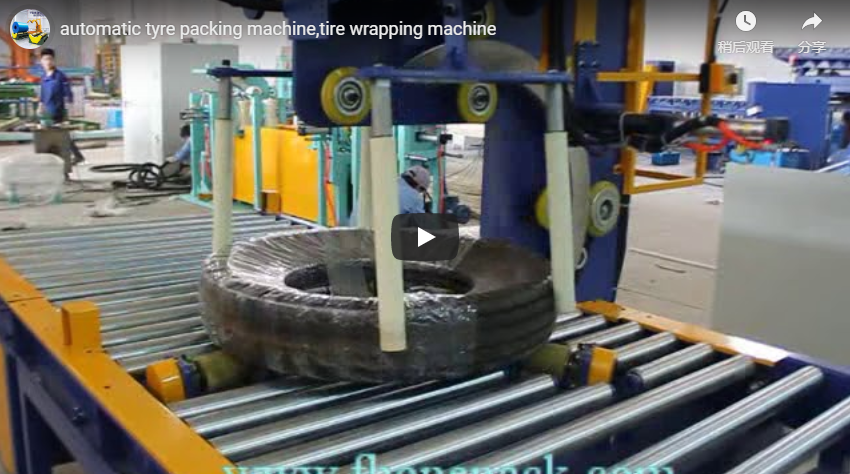
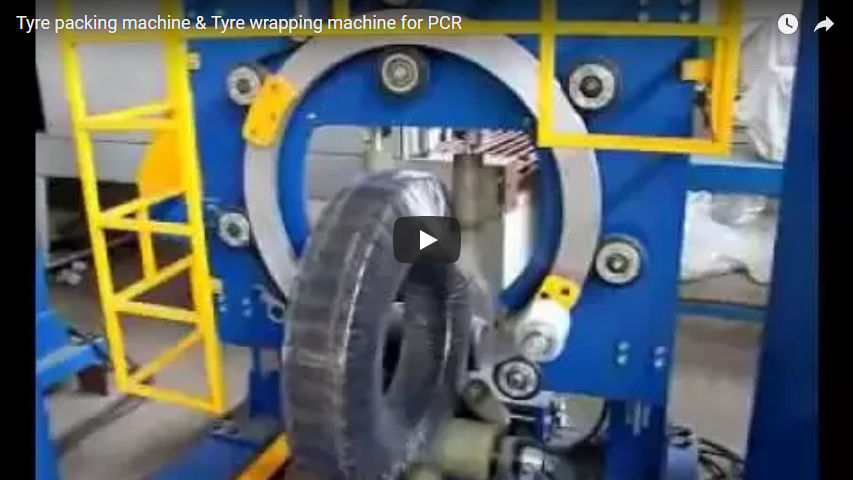
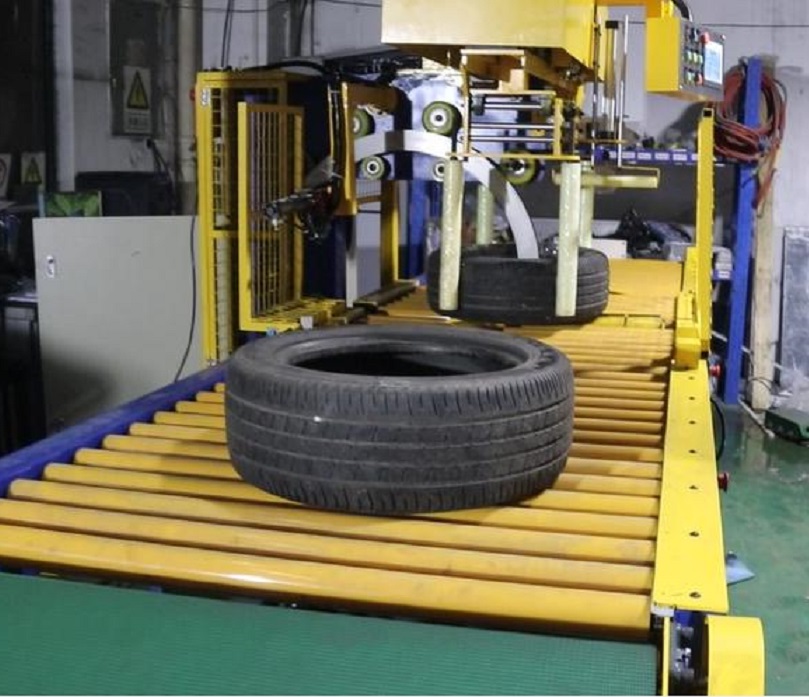
The station in the clip is built around a roller conveyor and a wrapping head. A tyre ring is placed on the conveyor, rides into the work position, and a press head comes down over it. Film is applied around the ring, and the finished, wrapped tyre moves on down the line.
The clip shows the parts of that cycle. A light-beige tyre ring sits on the yellow roller conveyor, the head is ready above it, and a moment later the ring appears wrapped in a white protective film, still on the conveyor. The work is automatic at the wrapping step; the surrounding steps are the things to confirm with the supplier.
Where this type of station earns its place is flow. A conveyor-through layout keeps tyre rings moving while separate stations wrap and prepare them, which suits a line processing many rings a day.
What decides a good tyre wrap
The film does the protective work, so its type and coverage decide the result. A soft white film or foam-style wrap protects a soft surface better than a hard film, because it cushions as well as covers. The number of passes and the tension set how tight and even the wrap is, and both should be adjustable to match different ring sizes.
Consistency is the second factor. The value of the machine is that every ring is wrapped the same way. That only holds if the feed, the positioning and the wrap repeat reliably, so ask how the station centres a ring and what keeps the film tension steady.
The third factor is fit. The station must accept your ring diameters and widths without the film dragging on the edges or the head missing the centreline. That is a dimensions question, and it cannot be read from the footage.
What the machine-line clip shows
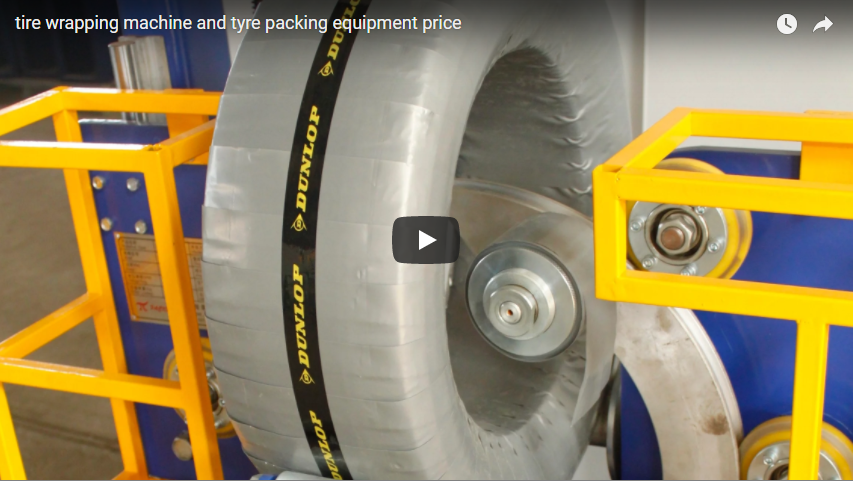
What the video shows is the working of a tyre-ring wrapping station. A circular tyre carcass sits on a yellow roller conveyor, the press and wrap head is ready beside it, and the ring emerges wrapped in a smooth white film before moving on. The finished rings are ring-shaped and hollow in the centre, as tyre rings are. Direct observation notes from the sampled frames, not a performance test.
The clip does not show a full cycle from load to unload, a cycle time, a tyre size range, the film material, or any rating or certification. The footage is a short, camera-cut sequence rather than one continuous run, so the order of the steps is indicative, not proven. No clock runs and no numbers appear on screen.
Printed marks on the wrapping film belong to the material and the site behind the demonstration, not to the machine, and they are not mentioned by name here. The work area is open as filmed, with no full fence or light curtain visible, which belongs on your checklist.
Buyer’s verification checklist
Six questions decide whether the station fits your tyre line. Ask them in writing, and keep the answers with the quotation.
| Ask the supplier for | Why it decides the purchase |
|---|---|
| Tyre ring envelope: outer and inner diameter, width and weight | Decides whether your ring sizes fit the conveyor and the head |
| Film specification: type, thickness, tension and passes per ring | The settings that decide how well the surface is protected |
| One uncut cycle with a clock running | The only footage that proves real cycle time and sequence |
| How the ring is centred and held during wrapping | Repetition depends on the positioning, not the film |
| Transfer to and from the station | The clip shows conveyor segments, not the full line integration |
| Safety devices: emergency stop, guarding, light curtain | The clip shows an open layout, so confirm what protects operators |
Send this to the supplier, and copy it as it stands:
- Your tyre ring sizes: outer and inner diameter, width and weight.
- The film: type, thickness, tension target and passes per ring.
- One uncut cycle on a single camera with a clock running.
- How the station centres a ring, and how the head aligns to it.
- The conveyor connections into and out of the station, and the floor layout.
- The safety arrangement for your site: emergency stop, guarding and light curtain.
- A ring wrapped by this machine, checked for coverage and clean edges.
FAQ
Is wrapping the same as protecting the rubber?
The film keeps dust, scuffs and moisture off the ring surface while it is handled and stored. It does not change the rubber itself. If your process has a specific cleanliness requirement, confirm the film choice and the storage cycle with the supplier.
What tyre sizes can it handle?
Not shown in the video. The clip shows one ring and no ratings. Send the supplier your outer and inner diameter, width and weight, and ask which of those the station was quoted for.
Is the process fully automatic?
The wrapping step is automatic in the clip. Feeding the ring onto the conveyor and removing it afterwards may be manual or automated depending on the configuration, so confirm the load and unload steps with the supplier.
Related reading
- Tyre packing machine — the wrapping equipment class this station belongs to.
- Steel coil wrapping machine — ring-style wrapping for coil formats.
- Wire coil wrapping machine — wrapping options for wound ring products.
- Coil packing machine — the coil-packing category this station fits into.
- Automatic packing line — integrated lines that combine wrapping with other steps.
- Automatic strapping machine — a companion step for rings that also need banding.
Next step
Send the supplier your tyre ring mix first: outer and inner diameters, widths, weights and daily volumes. The clip on this page carries none of those figures, so the envelope has to come from you.
Then send the seven questions above, and ask for the film specification, the uncut cycle and the transfer layout in writing.
Then book one uncut run and inspect a ring immediately after the station for coverage and clean edges. Use the contact page to start that exchange.
Last reviewed: 2026-09-28
Published: 2026-09-28