AUTO PALLET STRAPPING MACHINE PACKAGING MACHINE

Executive summary This video shows a fully automatic pallet packaging line in operation: pallets of stacked goods travel on a roller conveyor, receive vertical strapping from a moving strapping arm, and then pass through a stretch-wrapping station before exiting. The entire sequence runs with no operator touching the product, and the footage is the only factual source used in this article.

Why this video matters to buyers

If you are evaluating an automatic pallet strapping machine, the most useful evidence is not a brochure — it is watching the machine handle a real, heavy pallet load from infeed to discharge. That is exactly what this footage provides. In under a minute of visible operation, you can see how the pallet enters the line, how the strapping arm positions itself over the load, where the strapping ends up on the pallet, and how the load then continues downstream into a stretch-wrapping step. This article walks through what the footage shows, what it deliberately does not show, and the questions you should raise with the manufacturer before shortlisting a machine like this one.

Process overview: one pallet, end to end

The video follows palletized loads through a conveyorized, fully automatic line. The sequence can be broken into five visible stages:

Stage Approx. time in footage What is visible
1. Infeed ~0–6 s A green plastic pallet loaded with stacked dark brown/black blocks moves left to right on a galvanized steel roller conveyor. No operator is present. Yellow safety fencing frames the work zone.
2. Positioning ~8–12 s The pallet reaches the center of the machine. A yellow mechanical arm with a vertical lift structure begins moving down toward the top of the load; a yellow mast on the left shifts slightly.
3. Strapping ~14–24 s The arm stops above the pallet center. Indicator lights (blue/red) on the control cabinet are lit. The arm extends laterally; the end of the arm — appearing to be the strapping tension/seal mechanism — moves around the pallet sides while the pallet stays stationary.
4. Result ~26–28 s The arm retracts to its start height. The load is now covered by clear stretch film, and two vertical yellow strapping bands are visible passing down the sides of the pallet.
5. Wrapping and exit ~30–42 s A second pallet of stacked cartons enters a wrapping station. A stretch-film carriage travels up and down as the film wraps the load, covering sides, top and bottom edges. The pallet then exits the wrapping zone and the arm returns to its home position.

Two things stand out from this sequence. First, the process is genuinely hands-free: from conveyor infeed to discharge, no person touches the load or the machine. Second, strapping and stretch wrapping are shown as complementary operations — the strapping compresses and secures the stack vertically, while the film unitizes the load against dust and shifting.

What the machine looks like

Based on the footage, the equipment in view includes:

  • Painted steel frame. The main structure — columns, beams and protective framing — is finished in yellow, with some support posts in gray/silver and the conveyor rollers in galvanized steel.
  • Central automatic strapping unit. A yellow mechanical arm that can move vertically and extend laterally, ending in what appears to be the strapping tensioning and sealing head.
  • Control cabinet. On the right side, a light gray/cream enclosure with a small color LCD screen, several pushbuttons, and red/green/yellow indicator LEDs. In a second, yellow power/control box, an orange round button (likely an emergency stop) and small LED lights are visible.
  • Strapping supply. Two large black reels, likely strapping coils, are visible at the rear of the machine.
  • Roller conveyor. A silver-gray galvanized roller line runs through the whole work zone, carrying the pallets.
  • Stretch-wrapping unit. Further along the line, a wrap arm/carriage with a film head, plus a blue-and-white film rack holding large film rolls.
  • Safety fencing. Yellow metal mesh guarding encloses the core work area.

A black-and-yellow triangular warning symbol (with a lightning-bolt graphic indicating electrical hazard) is visible on top of the yellow arm. No readable brand names, model plates, or text labels appear anywhere in the footage.

The products being packaged

The footage shows two kinds of loads, which is useful because it demonstrates the line handling different product types:

  1. Heavy block goods. Roughly rectangular dark brown/black blocks — consistent with bricks, ceramic bodies, or refractory materials — stacked in a tall, regular pile on a green plastic pallet. The stack appears to be roughly 1.8–2.0 m high with a pallet footprint in the region of 120 × 100 cm (estimated from proportions in the frame; these are visual estimates, not specifications). A light brown protective sheet or cardboard layer covers the top of the stack.
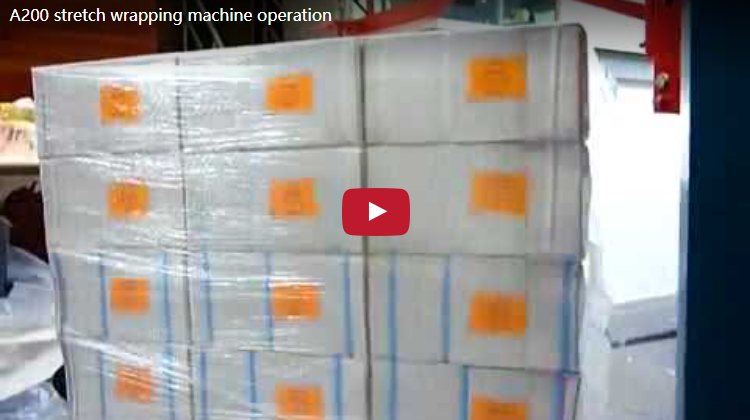
  2. Stacked cartons. A lower pallet of brown/gray-brown boxes, roughly pallet-height, wrapped in clear stretch film with visible folds. One vertical yellow strapping band can be seen on its side.

Both loads enter the machine squarely facing the direction of conveyor travel and stay in that orientation throughout — no rotation or turning is performed.

Direct observation notes

The following notes are kept deliberately close to the frame-by-frame analysis, with only light grammatical editing. They are the factual backbone of this article.

  • A green pallet carrying stacked dark block-shaped goods moves smoothly along a metal roller conveyor from left to right. No operator appears; the machine is not yet actuated. Yellow safety fencing and posts form the work-zone boundary; factory steel beams, windows, and a distant roller door are visible in the background.
  • The pallet advances to the machine’s central area; the yellow mechanical arm on the right, including a vertical lift structure, begins moving downward toward the top of the pallet.
  • The arm completes its descent and holds above the pallet, which is now roughly centered. Blue/red indicator lights on the right-hand control cabinet are lit, showing standby or running state.
  • The arm performs a lateral extension; its end mechanism (apparently the strapping tension/seal unit) travels around the pallet sides. The pallet stays still. Two large black reels, likely strapping coils, stand behind the machine.
  • The arm retracts to its initial height. The pallet is covered by transparent plastic film (reflective surface), and two vertical yellow straps pass down the pallet sides. The camera moves close, showing the finished package.
  • In the later segment, a pallet of stacked cartons enters a wrapping station; the film head lays clear stretch film over the sides, then the top and bottom edges, as the arm moves up and down in sync.
  • The wrapped pallet exits the wrapping area, the conveyor runs empty, and the arm returns to its initial safe position.
  • No readable text, nameplates, watermarks, or warning labels with words are observable anywhere in the video; only a triangular lightning-bolt hazard symbol is visible on the arm.

What the video does not show

The footage is genuine operation, but it is not a specification sheet. The following are not observable and should be verified with the manufacturer:

  • Machine model designation, rated power (kW), voltage and frequency
  • Cycle time per pallet (seconds per pallet)
  • Maximum load weight and maximum/minimum pallet dimensions
  • Strapping specifications: width, thickness, material (PP/PE/PET), and strap tension range
  • Whether sealing is by heat fusion, friction weld, or another method
  • PLC brand, HMI details, communication protocols (e.g., fieldbus or remote diagnostics)
  • CE / UL / ISO certification status
  • Maintenance intervals, spare-parts lists, and after-sales terms

None of these can be read from the video, and we deliberately do not invent them. Ask the manufacturer to put each item in writing during your inquiry.

Safety features visible in the footage

Three safety-related observations can be made directly from the video:

  • Physical guarding. Yellow mesh fencing encloses the moving-arm work zone, creating a barrier between personnel and the strapping mechanism.
  • Hazard marking. A triangular lightning-bolt warning symbol is fixed to the arm, flagging electrical hazards.
  • Emergency stop hardware. An orange round button, consistent in appearance with an emergency stop, is mounted on the yellow control box. However, no door interlocks, light curtains, or test of the e-stop are visible — treat those as items to confirm with the manufacturer.

Where a machine like this fits

Judging from the loads shown, this style of automatic pallet strapping and wrapping line suits:

  • Building materials and ceramics — heavy, regularly stacked blocks that need vertical restraint to survive forklift handling and transit.
  • Refractory and dense industrial goods — high-density stacks where manual strapping is slow and physically demanding.
  • Distribution and warehousing — cartonized pallet loads that benefit from film unitization for dust protection and load stability.

The visible benefits are qualitative but real: consistent strap placement pallet after pallet, film coverage without operator fatigue, and a continuous flow that matches conveyorized production. The clear limits are equally visible: the loads shown are regular, rectangular stacks. Irregular, over-wide, or unstable loads may need different handling — raise your specific load profile with the manufacturer.

Questions to ask before you buy

Use this checklist in your inquiry:

  • What strap material and width does the machine run, and what tension range is achievable?
  • What is the guaranteed cycle time for my pallet size and load weight?
  • Is sealing done by heat, friction weld, or another method, and how reliable is the seal on dusty products?
  • Can the strapping pattern be customized (number of straps, positions, double strapping)?
  • What conveyor height, roller pitch, and load transfer points does the line use — will it interface with my existing line?
  • What safety options are included: interlocked gates, light curtains, e-stop placement?
  • What diagnostics and alarm history does the control system provide?
  • What are the recommended maintenance intervals and the lead time for wear parts such as sealing components?

FAQ

Does the machine require an operator during the cycle? No operator is shown touching the machine or product at any point in the footage; the pallets move in, get strapped and wrapped, and exit automatically. Whether an operator is needed for loading upstream is outside what the video shows — confirm with the manufacturer.

Does the video show both strapping and wrapping? Yes. The first segment shows vertical strapping being applied to a heavy pallet load; the later segment shows a carton pallet passing through a stretch-wrapping station and leaving with film covering its sides, top and bottom edges.

What products were strapped in the video? Dark, block-shaped stacked goods on a green plastic pallet, and stacked cartons on a similar pallet. Exact product identity and weights cannot be confirmed from the footage.

How fast is the cycle? The video does not state or clearly measure a cycle time, so no figure is given here. Request a tested cycle-time figure for your load specification from the manufacturer.

Is there any readable branding or model information? No. No readable text, nameplates, or watermarks appear in the footage; only a lightning-bolt electrical hazard symbol is visible on the arm.

Does it integrate with an existing conveyor line? The machine is shown working inline with a roller conveyor, so conveyor integration is clearly part of the design. Compatibility with your specific line height and layout must be confirmed with the manufacturer.

Source and method

This article is based solely on the video embedded above. The footage was analyzed frame by frame using a vision model on sampled frames; the video contains background music only, with no narration or speech, so no transcription was performed. All observations above come from what is visible in the frames; where something could not be determined, it is listed under “What the video does not show” or marked for confirmation with the manufacturer.

Related reading

Explore related FHOPE packaging equipment:

Next step

If the pallet loads shown here resemble your products, the fastest way to move forward is to share your pallet dimensions, load weight, strap pattern, and required cycle time with our team. We will recommend the right strapping and wrapping configuration and confirm the specifications the video cannot show. Visit our contact page to start the conversation or request a tailored quotation.