Executive summary
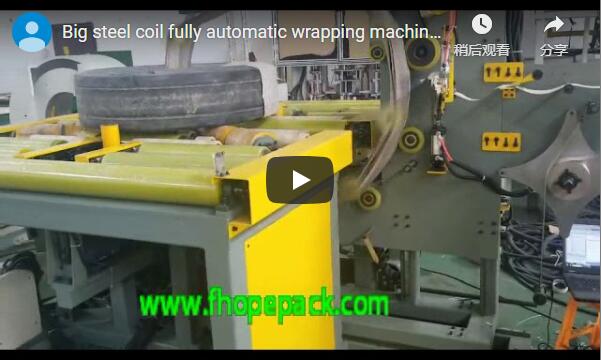
> > A steel coil strapping and wrapping packing line moves a large dark circular coil along a roller conveyor while a yellow robotic arm above the line handles the load. This page covers what the demo clip supports, the sizing data to send, and what this clip does not demonstrate.Table of Contents
- What this line does
- Conveyor and handling arm
- Coil handling cycle
- What the demo footage supports
- Sizing and configuration
- Operation and safety
- Engineering FAQ
- Next step: RFQ checklist
- Related reading
- Sources and standards
What this line does
A large steel coil needs stable transport, strapping and wrapping before it leaves the mill or enters storage. This line class carries the coil on a roller conveyor and lets a robotic handling arm above the line position the load through the cycle. Use this page to decide whether an automated coil strapping and wrapping line fits your metal processing flow, and to see which data FHOPE asks for to size one.Conveyor and handling arm
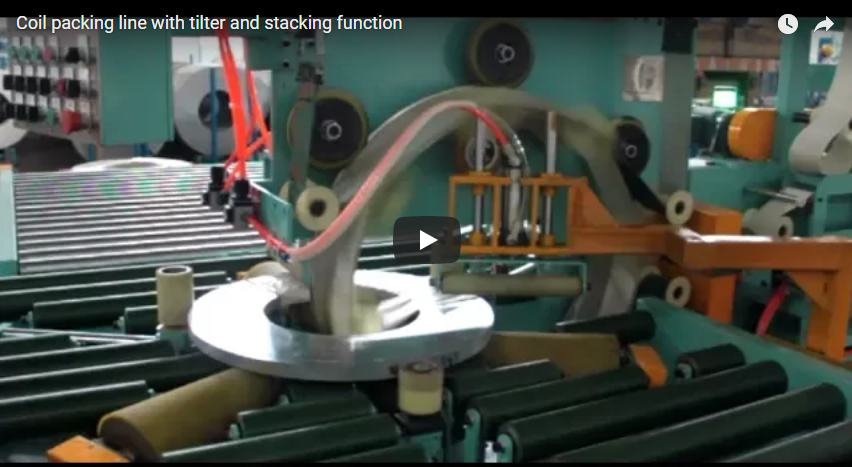
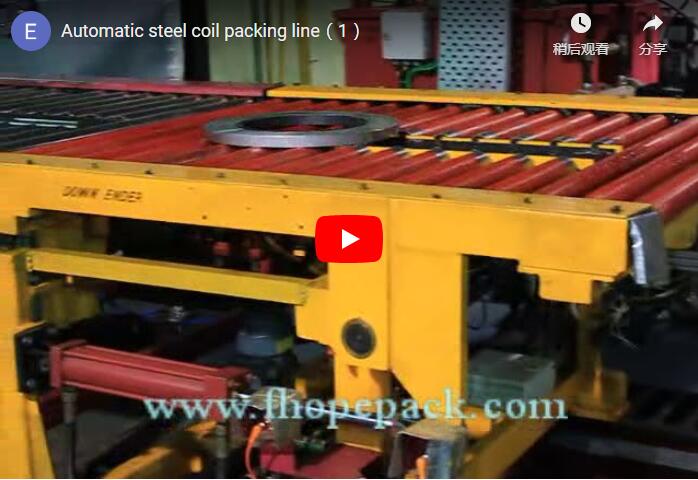
The line has a yellow roller conveyor with a white frame, a complex assembly of mechanical arms and motors, a control box, and a yellow safety cage on the left side of the machine. The FHOPE logo with MACHINE SOLUTIONS text is visible on the machine side panel. Coil weight and conveyor rating are set in the sizing step.Coil handling cycle
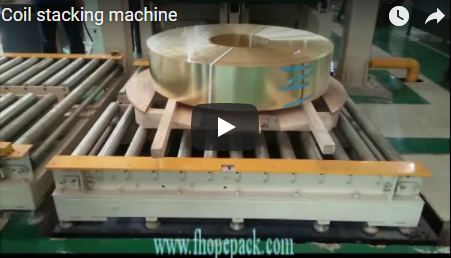
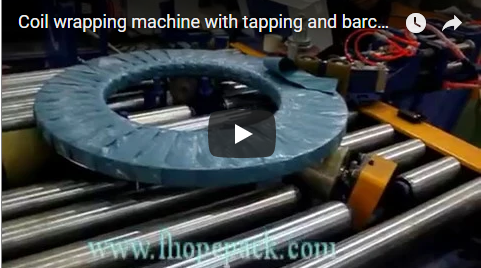
The cycle starts with the coil on the conveyor rollers: the robotic arm moves over the conveyor to position the load. Strapping and wrapping stations complete the packing as the coil travels through the line. The coil stays on the rollers through the cycle. Strap count and wrap coverage are confirmed with your coil in the sizing step.What the demo footage supports
The clip shows a large, dark, circular load, likely a metal casting or coil, resting on the conveyor rollers, with the yellow robotic arm moving above the line. It is a general demonstration. It does not show rated coil weight, max coil OD and width, cycle time, or strap and film specification, and it does not demonstrate a separate weighing or labeling station. Those points are confirmed in the enquiry, not assumed.Sizing and configuration
This line is sized from your coil range and site, not from a fixed rating plate. Confirm the following with FHOPE in the enquiry: | Data to confirm | What it determines | | :— | :— | | Coil weight, OD and width range (kg, mm) | Conveyor, arm and station sizing | | Strap width, thickness and film grade | Consumable stock and tension settings | | Coils per shift | Line sizing and cycle time | | How the coil enters and leaves the line | Loading equipment and layout | | Electrical supply (voltage, phase, frequency) | Drive and control build. House-typical 380 V three-phase 50 Hz, 220 V single-phase option, confirmed on site | Every row is confirmed to your site conditions before the build.Operation and safety
Place the coil on the conveyor, start the cycle, and let the arm and packing stations handle it automatically. Take the finished coil from the outfeed conveyor when the wrap is complete. Keep clear of the handling arm and the conveyor while the line runs, and check the arm path and the strap feed per the machine manual. Stop the line and isolate the power supply before clearing a jam or reaching near the arm, and apply lock-out per the site procedure before any service work.Engineering FAQ
Q: What does this coil strapping and wrapping line do? A: It carries a steel coil on a roller conveyor and lets a robotic arm position the load while strapping and wrapping stations complete the packing. Q: How is the coil moved through the line? A: The coil rests on the conveyor rollers and travels through the stations while the arm moves above the line. Q: What frame and guarding does it use? A: A yellow roller conveyor with a white frame, and a yellow safety cage on the left side of the machine. Q: Can weighing or labeling be added? A: Yes, both are options to confirm with the builder; the demonstrated cycle covers strapping and wrapping only. Q: What electric supply does it need? A: The house-typical build is 380 V three-phase 50 Hz; light machines can be arranged at 220 V single phase. Confirm the site supply in the enquiry.Next step: RFQ checklist
1. Email info@fhopepack.com with your coil weight, OD and width range. 2. State whether weighing or labeling stations are required. 3. Submit your layout drawing of the coil infeed and outfeed area. 4. Receive a proposal with strap grade, wrap coverage and cycle time within 48 hours, and book a site survey if you want the conveyor layout checked before the build.Related reading
– [Pallet Wrapping Machine with Automatic Film Cutting: Cycle, Film Use and Settings](https://www.fhopepack.com/videos/palllet-wrapping-machine-with-auto-film-cutting/) – [Cable Coil Packing Machine and Wire Packing Machine](https://www.fhopepack.com/videos/cable-coil-packing-machine-and-wire-packing-machine/) – [Automatic Copper Strip Coil Packing Line with Labeling, Wrapping, Stacking](https://www.fhopepack.com/videos/automatic-copper-strip-coil-packing-line-with-labeling-wrapping-stacking-system/) – [FHOPE packing machinery product lines](https://www.fhopepack.com/Products/)Sources and standards
– [ISO 12100:2010 Safety of machinery, general principles for design and risk assessment](https://www.iso.org/standard/51528.html) – [EN 415-10:2014 Safety of packaging machines, general requirements](https://www.nen.nl/en/nen-en-415-10-2014-en-191845) The standards that apply depend on the destination market. For CE markets, ISO 12100 sets the machinery risk-assessment method and EN 415-10 covers packaging machine safety. Demonstration footage (video l_eG9S5eHbw) reviewed as a general machine demo; rated outputs are not shown in the clip and are therefore not quoted. Last reviewed: 2026-10-18.