Executive summary This video shows a fully automatic packing line handling long white PVC cable raceway sections: continuous infeed, transport along a conveyor, wrapping in transparent plastic film, sealing, and output to a stacked finished area. No operator intervenes during the recorded run. Control is via a touchscreen panel with Start/Reset buttons and visible photoelectric sensors. Cycle time, capacity, and electrical ratings are not shown — confirm these with the manufacturer.
Why this video matters to buyers
If you produce PVC cable raceway in volume, the packing step is often where labor costs and inconsistency pile up. Bundles of long, lightweight profiles are awkward to handle by hand: they shift, scratch, and get wrapped unevenly. This video is worth your time because it shows, end to end, how a purpose-built automatic line takes those same profiles from loose infeed to neatly stacked, film-wrapped bundles — with no hands on the product.
The footage runs for roughly two and a quarter minutes and covers the whole flow. You can see the machine architecture, the control panel, the safety signage, and the final packed output. That makes it a useful reference point when you compare suppliers: you can ask each of them to show a comparable continuous run rather than a staged clip.
What the video shows
The video follows the product through the line in sequence:
| Approx. time | What happens on screen |
|---|---|
| 0–8 s | White PVC raceway sections are gripped and fed in from the left; a long metal pressing plate travels along the conveyor toward a stacked area of formed white components. |
| 8–20 s | The plate continues along guide rails; finished pieces accumulate in a tidy stack on the right; camera shows the column structure and fastening bolts. |
| 20–32 s | Control panel close-up: a green Start button lit, an orange Reset button, a touchscreen showing a parameter screen, and a yellow post carrying a red warning label. |
| 32–56 s | The pressing head comes down onto the workpiece; a red indicator flashes; the Start light stays on throughout — the line runs unattended. |
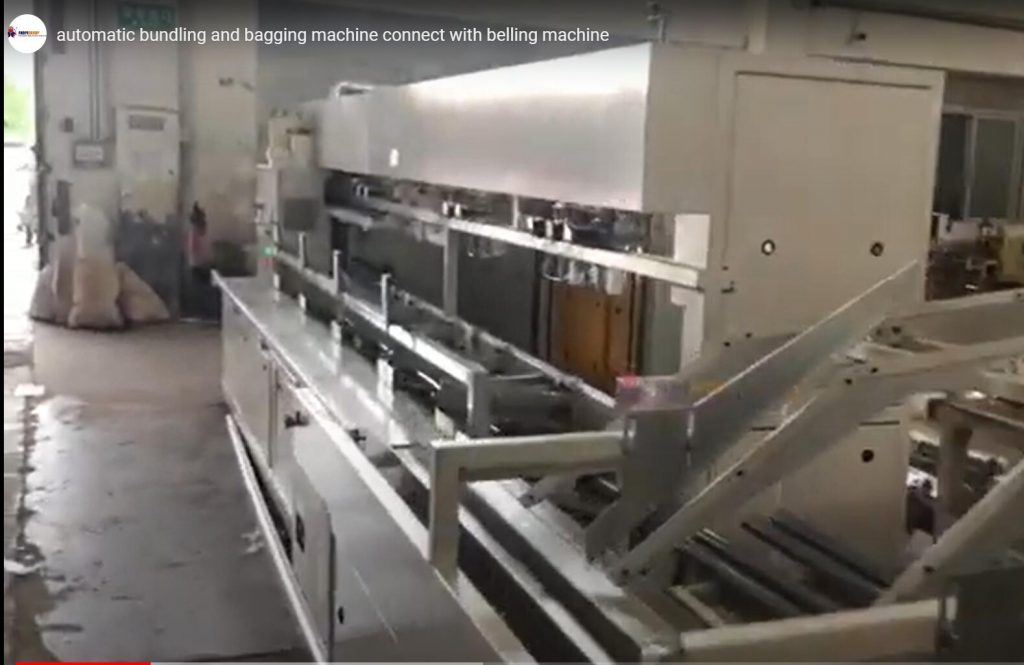
| 60–76 s | Camera pulls back: long white raceway profiles move steadily down the conveyor, motor and rail assemblies visible above the line. |
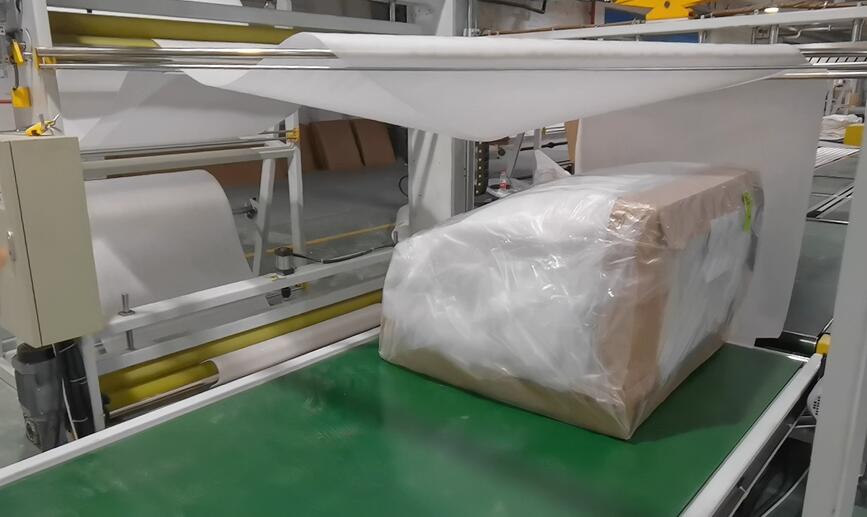
| 80–108 s | The profiles are wrapped in transparent plastic film as they travel; a pressing/sealing unit works on the wrapped surface; blue pneumatic lines and sensors are visible. |
| 112–136 s | Wrapped profiles reach the end station; a roller-type unit and gripper handle the tail end; the final shot shows stacks of packed raceway with their honeycomb-reinforced ends facing the camera. |
Read together, the sequence is: infeed → convey and align → wrap in film → seal → output → stacked bundles. The line runs continuously with no pauses visible in the sampled frames.
The machine in action: process breakdown
Feeding and conveying. Raceway sections enter horizontally, long edge forward, and stay oriented that way for the entire journey. Guide rails and support rollers keep each profile centered; there is no flipping or rotation, which matters because it keeps the film wrap even and prevents scuffing against the frame.
Wrapping. From roughly the 80-second mark, transparent film is drawn over each profile as it moves. The wrap is a single layer and clings closely to the surface, with only minor wrinkles where the film has been heat-affected. This kind of enclosure protects the white PVC surface from dust and moisture during storage and transport — a real concern for a product whose selling point is a clean, smooth finish.
Sealing and output. A pressing/sealing unit works the film edges as the bundle passes. At the end of the line, a roller assembly and gripper position each bundle, and finished pieces accumulate in ordered stacks. The closing shot shows bundles stacked end-face out, revealing the internal grid structure of the raceway — evidence that the packing process has not deformed the profile.
Direct observation notes
The following points are stated close to the frame-by-frame analysis, with only light grammar editing:
- The machine frame is a light grey/white painted metal structure; some supports are dark grey; yellow protective posts guard key moving parts.
- The product is white PVC cable raceway with a U-shaped or rectangular hollow section; the cut ends show an internal honeycomb/grid reinforcement pattern.
- The control panel includes a touchscreen, a green button labeled “启动 Start”, and an orange button labeled “暂停复位 Reset”; a phone number is printed below the buttons.
- A yellow post carries a red warning label reading “挤压注意 禁止伸手入” (pinch hazard — do not reach in), with a graphic symbol.
- Photoelectric sensors are visible at several stations; red indicator lights flash at certain process moments while the green Start light stays lit.
- Pneumatic lines (blue tubing) connect to valves and actuators along the wrapping and sealing section.
- Wrapped bundles leave the line and are stacked; the last frames show static stacks of packed raceway with end faces toward the camera.
- No operator touches the product at any point in the recorded footage.
What the video does not show
Be clear about the gaps before you shortlist this type of equipment:
- Throughput figures. No cycle time, pieces per hour, or line speed is displayed or stated. Ask the manufacturer for tested figures on your profile size.
- Model name and ratings. No machine model number, power rating, voltage, or footprint is visible.
- Full safety enclosure. The line has partial guarding and warning labels, but no full perimeter fence or light curtain is visible in the footage. Confirm the delivered configuration meets your local safety regulations.
- Size changeover. The line appears set up for one raceway cross-section. Whether tooling can be changed for other widths or heights is not demonstrated — verify with the manufacturer.
- Film specification. The type, thickness, and recyclability of the wrapping film are not stated.
- Certifications. No CE, UL, or similar marks are observable in the frames.
Where this line fits
Based on what the footage shows, this type of line suits:
- Profile extruders and electrical material plants running long, standardized raceway in bulk, where packing labor and wrap consistency are the pain points.
- Operations shipping to dusty or humid environments, where full-enclosure film wrap protects the product between plant and jobsite.
- Factories where the same profile runs for long campaigns — the tooling shown is product-specific, so high-mix, small-batch shops should raise changeover questions first.
It is likely a poor fit if you need frequent size changes with quick tooling swaps, or if your profiles are fragile in ways that film wrap alone cannot protect.
What to verify with the manufacturer
Use this checklist before requesting a quotation:
- Confirmed throughput (pieces/hour or m/min) for your raceway cross-section.
- Supported size range and the cost/effort of changing over between profiles.
- Delivered safety package: fencing, light curtains, emergency stops, and compliance with your local machine-safety rules.
- Film type, thickness options, and whether film is standard or consumable-specific.
- Control system integration: fault diagnostics, remote support, and compatibility with your MES/SCADA if relevant.
- Installation, training, spare-parts supply, and after-sales response terms.
FAQ
Is the line fully automatic? In the video, yes — profiles are fed, wrapped, sealed, and stacked with no operator intervention visible. Whether upstream feeding is automatic at your plant depends on your existing equipment; confirm with the manufacturer.
Does the machine handle different raceway sizes? The footage shows one configuration only. Size flexibility is not demonstrated — check with the manufacturer.
What protection does the wrapping provide? The transparent film fully encloses each bundle, protecting the white PVC surface from dust and moisture. The video does not state film thickness or material — verify with the manufacturer.
What safety features are included? Visible: yellow guarding posts, a pinch-hazard warning label, photoelectric sensors, and indicator lights. A complete safety enclosure or light curtain is not visible in the footage, so confirm the full safety specification before purchase.
Can I get performance data? Cycle time, capacity, and power ratings are not shown in the video. Request tested data for your product dimensions directly from FHOPE.
Related reading
Explore other FHOPE automatic packing solutions to compare configurations:
- Automatic packing lines overview
- Automatic coil packing line
- Automatic steel tube packing line
- Plastic pipe packing line
- Cable packing machine
Next step
If your plant packs long PVC profiles manually, this footage shows what a dedicated automatic line can look like in continuous operation. Contact FHOPE through the contact page to discuss your raceway dimensions, required throughput, and layout — and ask for a run video with your own product specifications.
Source and method: This article is based solely on the embedded video. Analysis was performed by a vision model on sampled frames; the video contains background music only, with no narration or speech to transcribe. Performance figures, ratings, and certifications are not observable in the footage and must be confirmed with the manufacturer.
Published: 2026-09-03