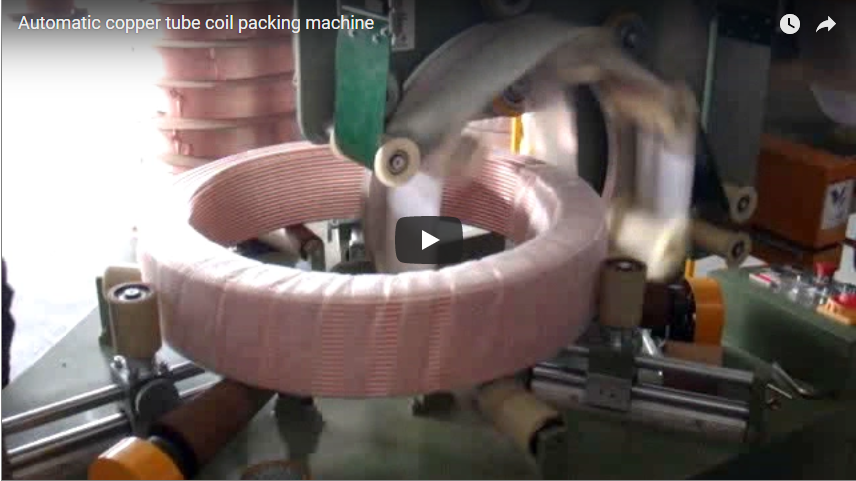
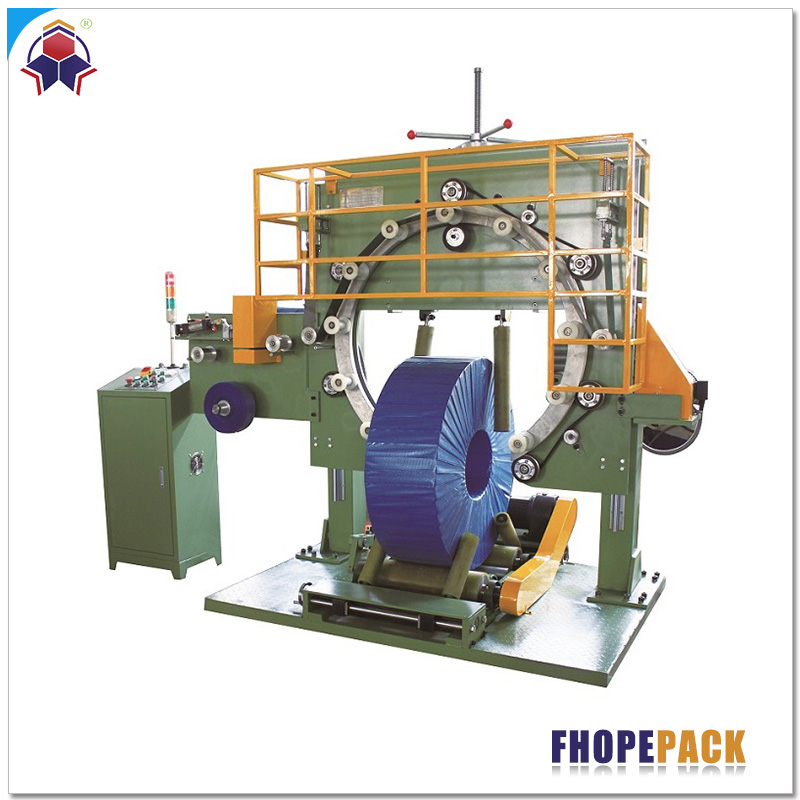
Executive summary This video shows a FHOPE coil packing machine wrapping small ring-shaped coils on a powered roller conveyor inside a yellow safety fence. A blue overhead arm and side clamping arms hold the coil while wrapping material is spiral-wound around its outer edge, after which the coil is moved down the line. The footage covers feeding, clamping, wrapping, and transfer — but no cycle-time figures, model names, or capacity ratings appear on screen.
Why small coils are hard to pack by hand
Small ring-shaped coils — metal strip coils, motor windings, transformer cores, cable rings — are awkward workpieces. They are heavy enough that lifting them repeatedly strains operators, yet their thin, ring-shaped profile makes hand wrapping uneven: one side comes out tight, another loose, and the film often slips off during storage or transit. When these coils move through a production line, inconsistent packing also slows everything downstream, because a badly wrapped coil has to be re-done before it can be shipped.
An online packing solution addresses this by making the wrap a fixed station on the conveyor. The coil arrives, gets clamped in a repeatable position, is wrapped by a rotating mechanism, and moves on. The video on this page shows exactly that kind of station in operation, and this article walks through what the footage actually shows, what it does not show, and what a buyer should verify before committing to a similar setup.
What the video shows: the machine in action, step by step
Based on frame-by-frame analysis of the footage, the packing sequence runs roughly as follows:
-
Feeding and positioning (from the start to about 12 seconds in). A small silver ring-shaped coil sits centered on a yellow roller conveyor. An operator in dark clothing stands to the right of the machine, facing it, monitoring the initial state.
-
Clamping (roughly 12–20 seconds). A blue mechanical arm swings down from above toward the right side of the coil, while a yellow press arm on the left lowers to fix the coil on the conveyor. The operator continues observing without intervening.
-
Wrapping begins (roughly 24–32 seconds). Packing tape or film is fed out from a blue mechanism on the right, guided over rollers to the outer edge of the ring coil. The left press arm has already retracted, and the operator briefly reaches in to remove what appears to be a plastic bag or scrap piece.
-
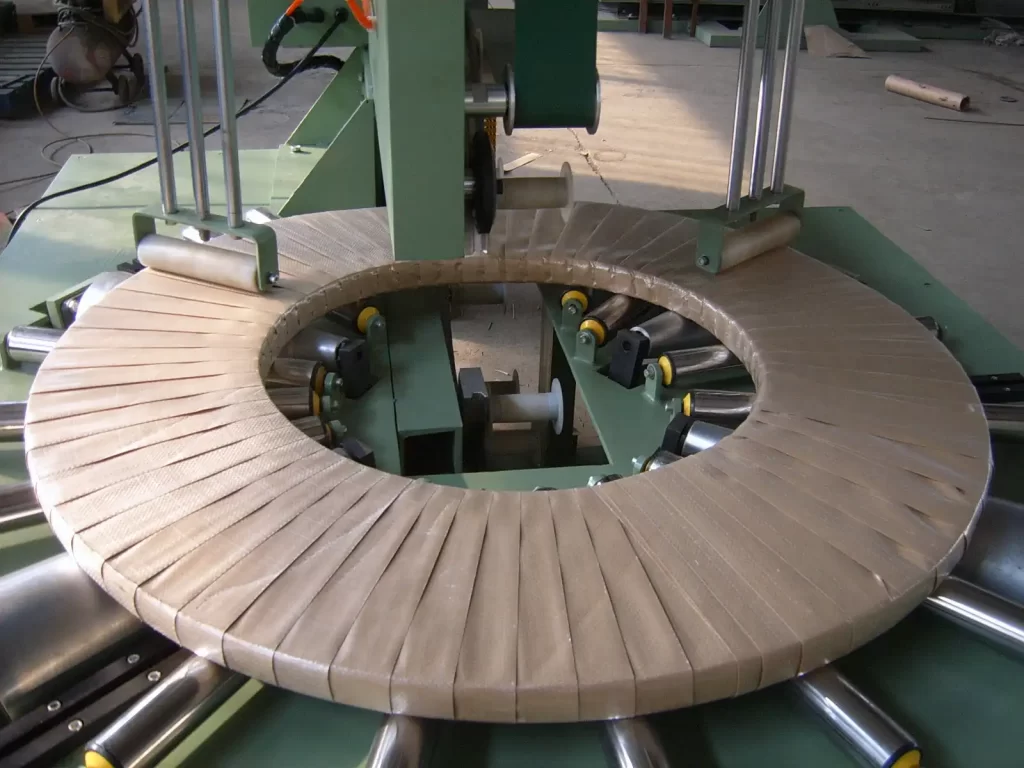
Spiral wrapping (roughly 36–56 seconds). A silvery band of material — likely plastic film or foil tape — is wound tightly around the coil in a spiral pattern. The yellow clamping arms on both sides rotate and feed in sync, and the coil itself turns slowly clockwise on the conveyor. The operator steps back outside the safety fence to keep monitoring.
-
Transfer downstream (roughly 100–108 seconds and after). In a later segment, the yellow swing-arm fixture lifts the wrapped coil from below and pushes it along the conveyor toward the next station. The camera pulls back to show the full conveyor line extending away from the packing position.
The full loop — coil in, coil clamped, coil wrapped, coil pushed out — is visible in the footage, which is the main reason this video is useful: it demonstrates the online nature of the solution rather than a standalone wrapping head.
Direct observation notes
The following is a plain factual account kept close to what is actually visible in the video. It is deliberately dry; interpretation follows in later sections.
- The work area is enclosed by a yellow metal mesh safety fence, roughly 1.2 m or taller, with a door that can open and hinged protective covers in places.
- The machine frame is a blue painted steel structure. The conveyor uses yellow rollers with a non-slip surface texture, evenly spaced, mounted on blue rails.
- A blue cantilever-style arm moves up and down from above the coil; it carries a film roll holder and tension rollers at its end.
- Yellow hydraulic or pneumatic swing-arm clamps on both sides grip, hold, and push the coil.
- A white/cream vertical control cabinet stands to the side, with a touchscreen on the upper portion, a row of about ten square push buttons (red, green, yellow, grey), and several round LED indicator lights above the buttons, some lit steady green. A red round button, likely an emergency stop, is visible on the cabinet in later frames.
- The coils are silver-grey ring-shaped metal coils with hollow centers, smooth and reflective, with no visible rust or coating. In the first segment they appear relatively thin; a later, larger coil has a corrugated insulating layer on the winding.
- During wrapping, the coil rotates slightly clockwise (roughly 10–15 degrees per revolution, estimated from frames) so the band covers the ring evenly. The wrapped coil shows a regular spiral texture and, in the later segment, visible lengthwise wrinkles in the stretch film caused by wrapping tension.
- Two operators appear at various points, standing behind the fence, observing; one steadies the base of the mechanical arm at one moment. No operator intervenes during the wrapping itself.
- Legible on-screen text is limited to a “FHOPEGROUP” watermark in the top-left corner with the tagline “PACKAGING MULTIFUNCTIONAL EQUIPMENT”, plus “FHOPE” markings on the machine body and control cabinet. No model plates, parameter labels, voltage/power tags, operating instructions, or safety warning text are readable in any frame.
What the video does not show
The footage is a demonstration, not a datasheet. None of the following appear on screen, so none can be confirmed from the video — each should be checked with the manufacturer:
- Model designation and rated capacity (coils per hour)
- Precise cycle time per coil
- Minimum and maximum coil outer diameter, inner diameter, and width
- Power, voltage, frequency, and compressed air requirements
- Packing material specification (film type, thickness, width, stretch rate)
- Whether automatic discharge, stacking, or weighing is available
- Safety certifications (CE, UL, ISO) or compliance with standards such as IEC 60204
- Machine weight, footprint, and installation/foundation requirements
- PLC brand, control logic details, and remote monitoring or MES integration options
If any of these matter to your decision — and for most plants, cycle time and coil size range matter most — put them on your request-for-quotation list explicitly.
Where this kind of machine fits
The workpieces shown are small ring-shaped metal coils, which maps to a set of common applications:
| Application | Why the machine suits it |
|---|---|
| Metal strip coils (steel, aluminum, stainless) | Ring shape and smooth surface match what is wrapped on screen; spiral wrap protects edges and faces |
| Motor stator/rotor windings and transformer cores | Automatic wrapping reduces manual handling, lowering the risk of insulation damage from hands and tools |
| Cable drums and ring-shaped electrical components | Clamped positioning gives a consistent wrap regardless of who is on shift |
| Any line moving coils between processes | The conveyor-integrated design lets packing happen inline rather than as a separate manual off-line task |
The key benefit visible in the footage is consistency: the spiral wrap is even and tight, something hand wrapping rarely achieves across a full shift. The second benefit is separation of people from moving parts — the operator stays behind the fence while the arms and wrapping head work.
Honest limitations visible in the footage
A trustworthy review should note what the video suggests are weaknesses:
- Feeding appears manual or semi-automatic. Operators position the coil on the conveyor; no automatic loading gripper is shown. For high volumes, confirm what level of automation is available.
- No vision or breakage detection is shown. There is no visible system to catch film breakage or coil misalignment in real time.
- One red emergency-stop button is visible, on the control cabinet. No light curtains or photoelectric safety sensors were observed in any frame; protection relies on the physical fence. Whether the fence door is electrically interlocked cannot be confirmed from the video — ask the manufacturer directly.
- Size flexibility is unknown. Changing to a different coil diameter may require manual adjustment of clamps or guides; verify the adjustable range and how changeover is done.
Buyer checklist: what to verify before purchase
Use this list when contacting a supplier about a similar small-coil online packing line:
- Coil size range handled (OD, ID, width) and how changeover between sizes works
- Actual cycle time for a coil of your size and weight
- Packing material options (stretch film, tape, compound wrap) and consumption per coil
- Whether the fence door is interlocked with machine stop, and the full e-stop layout
- PLC control with fault diagnostics (not pure relay logic), and available fieldbus/IO interfaces for line integration
- Warranty terms, spare parts availability, and local service response time
- Compliance documentation for your market (CE or local equivalent, electrical safety per IEC 60204 if relevant)
- Options for automatic loading/discharge if manual feeding will bottleneck your line
Frequently asked questions
What sizes of coils can this machine pack? The video shows small ring coils estimated at roughly 600–700 mm outer diameter in one segment, and larger ring coils later. Exact minimum and maximum specifications are not shown — confirm the size window with the manufacturer for your specific coil dimensions.
Does the machine wrap automatically, or does an operator do it? The wrapping itself is automatic: clamping arms, an overhead arm, and the wrapping mechanism perform the sequence while operators only observe from behind the fence. Loading and any final removal appear to involve operator assistance.
How long does one packing cycle take? A precise cycle time cannot be read from the video because no timing is displayed. Ask the manufacturer for measured cycle time with a coil of your dimensions.
What packing material is used? The footage shows a silvery band and a translucent stretch-type film being wound around the coils. The exact material type, thickness, and width are not stated on screen — verify material options and cost per coil with the manufacturer.
Is the machine safe to operate alongside people? The work area is fully enclosed by a tall yellow mesh fence and operators stay outside during operation, which is good practice. However, no light curtains or door interlocks are visible in the video, so confirm the complete safety design — interlocks, e-stop coverage, and applicable certification — before purchase.
Related reading
- Automatic coil packing line — full-line solutions where packing stations like this one sit inside a larger conveyor system.
- Coil packing machine overview — the broader machine family and wrapping methods for coil products.
- Copper coil packing machine — packing solutions tailored to copper coil handling and surface protection.
- Automatic packing line — general automated packaging line configurations beyond coils.
- Automatic steel tube packing line — similar online wrapping principles applied to long steel tube products.
Next step
If small ring coils are part of your production flow and manual wrapping is slowing you down, the fastest way forward is to send the manufacturer your coil dimensions, weight, and target output. The team at FHOPE can recommend a matching configuration and confirm the specifications this video cannot show. Visit the contact page to request a quotation or arrange to discuss your line layout.
Source and method
This article is based entirely on the embedded video as the factual source. The footage was analyzed frame by frame using a vision model on sampled frames; the video contains background music only, with no narration, so no speech transcription was performed. All times given are approximate, derived from frame positions. Statements about capacity, specifications, certifications, and options that do not appear on screen are explicitly marked for manufacturer confirmation rather than asserted.
Published: 2026-09-03