🛠️ Standard Overview
Modern coil packaging prioritizes dimensional stability, moisture barrier integrity, and secure strapping retention to ensure excellent protection and elegant appearance during transit. Compliance relies on Through Eye Wrapping (TEW) technology, which delivers airtight seals against corrosion, supported by recyclable polyethylene (PE) films, crepe paper, and corrosion-inhibiting vapor corrosion inhibitor (VCI) materials.
The operational baseline for coil handling has shifted from manual folding to automated TEW systems, which compress the coil opening and inspection cycle to 1–2 minutes. This timeframe accommodates essential verification steps, including dimensional measuring, automated weighing, and unique identification labeling, ensuring 100% traceability before the wrapping process begins. By integrating these inspection protocols directly into the packaging workflow, facilities eliminate manual handling bottlenecks while maintaining strict quality control standards.
Technical compliance is no longer dictated by a single international standard but rather by a composite of customer-specific transport requirements and corrosion prevention benchmarks. The industry now mandates airtight packaging envelopes that actively block external moisture, a critical requirement for preventing edge corrosion during long-haul logistics. This shift is underpinned by the adoption of recyclable packing materials, including PE film and crepe paper, which are frequently manufactured from post-consumer recycled content to align with modern sustainability mandates.
🏗️ Packaging Functions Breakdown
Effective coil packaging executes five synchronized functions: secure transport via specialized carriages, automated inspection for traceability, TEW for airtight sealing, body wrapping for scratch prevention, and eye protection to maintain core integrity. Each function operates within a tightly controlled material-handling sequence designed to minimize physical contact and preserve surface quality.
Transport carriages, including coil cars and turnstiles, serve as the primary interface for moving heavy metal stock through the facility. These systems work in tandem with precision down-enders and lifting devices such as C-hooks, grabs, and tongs to position coils accurately for processing. By strictly minimizing coil movements and enforcing material-specific handling protocols, operators reduce the risk of mechanical damage and maintain equipment cleanliness throughout the production cycle.
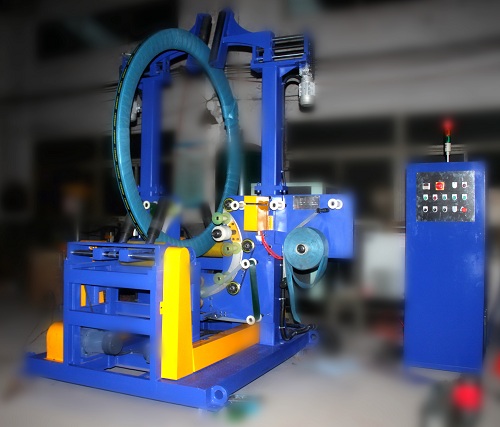
The inspection phase integrates automated measuring, weighing, and identification labeling to establish a digital record for each coil before wrapping commences. Following verification, the TEW process rotates a film carriage through the coil’s central eye, creating a continuous, weld-free barrier that completely isolates the metal from ambient humidity. This airtight configuration is significantly more effective than traditional folding methods, which historically left vulnerable seams and gaps at the coil eye.
Body wrapping applies spiral stretch film overlays to provide mechanical padding against transit vibrations and surface scratches, while dedicated eye protection utilizes edge guards and VCI paper inserts to prevent core collapse and internal rust. The entire assembly is secured using PET (polyester) strapping, which is now preferred over steel alternatives due to its superior safety profile and total cost of ownership (TCO) advantages in high-volume industrial environments.
🔗 Related: Explore more solutions
📈 Key Changes
The industry transition from manual folding to TEW technology represents a relative 100% improvement in packing effectiveness, primarily by eliminating moisture ingress and corrosion failure points. This shift is reinforced by the adoption of recyclable PE films, VCI products, and PET strapping, alongside a move toward fully integrated MES/ERP automation systems.
Traditional folding techniques relied on multi-step manual processes that frequently resulted in compromised seals, allowing humid air to penetrate the coil eye and initiate corrosion. TEW technology resolves this by continuously rotating the film roll around the coil axis while passing through the center, generating a fully airtight package that actively blocks external moisture. Field observations indicate this method delivers substantially higher protection levels compared to legacy folding approaches, particularly in high-humidity storage environments.
Material selection has evolved to prioritize both performance and lifecycle economics. Vapor corrosion inhibitor (VCI) products and pre-stretched stretch films now dominate high-value applications, replacing older multi-layer paper systems. Simultaneously, PET strapping has largely superseded steel banding, offering comparable tensile retention without the risk of rust contamination or dangerous snap-back injuries during handling. These material upgrades directly support the dual objectives of excellent protection and elegant appearance.
Automation maturity has progressed from semi-automated standalone machines to fully integrated packaging lines synchronized with Manufacturing Execution Systems (MES) and Enterprise Resource Planning (ERP) platforms. This connectivity enables dynamic wrapping recipes tailored to specific coil dimensions and material grades, while simultaneously logging real-time quality data for downstream analytics. The integration reduces manual intervention, standardizes cycle times, and ensures consistent packaging quality across all production shifts.
🛡️ Business Impact
Deploying advanced coil packaging systems yields measurable operational gains by compressing cycle times to 1–2 minutes per coil and significantly reducing transit-related damage claims. The adoption of PET strapping and recyclable films lowers total cost of ownership, while MES/ERP integration streamlines compliance reporting and strengthens supplier scorecard performance for automotive and construction clients.
Cycle time compression is a primary driver of throughput improvement, with automated TEW lines consistently achieving coil opening and wrapping durations of 1–2 minutes. This efficiency gain directly offsets labor requirements and reduces bottlenecks in high-volume service centers. When compared to traditional manual folding methods, the automated approach delivers substantially faster turnaround times, allowing facilities to scale output without proportional increases in headcount or floor space.
Logistics and material costs are optimized through strategic packaging choices. PET strapping eliminates the hidden expenses associated with steel banding, including rust contamination remediation and workplace safety incidents. Furthermore, the shift toward recyclable PE film and crepe paper reduces overall packaging weight and waste disposal fees, while aligning with corporate sustainability targets. These material substitutions collectively lower the total cost of ownership without compromising structural integrity.
Customer retention and market access are increasingly tied to packaging compliance. Major automotive and construction procurement teams now mandate airtight TEW packaging and full digital traceability as baseline supplier requirements. Facilities that fail to meet these standards risk delisting from key supply chains, whereas compliant operations benefit from reduced rework, fewer customer complaints, and enhanced brand reputation for delivering excellent protection and elegant appearance.
🔗 See Also: Related equipment
⚙️ Compliance Actions
Achieving packaging compliance requires a structured four-step protocol: selecting VCI and edge guards per coil specifications, programming TEW cycles for airtight sealing, applying PET strapping with controlled tension, and executing automated inspection for traceability. Strict adherence to material-specific handling protocols and equipment cleanliness standards ensures consistent quality and regulatory alignment.
The initial compliance step involves selecting appropriate barrier materials based on coil width, outer diameter, and storage environment. Vapor corrosion inhibitor (VCI) products and pre-stretched stretch films must be matched to the specific metal grade to prevent chemical incompatibility, while edge guards provide critical mechanical reinforcement at vulnerable contact points. These materials are chosen not only for performance but also for their recyclability, with many PE films and crepe papers already manufactured from recycled feedstocks.
Equipment handling protocols are equally critical to maintaining compliance. Precision down-enders, coil cars, and lifting devices such as C-hooks, grabs, and tongs must be regularly calibrated and kept free of debris to prevent edge marking or surface contamination. Operators must enforce material-specific handling procedures that minimize unnecessary coil movements, thereby preserving the integrity of the protective film envelope and ensuring the airtight seal remains uncompromised during transit.
Final compliance verification integrates automated inspection with digital documentation. Each coil undergoes measuring, weighing, and identification labeling before strapping, with data automatically transmitted to MES/ERP systems for audit trails. The application of PET strapping requires precise tension control to maintain structural retention without over-compressing the film layers. Regular calibration checks and documented sign-offs ensure that every packaged unit meets the stringent requirements of modern industrial supply chains.
🛠️ Timeline & Deadlines
Packaging line deployment typically follows a six-month procurement and commissioning cycle, with compliance validation required prior to initial shipment. Facilities should prioritize MES/ERP integration and TEW cycle verification during factory acceptance testing, while allowing 30-day windows for post-installation audits and non-conformance rectification to meet customer delivery schedules.
Procurement milestones begin with budget approval and supplier selection, where technical specifications must explicitly define cycle time targets, automation levels, and MES/ERP connectivity requirements. Factory acceptance testing (FAT) should verify that the TEW system consistently achieves the 1–2 minute coil opening and wrapping benchmark. Suppliers must demonstrate that their equipment maintains airtight sealing performance under variable load conditions before site delivery is authorized.
Installation and commissioning phases require careful coordination with existing material handling infrastructure. Precision down-enders, coil cars, and turnstiles must be aligned with the packaging line to ensure seamless coil transfer without manual intervention. Operators undergo training on material-specific protocols, equipment cleanliness standards, and automated inspection workflows to guarantee consistent execution from day one.
Post-installation validation focuses on compliance verification and continuous improvement. Facilities should conduct initial customer audits within the first production month, allowing a 30-day lead time to address any non-conformances related to film tension, strapping placement, or digital traceability. Retrofitting existing manual stations to semi-automated TEW configurations typically requires 1–2 days of downtime, with performance improvements measured relative to legacy folding methods rather than absolute guarantees.
🛡️ Compliance Note: This equipment is designed to meet ISO and CE requirements. Verify specific certifications with the manufacturer before procurement.
🏗️ FAQ
TEW technology scales across coil sizes, while PET strapping and recyclable films optimize total cost of ownership. Automation ranges from semi-automated standalone units to fully integrated MES/ERP systems, with retrofit options available for legacy lines. All configurations prioritize airtight sealing, minimal handling, and compliance with modern transport and corrosion prevention standards.
TEW (Through Eye Wrapping) systems are engineered to accommodate a wide range of coil diameters and weights, including smaller slit coils and cable reels. Adjustable core adapters and variable-speed film carriages allow operators to maintain consistent airtight sealing regardless of coil dimensions. This scalability ensures that facilities can standardize their packaging approach across diverse product lines without compromising protection or appearance.
The primary cost drivers for coil packaging lines are automation level and integration depth. Semi-automated standalone machines offer a practical entry point for facilities seeking to replace manual folding, while fully integrated lines with conveyors, automated strapping, and MES/ERP connectivity deliver maximum throughput and data transparency. Retrofitting existing stations typically involves adding film carriages, rotating arms, and programmable logic controllers, with implementation timelines ranging from one to two days.
Material selection and handling protocols directly influence long-term operational efficiency. PET strapping is recommended over steel alternatives due to its safety profile and total cost of ownership benefits, while recyclable PE film and crepe paper support sustainability initiatives. Strict adherence to material-specific handling procedures, combined with regular equipment calibration, ensures that packaging performance remains consistent and aligned with customer compliance requirements.