Executive summary
A heavy pallet load that cannot easily turn on a turntable still needs a full film wrap, and this machine’s rotary arm carries the film instead. The arm moves around the load, lowering and rising to cover the height of the stack, then cuts the film at the top. The load stays in place, so heavy or oversized items need no spinning deck. Load size, arm travel and film setup are confirmed per project.
Table of Contents
- Why wrap from a rotating arm
- What the machine does
- The arm carries the film
- Cut and finish
- What the footage shows
- Typical configuration
- Selection checklist
- Operation and safety
- Engineering FAQ
- Next step
- Related reading
- Sources and standards
Why wrap from a rotating arm
Some loads are too heavy, too wide, or too tall to sit safely on a spinning turntable. A rotary arm wrapper solves this by moving the film around the load instead of moving the load itself.
Because the load stays put, it can be any size the arm can reach around, and heavy items do not have to be balanced on a rotating deck. The arm travel sets the wrapping height. Load dimensions are confirmed per project.
What the machine does
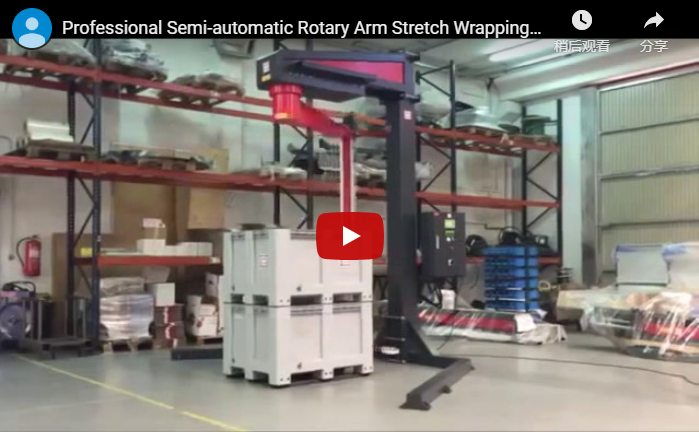
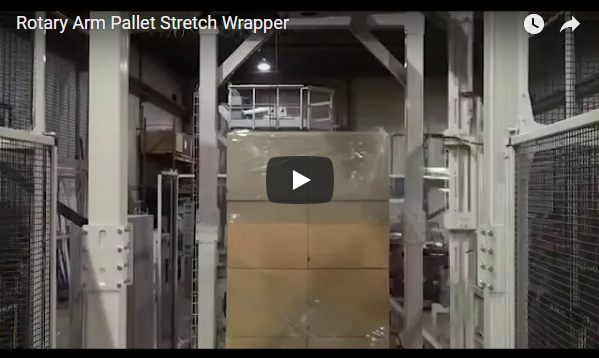
The machine is a semi-auto rotary arm stretch wrapper. A yellow rotary arm is mounted on a mast above the load, with the film roll carried on the arm. When the cycle starts, the arm rotates around the load while it lowers and rises, laying stretch film around the stack from the arm-hung film roll.
The load stands on the floor or low deck and does not turn. The operator loads the pallet and starts the cycle from a control panel outside the guarding. Arm travel and film setup are confirmed per project.
The arm carries the film
The arm rotates around the load as the film is paid out, and at the same time the arm moves vertically so the film covers the stack in bands from the base upward. Because the film source travels with the arm, tension and overlap stay consistent around the whole circle.
As the arm comes down and rises again, each pass adds another band. The number of passes and the arm speed are confirmed per project.
Cut and finish
When the wrap reaches the top, a film cutting device in the arm area cuts the film, ending the cycle with the wrap closed. The arm then returns to its highest position ready for the next load.
The cut makes the cycle repeatable: the film is severed at the top so the next load starts clean. Cut position and film tail are confirmed per project.
What the footage shows
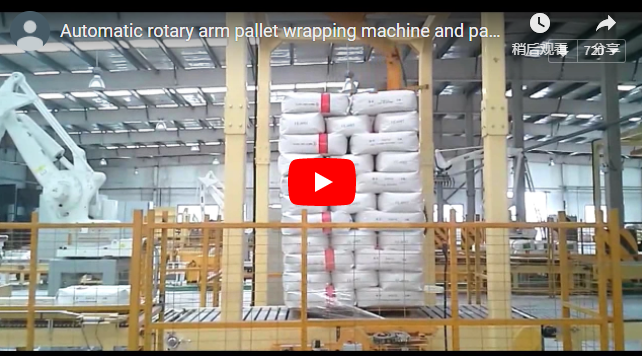
Our footage shows a semi-auto rotary arm stretch wrapper wrapping a pallet of stacked boxes, with the arm rotating and moving vertically and the film cut at the end. It is a general demonstration, so your load size, arm travel and film requirements are confirmed with us per project.
Typical configuration
Figures below list functional design boundaries rather than numeric values, and are confirmed per project.
| Parameter | Typical range, confirmed per project |
|---|---|
| Load | floor-standing pallet load |
| Arm | rotary film arm |
| Wrap | rotating pass, vertical travel |
| Film | film roll on the arm |
| Finish | film cut at top |
| Electrical supply | 380 V three phase 50 Hz, or 220 V single phase for light machines, selected per project |
Selection checklist
| Question | Confirm per project |
|---|---|
| Load range | pallet size, height, weight |
| Arm | reach, travel, speed |
| Film | width, tension, overlap |
| Cut | finishing method |
| Guarding | fence and interlock |
| Electrical supply | voltage, phase and frequency on site |
Operation and safety
Place the load, start the cycle from the panel, and the arm wraps the stack while the load stays put. Keep out of the arm circle and the film path while the machine runs, with the area fenced off and emergency stops in reach.
Routine checks cover the arm drive, the vertical travel, the film feed and the cutting device, per the machine manual. Confirm the wrap settings against the load before each run.
Engineering FAQ
Q: What does this machine do? A: It wraps a pallet load with film carried by a rotary arm that travels around and up the load.
Q: Why does the load stay put? A: The arm revolves instead, so heavy or oversized loads need no turntable.
Q: How is the wrap finished? A: The film is cut at the top when the wrap reaches the last band.
Q: Is it fully automatic? A: The operator loads and starts it; the arm does the wrapping.
Q: What does the footage prove? A: A pallet wrapped by a rotary arm and cut at the end in one continuous demonstration.
Next step
- Email us at info@fhopepack.com with your pallet size and load weight.
- We send a rotary arm wrapper proposal and a layout drawing within 48 hours.
- We arrange a site survey to confirm arm travel and film requirements.
Related reading
- Semi-auto rotary arm stretch wrapper
- R100 rotary arm pallet wrapping machine
- Automatic turntable pallet wrapping machine
- FHOPE packing machinery product lines
Sources and standards
- ISO 12100:2010 Safety of machinery, general principles for design and risk assessment
- EN 415-10:2014 Safety of packaging machines, general requirements
- EN ISO 13849-1:2023 Safety of machinery, safety-related parts of control systems
FHOPE semi-auto rotary arm stretch wrapper demonstration video. Reviewed as a general demonstration; load size, arm travel and film setup confirmed per project.
Last reviewed: 2026-10-11