Executive summary Our orbital tape wrapper runs a roll of BOPP adhesive tape round a product on a turning ring, laying tight bands across it as it passes on a conveyor. A top press comes down first and holds light or springy products still while the tape goes on. The box model takes products 400 mm wide and 300 mm high, at about 2 s per lap. A worked example shows how much tape each pack uses.
Table of Contents
- Why band with BOPP tape instead of film
- How the orbital tape wrapper works
- The top press: holding light products still
- Tape wrapper specifications
- Worked example: tape per pack and packs per roll
- Tape bands, plastic straps or full film
- Selection checklist: what to send us
- Safety and EN 415-10
- Engineering FAQ
- Next step
- Related reading
- Sources
Why band with BOPP tape instead of film
Many products only need to be held together, not sealed. Stacks of foam trays, bundled cartons, moulded parts and closed boxes need a few tight bands to stop them sliding apart. A full stretch-film cover would cost more film and hide the labels.
BOPP tape sticks to itself and to the product. A band cannot slide off a corner the way a loose strap can. It needs no buckle or seal head, and it can be printed with your logo.
How the orbital tape wrapper works
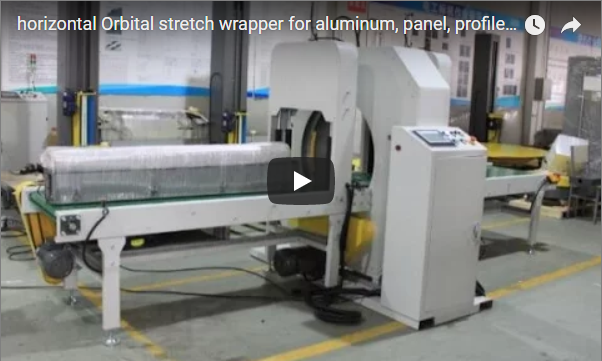
The machine uses the ring of our orbital stretch wrappers, but the carriage carries pressure-sensitive BOPP tape instead of stretch film. Tape holds by adhesive tack rather than by stretching. The product rides a belt conveyor into the ring frame. The tape roll sits on a carriage on the ring. When the product reaches the banding position, the conveyor stops. The top press lowers, and the ring turns to lay the tape round the product.
After the set number of laps the tape is cut and pressed down. The conveyor then moves the product on to the next band position or out of the machine. The box model lays 2 or 4 bands per pack. In-feed and out-feed telescopic roller conveyors carry products to and from the ring.
The top press: holding light products still
Foam blocks and empty trays are light. Tape tension alone can pull them sideways or lift them off the belt. The top press lowers onto the product before the ring starts and holds it flat on the conveyor while the tape goes on. It then lifts so the product can move on.
The press also squeezes soft stacks slightly. When it lifts, the stack springs back against the tape, so the bands sit tight.
Tape wrapper specifications
| Item | Box tape wrapping machine |
|---|---|
| Product size | 400 mm wide, 300 mm high |
| Bands per pack | 2 or 4 |
| Speed | about 2 s per lap |
| Tape | BOPP, 24–48 mm wide, 50–200 m per roll |
| Machine size | 880 × 500 × 900 mm, base height 470 mm, total height 1,370 mm |
| Line length | about 2,550 mm with conveyors |
| Weight | 65 kg |
| Supply | 220 V, 50 Hz |
For tape rolls up to 60 mm wide, on a 76 mm core with an 80–120 mm outside diameter, we use our tape wrapping and sealing machine.
Worked example: tape per pack and packs per roll
Take a stack of foam trays 400 mm wide and 300 mm high, the largest size the box model takes. These are illustrative customer figures.
- One lap round the stack: 2 × (400 + 300) = 1,400 mm, or 1.4 m
- Two laps per band, an illustrative setting: 2.8 m per band
- Four bands per pack: 4 × 2.8 = 11.2 m per pack
- A 200 m roll: 200 ÷ 11.2 = 17.9, so 17 full packs
With two bands per pack, the same roll gives 35 packs. At about 2 s per lap, the four bands take about 16 s of ring time. Total cycle = ring time + (bands − 1) × index time + in and out transfer. Conveyor index time depends on band spacing and conveyor speed, which we confirm on your product.
Tape bands, plastic straps or full film
| Method | Holds | Best for |
|---|---|---|
| BOPP tape bands | Adhesive grip, no buckle | Light stacks, trays, boxes, printed branding |
| PP or PET straps | High tension, sealed joint | Heavy bundles, timber, steel |
| Full stretch film | Covers the whole surface | Dust and moisture protection |
Tape is the light-duty choice. Choose straps when the load is heavy, and film when the surface must be covered.
Selection checklist: what to send us
- Product width, height and length.
- Product weight and how soft it is.
- Bands per pack and their positions.
- Tape width and whether it is printed.
- Packs per hour.
- Power supply at site.
Safety and EN 415-10
We design the tape wrapper to EN 415-10 for packaging machines and assess risks to ISO 12100. The turning ring and the top press are the main hazards. We guard the ring and the press zone so the machine stops if a hand reaches in. An emergency stop sits on the control panel.
Engineering FAQ
Q: Will the tape mark printed boxes? A: BOPP tape peels cleanly from most carton board. Test on your print before you choose.
Q: Can it put more than one band on a long product? A: Yes. The conveyor indexes the product to each band position.
Q: Why use a top press? A: It stops light products moving under tape tension, and it gives soft stacks a tighter band.
Q: Which safety standards apply? A: ISO 12100 for the risk assessment and EN 415-10 for the machine, in CE markets.
Next step
- Email your product sizes, weights and packs per hour to info@fhopepack.com.
- We reply within 24 hours with a proposal naming the model and tape.
- We send a layout drawing of the machine in your line.
Related reading
- Box tape wrapping machine
- Tape wrapping and sealing machine
- BOPP tape orbital wrapping and packing machine
- Horizontal stretch wrapper for paper and light products
- Orbital wrapper for long objects with 3 straps
- Automatic tape binding machine for box
Sources
- Specifications: FHOPE box tape wrapping machine and tape wrapping and sealing machine product pages
- Machine video: orbital BOPP tape wrapper on YouTube
- Tape use: our worked example, illustrative product figures
- Standards: EN 415-10 (packaging machines, general safety); ISO 12100:2010
Last reviewed: 2026-10-17