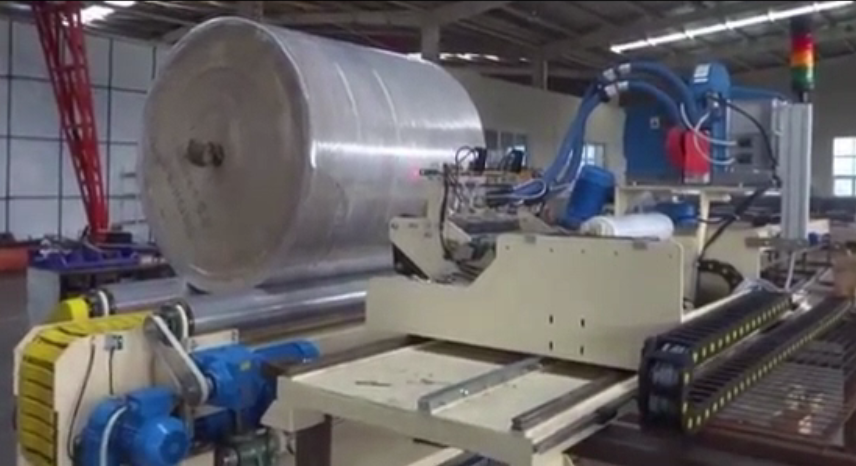
Executive summary This online roll film wrapping machine wraps heavy industrial rolls radially on the production floor. A floor-level conveyor feeds the roll in, an arc-shaped pusher rolls it into the station, and motorized support rollers rotate the roll while stretch film wraps its radial surface. The cycle is semi-automatic: the operator starts the film and cuts it, and the wrapped roll discharges onto the outfeed line. Rotation speed runs 0–15 rpm, with synchronous VFD drives available per project.
Table of Contents
- What this online roll film wrapping machine does
- The floor-level operation flow
- The wrapping cycle step by step
- Machine specifications and options
- Safety and packaging benefits
- Support rollers and roll materials
- Line integration and PLC interface
- Specification and selection checklist
- Applications for wrapped rolls
- Engineering FAQ
- Next step
- Related reading
- Sources and standards
What this online roll film wrapping machine does
This is a semi-automatic wrapping machine that applies stretch film around the radial surface of a heavy roll or coil, inline with the material flow. Instead of lifting a roll to a wrapping position with a crane, the machine keeps everything at floor level. The roll travels in on a conveyor, is pushed into the station, is rotated on support rollers, and leaves wrapped onto the outfeed line.
The machine is built around the heavy end of the range, where manual wrapping is slow and crane handling is risky. Unlike an automatic roll stretch wrapper with an inclined infeed, this machine keeps the roll at floor level on rollers, so the operator works at floor height for the whole cycle.
The floor-level operation flow
The system is designed to sit inside a plant-floor material flow rather than as an isolated station.
The heavy roll arrives on the automated floor-level infeed line. That single step removes the need for crane lifting or manual hoisting at entry. When the roll reaches its position, a heavy-duty arc-shaped pushing mechanism pivots the roll onto the wrapping station without dragging it. The push mechanism is pneumatic on the standard machine and hydraulic on the heavy-duty option.
From there the roll rotates on its support rollers while the film is applied. At the end of the cycle the wrapped roll is lifted by an integrated roller mechanism and discharged onto the outfeed line. Nothing in that flow rises above waist height, which is where the safety benefit comes from.
The wrapping cycle step by step
The operator starts the film on the surface of the roll, and the machine drives the rest of the cycle.
- The roll reaches its position in the wrapping station.
- The operator attaches the leading edge of the stretch film to the roll surface.
- The motorized support rollers rotate the roll, drawing the film under tension.
- The film wraps the radial body in overlapping layers to the set coverage.
- The operator cuts the film at cycle completion.
- The roller lift mechanism raises the wrapped roll and discharges it to the outfeed line.
The overlap density and wrap count adjust per roll profile, so a heavy paper roll and a light textile roll each get the coverage they need.
Machine specifications and options
The standard machine and its options are summarized below. Roll diameter, length and capacity follow your rolls per project.
| Machine parameter | Standard specification | Industrial option |
|---|---|---|
| Infeed system | Automatic floor-level conveyor | Custom-length slat or chain conveyor (slat for heavy or irregular bases, chain for standard cores; per project) |
| Transfer mechanism | Automated pneumatic arc-pusher | Heavy-duty hydraulic pusher block (per project for very heavy rolls) |
| Wrapping axis | Radial surface rotation | Adjustable overlapping density |
| Support rollers | Polyurethane-coated steel rollers | Custom roller length and pitch |
| Discharge control | Motorized cylinder lifting roller | Gravity outfeed for manual sorting, powered outfeed for continuous lines (per project) |
| Rotation speed | 0–15 rpm, variable speed control | Synchronized VFD drive systems |
| Standards and interface | ISO 12100, EN 415-10, EN ISO 13849-1, PLC signal |
The machine scales with daily throughput. Where the line runs at high volume, the infeed conveyor lengthens, pusher and discharge configurations upgrade to heavy-duty hydraulic or powered systems, and the drive control shifts to synchronous VFDs. Each option is selected per project.
Safety and packaging benefits
Floor-level material transport is the main safety feature. Rolls move on conveyors and rollers instead of hanging from forks or hooks, so the risk of overhead loads over operators drops. Manual film start and cut keep the cycle simple, and the lifting that does happen is a short, guided lift at the discharge point.
The wrap itself protects the product. Continuous rotation lays tight, overlapping layers of stretch film over the full outer circumference, which blocks dust, moisture and impact damage during storage and transport. For high-density paper, textile or rubber rolls, the polyurethane-coated support rollers prevent surface friction marks and material deformation while the roll spins.
Support rollers and roll materials
The support rollers are coated in polyurethane and machined for the roll surface. The coating grips the roll without scratching it, which matters for rolls where the outer layer is part of the sale. Roller length and pitch adjust so a narrow coil and a wide board roll both sit flat without sagging.
The same floor-level wrapping principle suits paper and board rolls, textile and nonwoven rolls such as a fabric roll stretch wrapping machine application, rubber and plastic film rolls, and metal coils on cores. The roller set and the overlap settings are matched to the material and its sensitivity per project.
Line integration and PLC interface
The machine is an inline finishing station. It sits at the end of the production or conversion line, receives the roll from the existing transport, wraps it, and hands it to the outfeed. The control uses standard PLC interfaces, so the machine can take its release signal from the line and report cycle complete back to it.
Because the machine is online rather than a separate wrap cell, it does not add a handling step. The material moves in a straight line from production to wrapped roll, and operators do not carry rolls sideways to a wrapper. The conveyor lengths, pusher timing and discharge height are confirmed against your line layout per project.
Specification and selection checklist
Send us these points when you size an online roll wrapper, and we confirm the configuration per project.
| Item | What we confirm per project |
|---|---|
| Roll diameter | mm, target the largest roll in your range |
| Roll length and weight | mm / kg, match the roller bed and drive |
| Infeed conveyor length | mm, bridge the distance from your line |
| Transfer mechanism | pneumatic or hydraulic pusher by roll weight |
| Rotation speed | rpm per project, balance cycle time and stability |
| Outfeed height | mm, match your takeaway conveyor |
| Standards and interface | ISO 12100, EN 415-10, EN ISO 13849-1, PLC signal |
Applications for wrapped rolls
The machine fits production lines that finish heavy rolls: paper and packaging board mills, textile and nonwoven finishing, rubber and plastic film producers, and coil and core packaging in metal processing.
In each of these, the roll leaves the line wrapped and ready for storage or shipping. For lighter paper grades a horizontal stretch wrapper for paper is the alternative, while this machine handles the heavy end. The wrapping blocks dust and moisture on the outer surface, protects roll edges during handling, and keeps the coil tight on its core.
Engineering FAQ
Q: Is the machine fully automatic? A: No. The machine is semi-automatic: the operator attaches the film at the start, cuts it at the end, and the machine drives the wrapping automatically.
Q: What roll sizes can it handle? A: The machine scales to the roll range you run. Diameter, length and capacity are confirmed per project.
Q: How fast does the wrapping run? A: Rotation speed runs 0–15 rpm with variable speed control, and synchronous VFD drives are available per project.
Q: Does it need a crane or forklift? A: No. Rolls enter on the floor-level infeed conveyor and discharge on the outfeed line, so overhead lifting is not part of the cycle.
Q: Can it join our existing production line? A: Yes. The machine works as an inline finishing station with standard PLC interfaces, and conveyor lengths are matched to your line per project.
Q: What about rolls that mark easily? A: Polyurethane-coated support rollers reduce friction marks, and overlap and tension follow the material sensitivity per project.
Q: What machine safety standards does this equipment satisfy? A: The system is engineered to ISO 12100, EN 415-10 and EN ISO 13849-1, and it interfaces over standard PLC signals.
Q: What utilities does it need? A: Standard units need three-phase electric power and compressed air for the standard pneumatic pusher. Hydraulic units are specified per project.
Next step
The machine is sized to the rolls you actually wrap, so the configuration starts with your roll range and line layout.
- Send your roll diameter range, length, weight and line speed to info@fhopepack.com.
- We confirm the roller bed, infeed length and pusher type for your operation.
- We provide a layout drawing and a site survey within 48 hours.
- We quote the machine per project, including VFD drives and outfeed integration.
Last reviewed: 2026-10-09
Related reading
- In-Line Wrapping Technology for Cold-Rolled Steel Coils
- Automatic Horizontal Orbital Wrapping Machine: Full Coverage in One Pass
- Automatic Wire Coil Rewinding and Tying Machine
- Upgrading Old Packing Lines with Automatic Steel Rod Bundle Strapping Machines
- FHOPE main-site product range
Sources and standards
- ISO 12100:2010 — Safety of machinery: General principles for design
- EN 415-10:2014 — Safety of packaging machines: General requirements
- EN ISO 13849-1:2023 — Safety-related parts of control systems: Functional safety
- EN ISO 14120:2015 — Guards for machinery: General requirements