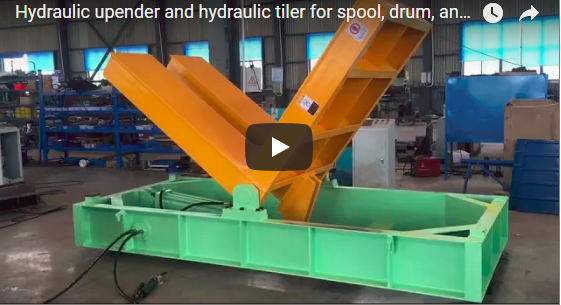
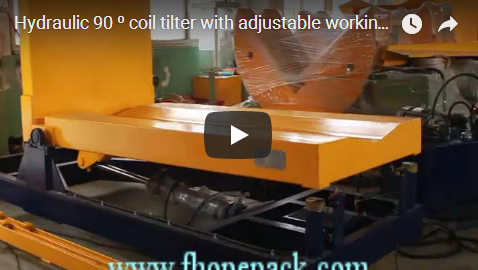
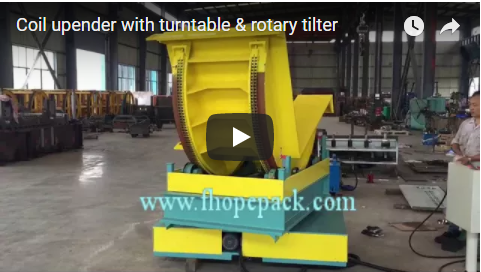
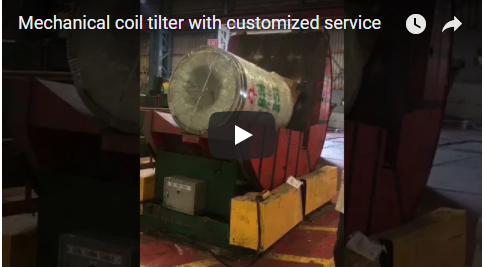
Executive summary An industrial mold tipper and upender turns a heavy mold from lying flat to standing on its side, so it can be split, serviced or set into a press. Our clip, about 103 s long, shows a yellow cradle on a green base tipping a large green mold up to a steep angle and lowering it again. Our FPCT mold tilters handle 5 to 30 t, with a turn time of 40 to 90 s.
Table of Contents
- What the clip shows, in order
- Cycle time on the clip
- How a roller cradle mold tipper works
- FPCT mold tilter specifications
- Takt check
- Selection checklist for a mold tipper
- Controls and safety
- Engineering FAQ
- Next step
- Related reading
- Sources
What the clip shows, in order
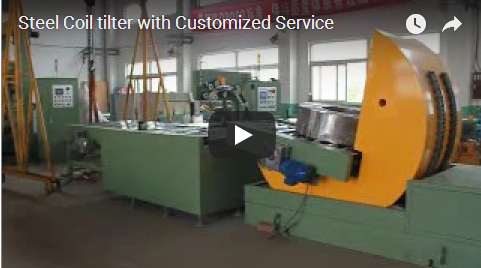
The tipper has a green steel base and a large yellow L-shaped cradle with a curved back. The cradle edges carry black and yellow hazard stripes, and its two faces are marked A and B. A large rectangular green mold sits in the corner of the cradle. No person is near the machine in any frame.
- 0 s. The cradle is in its low position. The mold rests flat on face A.
- About 5 to 60 s. The cradle rolls back on its curve and tips the mold up, step by step. Face B comes down under the mold as it turns.
- About 65 to 85 s. The cradle reaches its steepest position. The mold now stands almost upright, carried on face B.
- About 90 to 100 s. The cradle rolls forward again and lowers the mold back towards its flat position.
Cycle time on the clip
| Step on the clip | Time window | Duration |
|---|---|---|
| Tip up from flat | about 5 to 60 s | about 55 s |
| Held at the steepest position | about 65 to 85 s | about 20 s |
| Lowered again | about 90 to 100 s | about 10 s |
The clip runs about 103 s, and the times come from frames 5 s apart. The tip-up of about 55 s sits inside our quoted 40 to 90 s per turn. The lowering in the clip looks faster. It may be a partial descent or a cut in the clip, and with frames 5 s apart its length is only approximate.
How a roller cradle mold tipper works
The mold is set by crane into the corner of the L-shaped cradle, lying on face A. The curved back of the cradle rests on four rollers in the base. A double chain electric drive with a helical gear and worm reducer turns the cradle on those rollers, so the whole cradle rolls through its arc.
As it rolls, face B takes over the weight, and the mold ends up standing on its side. The mold stays supported by both faces through the turn. A position lock holds the cradle in any position, so it can stop part way.
| Part | What it does |
|---|---|
| L-shaped cradle with faces A and B | Carries the mold before and after the turn |
| Curved cradle back | Rolls on the base rollers |
| Four rollers with polyamide cover | Support the cradle and protect its surface |
| Double chain drive with worm reducer | Turns the cradle |
| Frequency converter | Sets the turning speed |
| Position lock and travel limiters | Stop the cradle in any position and limit its travel |
FPCT mold tilter specifications
| Model | Maximum load | Power | Turn time |
|---|---|---|---|
| FPCT-05 | 5 t | 2.5 kW | 40 to 90 s |
| FPCT-10 | 10 t | 3.5 kW | 40 to 90 s |
| FPCT-20 | 20 t | 4.5 kW | 50 to 90 s |
| FPCT-30 | 30 t | 5.5 kW | 60 to 90 s |
All four run on 380 V, 50 Hz. Control is by a control panel or a remote control, with inverter speed setting. Conveyors can be added on the cradle faces for automatic loading and unloading, and we size the cradle to the mold.
Takt check
For an illustrative die shop turning 10 molds per hour, the takt is 3,600 ÷ 10 = 360 s per mold. A turn of 40 to 90 s each way uses 80 to 180 s, leaving 180 to 280 s for crane handling.
That is a comfortable margin for a tool room. Where molds arrive faster, for example on a press line, we add powered conveyors on both faces so the mold runs in and out without a crane hook.
Selection checklist for a mold tipper
- Heaviest mold weight, against 5 to 30 t.
- Mold length, width and height, for the cradle faces.
- Turn angle needed and the side the mold must stand on.
- Loading by crane, forklift or conveyor.
- Molds per hour, against 40 to 90 s per turn.
Controls and safety
The cradle carries a heavy mold through a wide arc, and the gap between the cradle and the base closes as it rolls. On the clip nobody stands near the tipper while it moves, and that is how we lay out the cell. A person inside the arc of the cradle is the move to design out.
The machine has an emergency stop, a position lock against uncontrolled rotation and two travel limiters, and it can stop rotating at any point. Stop, isolate and lock out the tipper, with the cradle at rest, before anyone enters the cradle area or unhooks a mold.
The standards that apply depend on the destination market. For CE markets, EN 415-10 covers general requirements for packaging machines, which fixes guarding and the stop arrangement, and ISO 12100 sets the risk-assessment method.
Engineering FAQ
Q: How heavy a mold can the FPCT tipper turn? A: From 5 t on the FPCT-05 up to 30 t on the FPCT-30.
Q: How long does one turn take? A: 40 to 90 s on the FPCT-05 and FPCT-10, 50 to 90 s on the FPCT-20 and 60 to 90 s on the FPCT-30, set by the frequency converter.
Q: Can the tipper stop part way through a turn? A: Yes. The position lock holds the cradle in any position, and the drive can stop rotating at any point.
Next step
We size a mold tipper and upender in three steps:
- Submit your layout drawing with the mold weight, size and handling method, to info@fhopepack.com.
- Receive a proposal within 48 hours, with the cradle size, the model and the cycle check.
- Book a site survey so we confirm the floor, the crane reach and the safe zone around the tipper.
Related reading
Sources
- Machine specifications: mould tilter product page
- Clip timing: frame timings taken from our clip, 5 s between frames
- Machine in action: our video on YouTube
- Standards scope: EN 415-10:2014, ISO 12100:2010
Last reviewed: 2026-10-05