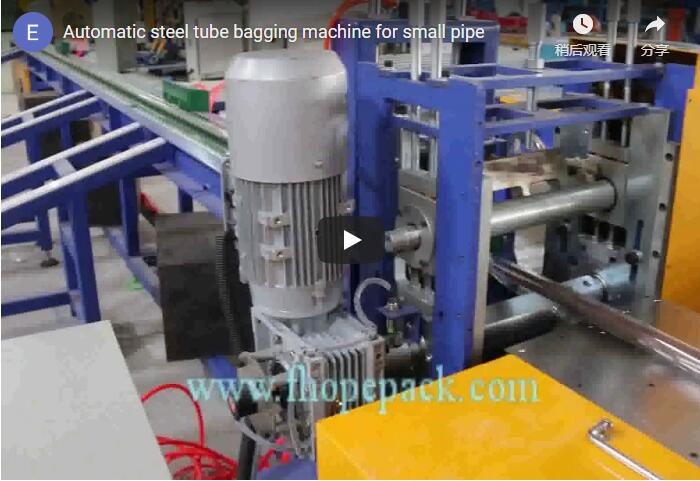
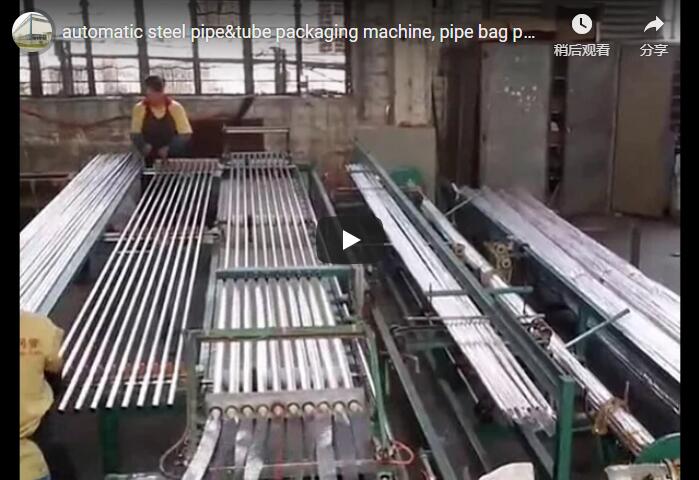
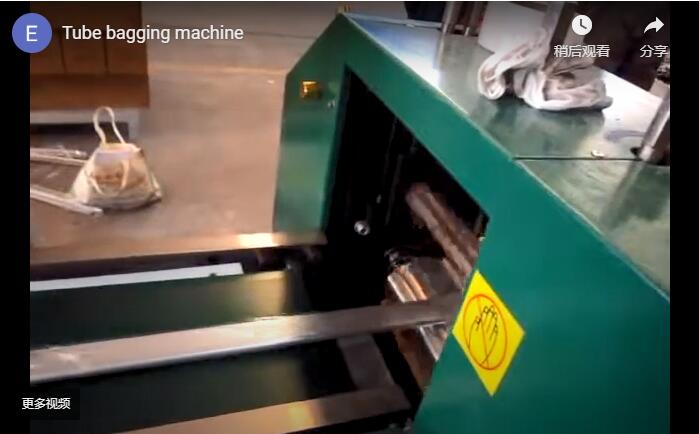
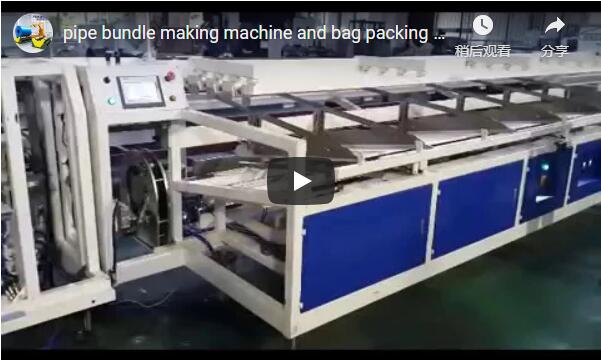
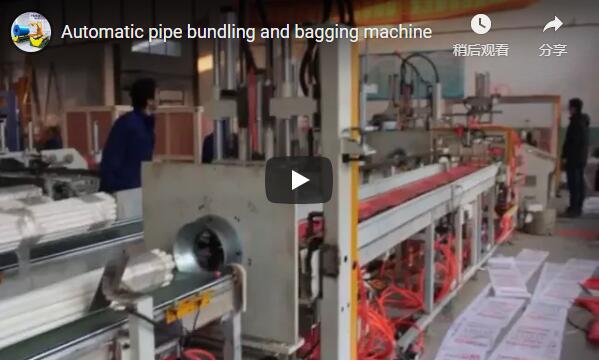
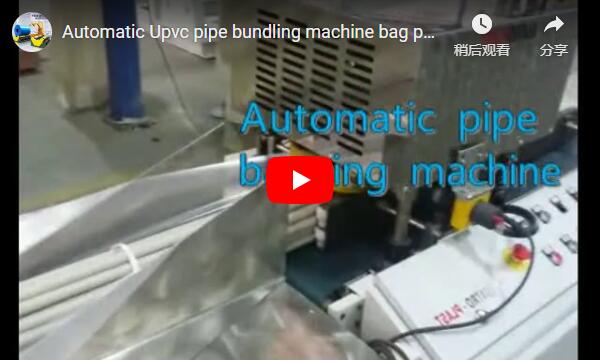
Automatic bundle making and film binding machine

Executive summary This video shows an automatic bundle making and film binding machine in operation on a roller conveyor line. Long metal tubes are fed in, wrapped with transparent plastic film, folded and sealed by a press mechanism, and output as tight, uniform bundles. The footage also shows a weighing station and a sealed bundle ready for the next step. Specs such as capacity, film type, and power are not shown — confirm those with the manufacturer.

What the video shows

The video runs about 70 seconds and is filmed on a factory floor, with a “FHOPE” watermark visible in the corner throughout. The footage follows the machine and its product through several stages:

  • 0–8s — Wide view of the line. A fixed wide shot shows the full layout: a blue multi-station machine on the left, a roller conveyor with yellow-covered rollers in the center, and a row of silver-gray metal tubes being fed toward the yellow binding unit on the right. Several workers in safety helmets and reflective vests can be seen in the background.
  • 10–22s — Approaching the binding unit. The camera moves in on the yellow bundling unit at the end of the conveyor. It has two white plastic guide rails or clampers, a pair of rotating pressure rollers, and a control panel with green and red indicator lights. The tubes are aligned and positioned into the film channel.
  • 26–30s — Film supply unit. The shot cuts to a separate blue-framed unit holding a large roll of white film, with multiple guide rollers and a tension adjustment handwheel. It stands by, feeding film toward the main unit.
  • 28–30s — Wrapping begins. Back at the main unit, the tubes are already partially covered with transparent film as they pass through the pressure rollers.
  • 30–46s — Film covering and sealing. The film is drawn down over the tube bundle from above. A yellow press/folding head descends, folds the film edges inward, and applies heat-sealing pressure along the bundle, completing the longitudinal seal.
  • 50–58s — Output. The finished bundle — silver-gray tubes under semi-transparent film — travels down the conveyor. A control cabinet behind a yellow mesh guard is visible, fitted with red, green, and black buttons, indicator LEDs, and a red mushroom-head emergency stop. A small electronic scale with a red digital display appears near the end of the line.
  • 60–70s — Weighing and idle. The final frames show a sealed bundle resting on the line, secured with a white strapping band, next to a digital scale on a stool (readings around 49.1–49.2 are visible; a later close-up shows “14.50” on a scale display). No further movement occurs — the machine is in a standby state.

The machine in action: process overview

Based on the sequence in the footage, one bundling cycle moves through four observable stages:

Stage Approx. time What happens on screen
1. Feeding 0–10s / 30–36s Multiple long tubes ride the roller conveyor into the work zone and align side by side
2. Film covering 10–22s / 36–42s Film from the overhead roll is guided down and laid over the tube bundle
3. Folding and sealing 24–30s / 42–48s The press head folds the film edges inward and applies sealing pressure; film tightens around the bundle
4. Output 48–58s The wrapped, sealed bundle exits along the conveyor toward the next step

The bundle shown in the last section is secured with a white strapping band in addition to the film, suggesting a combined film-wrap-plus-strap finish — though the strapping step itself is not shown being performed. Verify with the manufacturer whether strapping is integrated or manual.

Direct observation notes

The following points stay close to what is actually visible in the frames:

  • The main frames are painted blue steel; functional modules such as the binding unit and press head housing are yellow; one later machine section appears light green/teal with a vertical guide rail.
  • The conveyor uses parallel rollers with yellow polyurethane- or rubber-covered surfaces.
  • The yellow binding unit contains a pair of adjustable pressure rollers, two white plastic guide/clamping arms, and a control panel with green and red indicator lights.
  • The film supply unit has a large roll cradle, tension rollers, guide rollers, and a manual adjustment handwheel.
  • The control cabinet behind the yellow mesh guard has one red, one green, and one black round button, red and green LED indicators, a small digital display, and a red mushroom-head emergency stop button.
  • The product is long, silver-gray metal tubes (estimated roughly 20–40 mm diameter, over 2 m long, bundled about 10–15 per bundle), with some surface oxidation marks.
  • The finished bundles carry semi-transparent film with slight heat-seal wrinkles, and one bundle shows a white strapping band around the middle.
  • An electronic scale with a red LED display sits on a blue stool near the line; readable values include “49.1”, “49.2”, and “14.50”.
  • A “FHOPE” watermark is visible on the footage. No readable nameplates, parameter labels, or warning labels appear on the equipment.

What the video does not show

The footage is a short demonstration, so many buyer-relevant details are simply not observable:

  • Rated capacity (bundles per hour) and exact cycle time
  • Motor power, voltage, frequency, and drive type (servo / VFD / pneumatic)
  • Machine model designation
  • Film specification: thickness, width, material type
  • Minimum and maximum bundle diameter and length range
  • Sealing temperature and pressure settings
  • Safety certifications (CE, UL, ISO) — none visible in the frames
  • PLC brand, HMI type, or remote monitoring interfaces
  • Whether film roll changes require a machine stop
  • Maintenance intervals and spare-parts list

If any of these matter to your purchasing decision, request written specifications from the manufacturer before comparing offers.

Applications and fit

From the product and process visible on screen, this type of machine suits:

  • Steel tube and pipe plants — bundling finished tubes for dust and moisture protection before storage or shipping
  • Aluminum profile and metal bar processors — consistent, presentable bundles for builders’ merchants
  • Building-materials distribution — tidy, film-wrapped bundles that are easier to handle, count, and identify in the warehouse

The transparent film keeps bundles visible for identification while protecting surfaces from scuffs, oxidation, and dirt. A weighing station nearby supports weight-based traceability and shipping checks.

Situations where it may not fit — verify before ordering:

  • Irregular or non-round cross-sections (the guides shown appear fixed-spacing)
  • Very small batches where manual wrapping is already sufficient
  • Lines requiring automatic counting, labeling, or coding — none of these are shown

What to verify with the manufacturer

Before requesting a quote, put these questions in writing:

  1. What bundle diameter and length range does the machine accept, and how are adjustments made between sizes?
  2. Are sealing temperature and pressure adjustable, and which film types (PE, POF, others) are compatible?
  3. What is the rated throughput, and what is the measured cycle time per bundle?
  4. Does a film roll change require stopping the machine?
  5. What fault diagnostics and alarm outputs are included beyond indicator lights?
  6. Which safety features are standard (interlocks, light curtains), and what certifications apply?

FAQ

Is the machine fully automatic? The video shows tubes fed, wrapped, folded, and sealed without an operator at the machine, and a control cabinet with start/stop buttons is visible. The full degree of automation, including infeed and outfeed handling, should be confirmed with the manufacturer.

What products can it bundle? The footage shows long, slender metal tubes and bars. The report estimates roughly 20–40 mm diameter and over 2 m length. Exact size ranges are not stated — check with the manufacturer.

Does it strap as well as wrap? A finished bundle with a white strapping band is visible near the end of the video, but the strapping action itself is not shown. Confirm whether strapping is integrated or done separately.

What safety features does it have? Visible: a red mushroom-head emergency stop, and yellow mesh guarding around the press head and film area. No light curtains or warning labels are visible. Confirm the full safety package with the manufacturer.

How fast does it run? Cycle time and capacity are not shown or labeled anywhere in the video. Request performance data directly.

Maintenance notes

No maintenance procedures are demonstrated, but the visible construction suggests routine items worth planning for:

  • Rollers and guides — keep the conveyor rollers and white guide arms clean; metal fines and film residue build up quickly in tube handling.
  • Sealing head — inspect sealing surfaces and film fold edges regularly; uneven seals in the footage suggest this is the precision-critical zone.
  • Film tension system — the manual handwheel on the film unit indicates tension must be checked and adjusted as rolls deplete.
  • Emergency stop — test the mushroom-head button periodically; the report notes it should be verified regularly.
  • Guards — keep the yellow mesh guarding closed whenever the press head cycles.

A formal maintenance schedule and spare-parts list are not shown — ask the manufacturer for both.

Related reading

Next step

If long tubes, bars, or profiles are part of your product range and bundling is still done by hand, this video gives you a realistic picture of what an automatic bundle making and film binding machine does on the floor. For specifications, sizing, and a quotation matched to your tube dimensions and required throughput, contact the FHOPE team and reference this video.


Source and method: this article is based solely on the video embedded above. Analysis was performed by a vision model on sampled video frames. The video contains background music only — no narration or speech track — so no dialogue was transcribed. All specifications not visible on screen are marked “check with the manufacturer.”