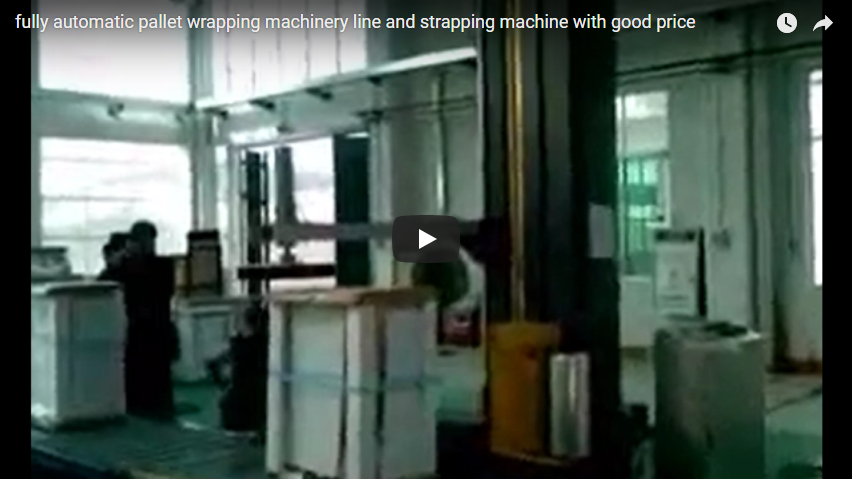
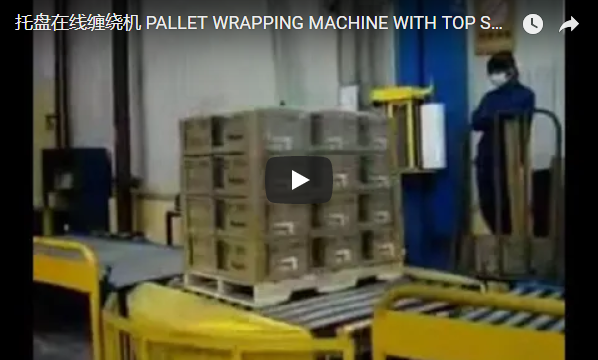
Executive summary This video shows an M type pallet wrapping machine running a complete, hands-off stretch wrapping cycle on a tall palletized load: the operator starts it from the control panel, the turntable rotates, and the film carriage travels vertically to build even layers of film over the full load height. The footage covers startup, wrapping, and finish — but no specs, cycle times, or load ratings appear on screen, so those must be verified with the manufacturer.
Why this machine matters for tall, unstable loads
Tall pallet loads are the hardest ones to wrap by hand. Walking around a load that stands roughly twice as tall as it is wide, pulling film at a consistent tension, takes time and physical effort — and the result varies with every operator. A turntable-style pallet wrapper solves this differently: the load stays still relative to the machine, the platform spins, and a film carriage rides up the load’s height, laying film in uniform layers.
That is exactly what this video demonstrates. If you are evaluating an M type pallet wrapping machine for tall palletized goods — cartons, boards, or equipment casings — this footage gives you a realistic look at the wrapping sequence, the operator’s role, and the level of supervision the cycle requires.
The machine in action: what the video shows
The video runs about a minute and a half, sampled here from frames at roughly 4-second intervals. The visible sequence is:
| Time | What happens on screen |
|---|---|
| ~0–8s | The load sits on the rotating platform, already partially covered with translucent stretch film. An operator’s hand is near the control panel; the stack light at the top is off or barely lit. |
| ~12–20s | The turntable begins rotating (counter-clockwise as viewed). The operator presses buttons on the panel; the stack light shows red + yellow, indicating the cycle is active. |
| ~24–36s | The platform rotates steadily. The vertical film carriage — carrying the film reel and tension device — descends slowly along the load’s side, pulling film onto the surface. |
| ~40–56s | The carriage completes its travel; film layers visibly build up over the load. The stack light settles to steady green. The operator steps away from the panel. |
| ~60–72s | The load, now standing tall and fully film-covered, rests on the platform. A yellow arm structure extends and presses film against the load’s side; film appears in a mesh-like pattern over the middle and lower sections. |
| ~76–88s | The carriage/arm mechanism completes top-of-load adjustments and retracts to its home position. Wrapping is essentially complete. |
| ~92s | Final frame: the wrapped load stands still on the platform, the mechanism at standby, loose film tail visible near the base. |
Throughout the cycle, the load rotates continuously in one direction with no tilting or turning. The operator’s only hands-on involvement is pressing the start controls — after that, the machine runs the wrap unattended.
Direct observation notes
The following notes stay close to what is visible in the footage, with only light grammatical editing:
- The main uprights are light grey-white painted metal; the base and rotating platform are dark grey/black metal; some guards and support arms are painted high-visibility yellow.
- A control panel is embedded in the right-hand column, partway down: a small blue backlit LCD screen (content unreadable) above a row of physical buttons with icons or text that cannot be distinguished.
- A vertical stack-light strip (red / yellow / green) sits above the panel and changes state with the process.
- The central rotating platform is a round metal turntable with a center locating pin and anti-slip surface; the load is a large rectangular palletized body, silver-grey metallic, standing roughly 1.8–2.0 m tall against an estimated platform diameter of 1.5–2 m.
- Film applied to the load shows irregular wrinkles and stretched stripes; several layers build up as rotation continues.
- The carriage assembly travels along vertical guide rails, with a film reel mount and tension adjustment mechanism.
- Black cable/hose runs (a drag-chain style arrangement) extend along the floor at the base.
- No readable text, nameplate, model number, or watermark appears anywhere in the footage; the blue panel screen is too blurry to identify any characters.
- No independent emergency-stop mushroom button, safety fence, light curtain, or clear warning signage is visible in frame. A low yellow barrier strip sits around the machine’s perimeter on the floor.
Process overview, step by step
- Load placement. The palletized load is already centered on the turntable at the start of the video. Loading itself is not shown — check with the manufacturer whether forklift or pallet-truck loading is supported for this model.
- Start. The operator presses a button on the control panel. The turntable accelerates to a steady rotation and the stack light switches to an active state.
- Film application. The film carriage descends along the load’s height. Film pays off the reel, is stretched, and wraps around the load as the turntable turns. Layer overlap is visible as the film thickens on the load’s surface.
- Top finishing. In the later frames, the arm/carriage mechanism adjusts near the top of the load and then retreats — consistent with securing the film tail at the top of the load.
- Cycle end. The mechanism returns to its home position and the wrapped load sits on the platform awaiting removal. The exact cut-and-clamp moment is not visible on screen; only the film tail’s finished shape suggests the cycle has completed.
What stands out is how little the operator does after start-up. There is no manual re-tucking of film, no walking around the load, no mid-cycle adjustment in any frame.
What the video does not show
For a fair evaluation, be clear about the gaps. This footage does not show or state:
- Rated power, voltage, or frequency
- Total cycle time (seconds per pallet)
- Maximum and minimum wrapping dimensions
- Maximum load weight
- Film specifications: width, thickness, roll diameter, or tension settings
- The machine’s model designation or any safety certification marks (CE, UL, GB, etc.)
- Whether automatic film cut / clamp / seal is fitted — the cutting moment is never seen, only inferred
- Loading method, conveyors, or upstream/downstream integration
- Maintenance procedures or spare-parts information
Every one of these belongs on your pre-purchase checklist. Do not assume a value from video proportions; verify with the manufacturer.
Where this machine fits
Based on the load visible in the footage — a tall rectangular palletized body — this style of turntable wrapper is typically used for:
- Cartonized goods stacked to pallet height, needing dust and moisture protection
- Boards, panels, and sheet materials that slide easily and need containment
- Equipment casings, molds, and bulky items where even, consistent film tension matters more than speed
- Operations currently hand-wrapping tall loads and losing time and film consistency doing it
| Situation | Turntable wrapper like this | Manual wrapping |
|---|---|---|
| Tall loads (≥1.5 m) | Carriage climbs the full height automatically | Operator works on ladders or stretches, inconsistent coverage |
| Film tension | Set once at the tension device | Varies by operator and fatigue |
| Repetitive daily volume | One operator starts multiple cycles | Labor-intensive each time |
| Occasional, small loads | Possible but may be over-specified | Usually adequate |
If your loads are light and short, a semi-automatic pallet wrapping machine may be the simpler choice. For higher throughput or integration into a line, compare with a fully automatic pallet wrapping machine or a rotary arm wrapping machine, where the load stays stationary and the arm rotates around it. For very high-speed operations, a rotary ring stretch wrapping machine is the typical next step up. A general overview of stretch wrapping machine types helps place each option.
Operating and safety considerations
The footage supports a few practical observations for operators and safety reviewers:
- Load/unload only when stopped. The turntable is in motion for most of the cycle; nobody should be near the platform while it spins.
- Supervised start. In the video, the operator remains at the panel through the early part of the cycle, then steps away. Confirm with the manufacturer whether unattended operation is intended.
- Perimeter marking. The machine sits in an open layout with only a low yellow floor barrier. Depending on your site’s safety requirements, additional guarding, a light curtain, or interlocked access may be warranted — this is a question to raise before installation, not after.
- Emergency stop. No dedicated e-stop button is clearly visible in the footage. Confirm the location and type of emergency stop (a hard-wired stop, not only a software stop) before accepting the machine.
- Pre-start checks. Verify the film reel is seated correctly and rollers turn freely before starting a shift.
These are operational judgments drawn from what the video shows and does not show — not statements about this specific machine’s certified safety configuration.
Questions to verify with the manufacturer
Before ordering, put these on the table:
- Cycle time per pallet at my load height and weight
- Maximum load dimensions and weight rating
- Automatic film cut / clamp / seal — included or optional?
- Powered pre-stretch ratio and tension control type (open-loop or closed-loop)
- Compatible film widths and thicknesses
- Emergency stop type and location; available guarding or light-curtain options
- Power supply requirements for my site
- Maintenance schedule and consumable parts list
FAQ
Does the machine wrap the load automatically once started? Yes, as far as the video shows. After the operator presses start, the turntable rotation and carriage travel proceed without hands-on intervention through the visible cycle.
How tall a load can it handle? Not shown. The demo load appears roughly 1.8–2.0 m tall, but the machine’s rated maximum height is not stated — check with the manufacturer.
Does it cut and seal the film at the end? The cutting moment is not visible on screen. The finished film tail suggests the step is completed, but whether it is automatic or manual must be confirmed with the manufacturer.
What film does it use? The footage shows translucent PE stretch film, but no width, thickness, or roll size is stated. Confirm film specifications with the manufacturer.
What safety features does it include? The video shows a yellow high-visibility structure and a low floor barrier, but no fence, light curtain, or clearly visible e-stop. This is a key item to verify before purchase.
Related reading
- Semi-automatic pallet wrapping machine
- Automatic pallet wrapping machine
- Stretch wrapping machine overview
- Rotary arm wrapping machine
- Rotary ring stretch wrapping machine
Next step
If tall, heavy, or unstable pallet loads are slowing down your shipping area, the fastest way to firm up this decision is a short technical conversation: send us your load dimensions, weight, and daily volume, and we will confirm the right configuration, cycle time, and film specification. Reach us through the contact page to request a quotation or a live demonstration.
Source and method
This article is based on a single product video. Frames were sampled at regular intervals and analyzed with a vision model; the machine’s behavior, structure, and load are described only as observed. The video contains background music only — there is no narration or speech, so no spoken content was transcribed. Anything not visible in the footage is explicitly marked as needing manufacturer confirmation.
Published: 2026-09-03