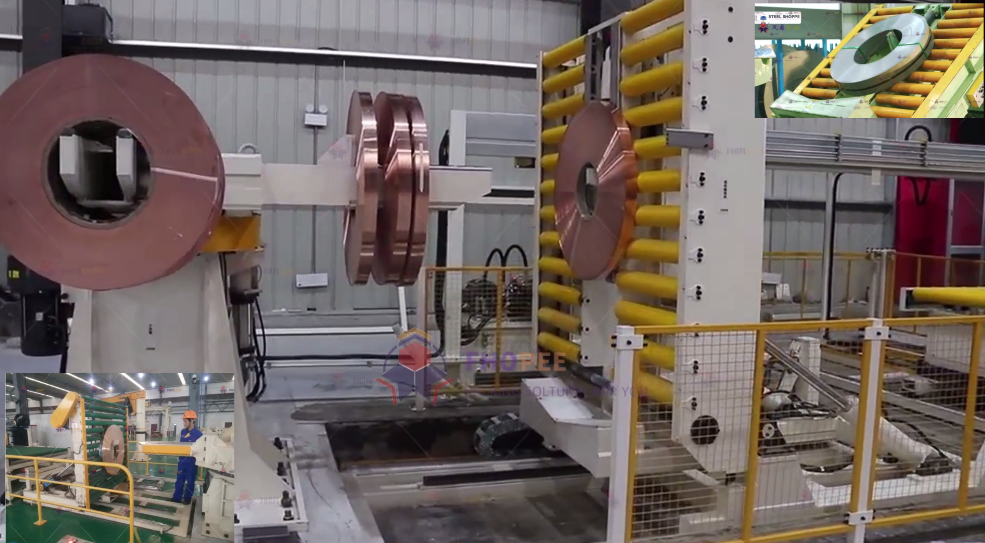
Executive summary Cold rolled coil is protected from transit rust and scratches by layers: paper wrap, outer cover, end covers, straps, and a lift through the eye. This clip of about 3 min follows one coil packing area from the mill recoiler to a C-hook crane. Paper and end covers go on by hand; circumferential and radial strapping run in two automatic stations. Below we map each step to the damage it prevents, give the data of our equivalent coil strapping machines (coils up to 20 t, strap tension 500–30,000 N), and work through coil weight and strap use.
Table of Contents
- Short answer: what stops rust and scratches
- What the clip shows, step by step
- Each layer and the damage it prevents
- Our equivalent solution: coil strapping data
- Coil weight and strap use
- Selection checklist
- Safety
- Engineering FAQ
- Next step
- Related reading
- Sources
Short answer: what stops rust and scratches
- Rust comes from moisture and condensation on bare steel. A close paper wrap, an outer cover and closed end faces keep that moisture off the strip.
- Scratches come from wraps sliding on each other, edges rubbing, and hooks or forks touching the coil. Straps hold the wraps still, end covers protect the edges, and a C-hook lifts through the eye.
- Repeatability matters on a high-output line. Machines set the strap tension and position the same way on every coil.
What the clip shows, step by step
Frames are read every 5 s, so the times are approximate.
| Clip time | Step | What you see |
|---|---|---|
| about 0–25 s | Recoiler and staging | A bright coil on a green mill recoiler, then a coil on a staging platform |
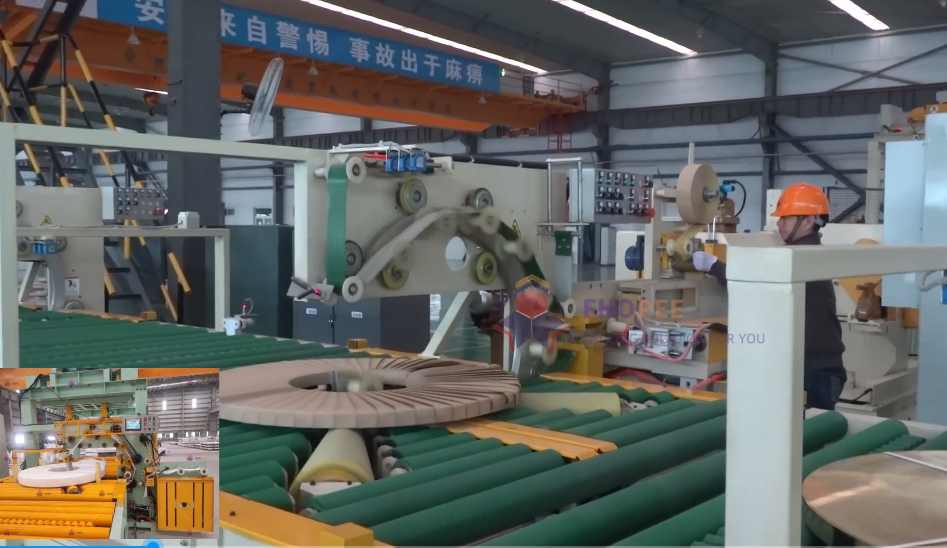
| about 30–75 s | Paper wrap | A sheet of brown printed paper is laid round the coil; workers fold the pleated edges into the eye |
| about 80–95 s | Outer cover | A silver outer layer is pulled over the paper and pressed down by hand |
| about 100–120 s | End covers | Workers fit blue end covers on the coil faces |
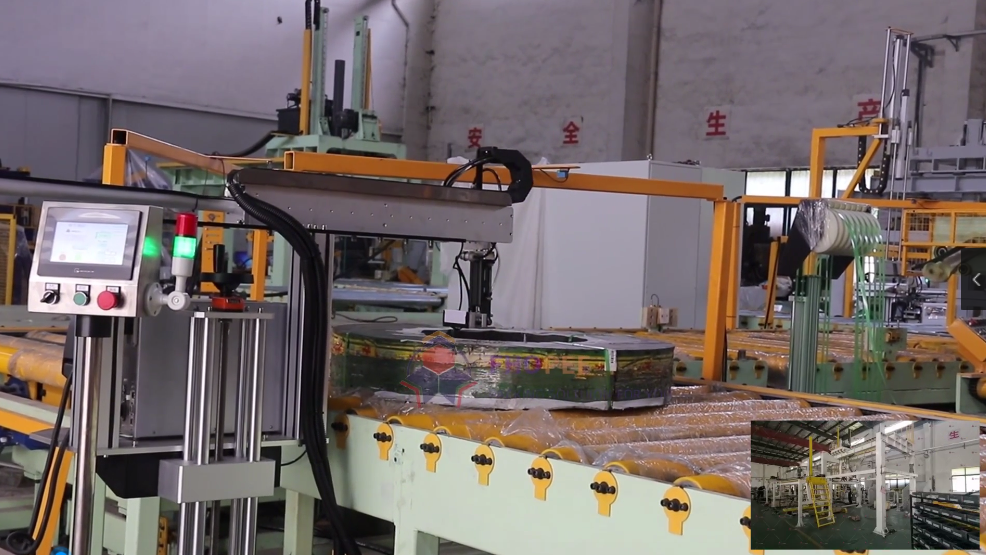
| about 130–145 s | Circumferential strapping | The coil lies on rollers under a red gantry with a strapping head over its outer diameter |
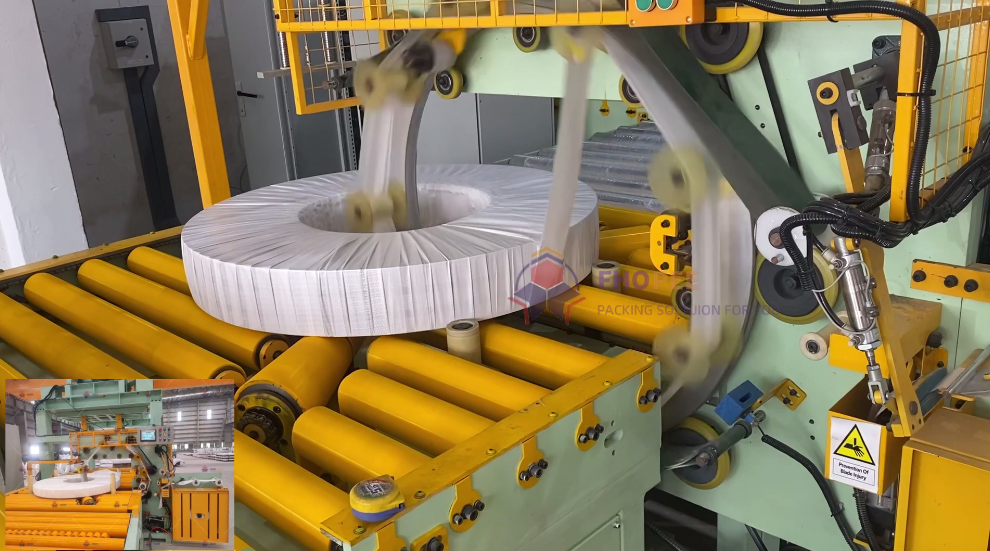
| about 150–170 s | Radial strapping | A green eye-through station runs straps through the eye; four radial straps are visible after |
| about 175 s to end | Lifting | A yellow C-hook crane lifts the finished coil through the eye |
The end covers carry the coil producer’s own print, which we leave unnamed.
Each layer and the damage it prevents
| Layer or step | Rust | Scratches |
|---|---|---|
| Paper wrap close to the strip | Keeps condensation off the steel; anti-rust paper can be specified | Cushions the outer wraps |
| Outer cover | Sheds water and dust | Takes rubbing in transit |
| End covers | Close the coil faces | Protect the strip edges |
| Circumferential straps | Hold the cover closed | Stop the outer wraps springing loose |
| Radial straps | Hold paper and covers at the faces | Stop wraps telescoping sideways |
| C-hook lift through the eye | — | Keeps hooks and chains off the coil surface |
In this clip the paper and covers are fitted by hand. On a higher-output line we automate the eye-through wrapping step as well, as in our coil strapping and wrapping lines, so the wrap tension and overlap are the same on every coil.
Our equivalent solution: coil strapping data
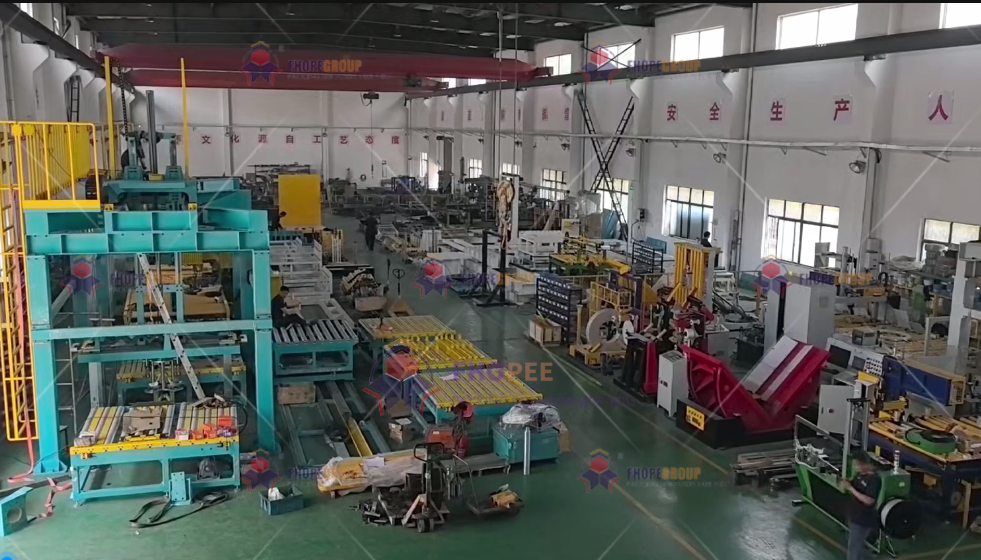
Our equivalent strapping stations for coils of this size come from our coil strapping machine range:
| Item | Published value |
|---|---|
| Coil diameter | 500–2,200 mm (customised) |
| Coil weight | Up to 20 t |
| Strap tension | 500–30,000 N, depending on the strapping head and strap material |
| Output | 40–60 straps per hour |
| Radial straps per coil | 2, 3, 4 or 6 |
| Strap | Steel, polyester or polypropylene, with accumulator |
| Conveyor | 360° turning and coil eye centring |
| Control | PLC sets strap tension and sealing force |
Parameters vary with each project, because we build every line to the customer’s coil range and layout.
Coil weight and strap use
Worked example (illustrative). Take a coil with OD 1,500 mm, ID 610 mm and width 1,250 mm. Steel density is about 7.85 t/m³.
- Volume: π/4 × (1.5² − 0.61²) × 1.25 = 1.84 m³, so the coil weighs about 1.84 × 7.85 = 14.5 t, inside the 20 t range.
- One radial strap runs round the section: 2 × (1,250 + (1,500 − 610) ÷ 2) = 3,390 mm. Four radial straps use about 13.6 m.
- One circumferential strap runs round the OD: π × 1,500 = 4,712 mm. Two use about 9.4 m.
- The coil takes about 23 m of strap, plus seal overlaps.
Selection checklist
- Coil OD, ID, width and weight range.
- Paper type (plain or anti-rust) and outer cover material.
- End covers or edge protectors, and how they are fitted.
- Number of radial and circumferential straps.
- Strap material: steel, polyester or polypropylene.
- Coils per hour and straps per hour.
- Lifting method: C-hook, eye-up or eye-to-wall handling.
Safety
Coils of this weight move on powered rollers and are strapped at high tension. We guard each strapping station to the risk assessment, so hand work such as fitting paper and covers is done away from moving rollers and the strap path. Coils are lifted only with a C-hook or eye lifter rated for the coil weight.
For CE markets we apply ISO 12100 for the risk assessment and EN 415-10 for general packaging-machine requirements.
Engineering FAQ
Q: What causes transit rust on cold rolled coil? A: Moisture and condensation on bare steel during storage and shipment; close wrapping and closed end faces keep it off.
Q: What causes surface scratches? A: Wraps moving against each other, unprotected edges rubbing in transit, and hooks or forks touching the coil surface.
Q: Why use both radial and circumferential straps? A: Radial straps through the eye hold the wraps and the face covers; circumferential straps stop the outer wraps springing loose.
Q: How many radial straps does your equivalent machine fit? A: 2, 3, 4 or 6 per coil, set to the coil width and weight.
Q: How heavy a coil can your equivalent strap? A: Up to 20 t, with coil diameter 500–2,200 mm.
Q: Which strap materials can your equivalent run? A: Steel, polyester or polypropylene strap, fed through an accumulator.
Q: How fast is your equivalent strapping station? A: 40–60 straps per hour.
Q: How do I estimate coil weight? A: π/4 × (OD² − ID²) × width × 7.85 t/m³; a 1,500 × 610 × 1,250 mm coil is about 14.5 t.
Q: Which standards apply? A: For CE markets, ISO 12100 and EN 415-10.
Next step
We size a cold rolled coil packing line in three steps:
- Submit your layout drawing with coil sizes, weight, wrapping materials, strap pattern and coils per hour, to info@fhopepack.com.
- Receive a proposal within 48 hours with the station layout and strapping data.
- Book a site survey so we confirm the floor space, crane and conveyor links.
Related reading
- Steel Coil Radial Strapping Machine: Through-the-Eye Strapping
- Steel Coil Packing with Paper and Stretch Film
- Steel Coil Strapping Line: Choosing the Strap Pattern
- Coil strapping machine data
Sources
- Clip of the packing area: the video on YouTube
- Coil diameter, weight, tension, output, strap and radial strap data: Coil strapping machine data
- Coil weight and strap use: our worked arithmetic (steel density about 7.85 t/m³)
- Standards scope: ISO 12100:2010; EN 415-10:2014
- Proposal timing: approved house CTA (proposal within 48 hours)
Last reviewed: 2026-10-09