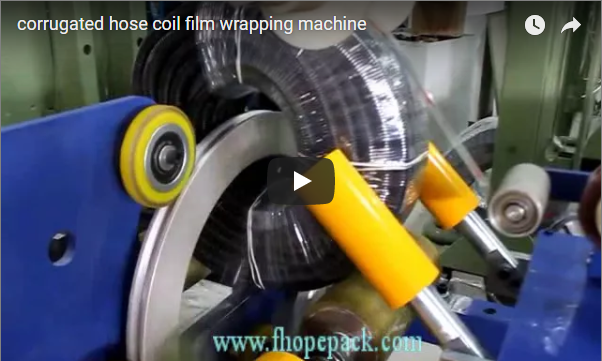
Engineering Design Principles for Downstream Slit Steel Coil Finishing: Balancing Structural Rigidity and Delicate Coil Protection During Tilting and Strapping

Executive summary: This review covers the manufacturer clip behind the article titled “Engineering Design Principles for Downstream Slit Steel Coil Finishing”. The clip shows slit coils handled on rotating platforms, banded, film-wrapped and stacked on pallets. Two things the titles promise are not in the footage: no upending or tilting motion appears, and nothing on screen carries a measurement. Below is what the clip proves, and what to ask the supplier for instead.

https://www.fhopepack.com/orbital-stretch-wrapper.html

Who this is for: plant engineers and packaging buyers who handle slit steel coil and are weighing an automatic finishing line against manual work. It separates what this 83-second clip puts on screen from what only the supplier’s engineering documents can settle.

How this review was made: The clip runs about 83 seconds. Forty-three still frames were sampled every two seconds, plus one frame from the final second. Each still was read on its own by a local vision model at temperature zero, and seven decisive frames were re-checked a second time. Every frame was also arbitrated as a single-camera view or an assembled layout. Stills cannot prove motion, sequence or timing.

In this review: What the video shows · Direct observation notes · What the video does not show · Claims vs footage · Stage by stage · Montage limits · Verification checklist · FAQ · Related reading · Next step

Wide view of the factory hall and the coil finishing line at the start of the reviewed clip
Still from the reviewed clip, t≈0s. The hall and the line before any coil appears. No coil is on screen in this still, and no model, capacity or rating text is readable in the frame.

What the video shows

The clip follows one coil finishing line through four visual bands. Five operations appear clearly enough to state:

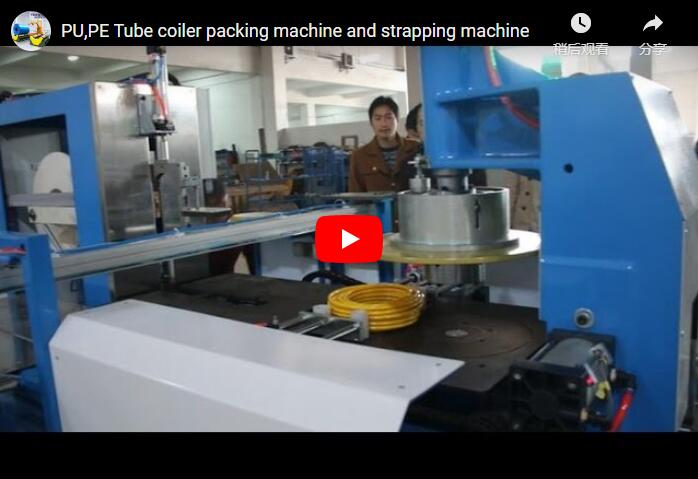
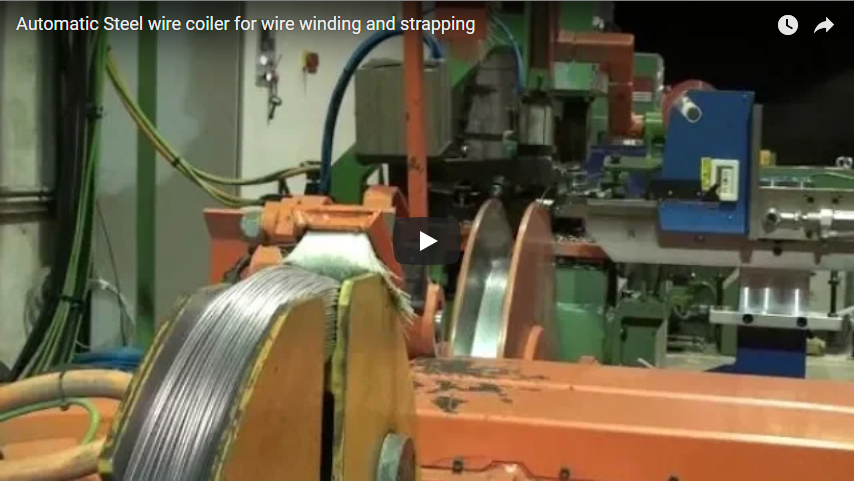
  • Rotating platforms. Coils sit flat on circular platforms at several stations, the most repeated equipment in the clip.
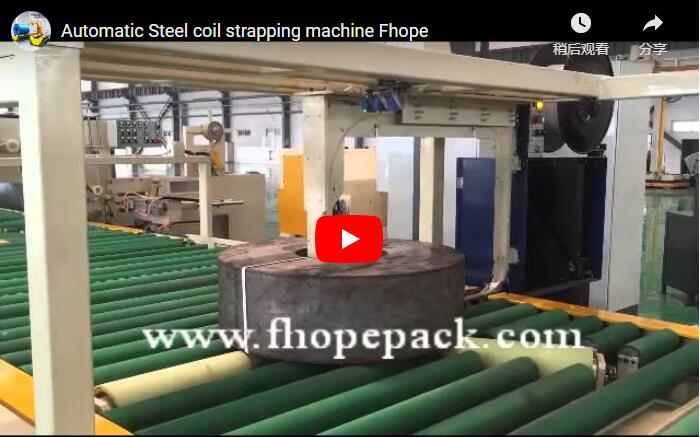
  • Bands. A band wraps around the coil body at the strapping stations.
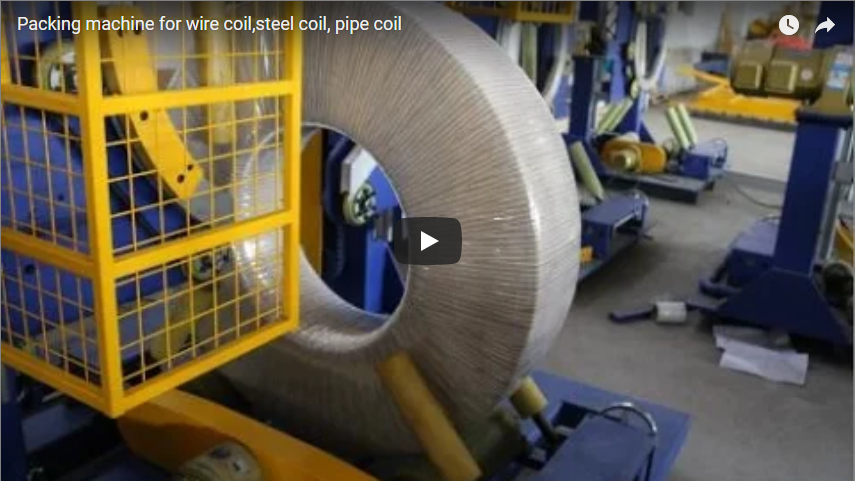
  • Film wrapping. Clear stretch film covers coil bodies, and wrapped coils recur in later frames.
  • Pallet stacking. Film-wrapped coils rest on a pallet at the end of the line, at least two on one pallet.
  • Handling. Coils move between stations on roller beds and by a lifting arm.

The clip’s own video title names two further steps, upending and labeling. Neither appears in any sampled frame. That gap is the reason this page ends with a document request rather than a specification.

Direct observation notes

What is readable in the frames, and what is not, so that nothing is filled in by assumption:

  • Orientation. Every coil on screen sits horizontal, flat on a platform or a conveyor. The first pass read a vertical coil; the re-check overruled it.
  • Bands. Bands sit around coil bodies. The material is not settled: two re-checked frames read rigid metal, one read soft film.
  • Film. Clear stretch film is the packaging material most clearly shown on the coil bodies.
  • Stacking. At least two film-wrapped coils rest on one pallet near the end of the line.
  • No instrumentation. No gauge, dial or display showing a value appears in any sampled frame.
  • No nameplate. No model number, capacity plate or rating text is readable anywhere, and the machine lettering resolves into no company name.
  • People. Operators appear in several frames, so this review makes no claim about an unmanned line.
Slit coil on a rotating platform with a band around the body, in the strapping region of the reviewed clip
Still from the reviewed clip, t≈46s. A coil on a rotating platform with a band around the body, in the strapping region. The re-check read this band as rigid metal, while another frame in the same set read as film, so the material is left to the supplier.

What the video does not show

For a purchase this size the gaps matter more than the footage. Nothing in the clip states:

  • any tilt or upending angle, or one completed re-orientation cycle;
  • any strap tension, film stretch ratio or consumable specification;
  • any cycle time, line speed or output rate;
  • any coil dimension, weight, grade or tolerance behind “slit” and “high-precision”;
  • any evidence of one integrated line: no line diagram, control screen or uninterrupted run;
  • any staffing model, test report or certification.

The word “principles” in the article title sets the same expectation. Principles are written down: forces, angles, tolerances, safety factors. A camera can record equipment, not a design rationale.

What the titles claim vs what the footage proves

Claim What this clip supports Status
Tilting during finishing No tilter or upender device appears, no tilting motion occurs, and every coil sits horizontal Not shown
Upending (video title) The same frames, the same result: no upending motion Not shown
Labeling (video title) No label printer, applicator head or affixed label appears Not observed
Structural rigidity and delicate coil protection Coils are handled and packed, but no force, tolerance or test appears Not demonstrable
Strapping and film wrapping Bands on coil bodies and stretch film on coils Shown
Stacking on pallets Two or more wrapped coils on one pallet Shown

The pivot of this page is the word “tilting” in the article title and “upending” in the video title. A tilt is a motion with an angle and a cycle. The clip shows stations that could host that motion, but not one completed tilt. Ask for the angle and the coil range in writing.

How the stages appear, band by band

Read as a walkthrough of what appears on screen, in the order the clip presents it:

  1. Band one, t≈0–12 s — the hall before any coil. A multi-station hall, a pallet travelling on a roller bed, a machine with a rotating platform, and a gantry with a yellow ladder. No steel coil is on screen in these frames.
  2. Band two, t≈14–36 s — handling stations. Coils appear, all horizontal, on roller conveyors and circular rotating platforms, with an operator in a high-visibility vest at the first station.
  3. Band three, t≈38–50 s — strapping stations. Bands sit around coil bodies on rotating platforms, and a robotic arm or tool head works above a coil.
  4. Band four, t≈52–82 s — wrapping and the end of the line. Stretch film is applied over coils, a lifting arm handles a wrapped coil, and wrapped coils rest on a pallet.

This is a list of what appears on screen, not a verified process order. Treat the sequence as the line’s real cycle only after one uncut run on a single camera confirms it.

Why this clip is a montage — and what that limits

Every sampled frame was arbitrated as single-camera or assembled. Twenty-four of the forty-three frames are layouts with a main scene and one or more inset panels. In most of them the inset shows a different view or a different machine from the main scene.

Three consequences follow for a buyer:

  • An inset may come from another machine or another moment, so panel order cannot be read as process order.
  • Cutting between views breaks the clock, so no cycle time or line speed can be read from the clip.
  • An edit can place side by side two stations that are not wired together as one line.

None of this makes the equipment unreal. The operations are genuine, on real coils. This clip is a montage, and a montage answers capability questions, not capacity questions.

Film-wrapped slit coils resting on a pallet near the end of the reviewed clip
Still from the reviewed clip, t≈82s. Wrapped coils on a pallet in the final second of the clip; the re-check reads at least two coils stacked there. A still freezes one instant, so the movement that placed them is not on show.

Buyer’s verification checklist

# Ask the supplier for Why it decides the purchase
1 The tilting or upending design: angle, cycle, and the coil sizes it serves Both titles rest on this step, and the footage does not show it
2 The strapping specification: band material, tension target and measurement point The band material is not settled by the footage
3 The wrapping film: type, stretch ratio and consumption per coil Consumables are usually the largest running cost after labour
4 Coil data range: diameters, bores, strip width, thickness, grade and weight Decides whether your heaviest and narrowest coils fit
5 One uncut cycle, one camera, clock visible The only footage that can support sequence and timing
6 Layout drawing and control architecture Shows whether the stations are one line or separate units

Work through this list before you commit:

  • Our coil range sits inside the quoted envelope, in writing.
  • We hold the tilting design document, not a video reference to it.
  • We have watched one full cycle, uncut, with a clock.
  • Band material and tension target are named with a measurement point.
  • Film cost per coil is quoted.
  • Guarding, interlocks and control architecture are documented for our audit.

FAQ

Does this clip prove that tilting or upending happens in this line? No. Every coil in the sampled frames sits horizontal, and the re-check found no upender device and no re-orientation motion. The stations that would perform the step are shown, but the step itself is not.

What should I ask for instead of a video? Three documents: the tilting design with its angle and cycle, the strapping and film specifications with tension targets, and one uncut cycle on a single camera with a visible clock.

Is the equipment therefore unproven? The equipment is shown working on real coils, so the operations are genuine. What stays unproven is the engineering claim in the titles and the line’s rated performance. Those need documents and measured data, not more footage.

Next step

Send the supplier your coil mix: outer diameters, bores, strip widths, thicknesses, grades and daily volumes. The clip supplies none of those figures, so the envelope has to come from them.

Then ask for the tilting design with its angle and cycle, for the strap tension target with its measurement point, and for the film specification with consumption per coil. Ask them to verify those figures against your own coil range, and to add measured output and staffing from a reference installation.

Then ask for one uncut cycle with the clock running, and a demonstration on one of your own coils. Use the contact page to start that exchange.

Last reviewed: 2026-09-21

Published: 2026-09-21