Executive summary A ring wrapper covers the four long sides of a stack and leaves both ends open, while six-side wrapping closes the ends as well. Our combined machine does both in one line: the stack rides roller conveyors through the wrapping stations, and a guarded tower wraps the ends. Film use follows from the stack size and the overlap set on each side. Both are set per project.
Table of Contents
- What the video shows
- How six-side wrapping works
- Planning film per stack
- Why close all six sides
- Controls and safety
- Selection checklist for a six-side wrapping line
- Engineering FAQ
- Next step
- Related reading
- Sources
What the video shows
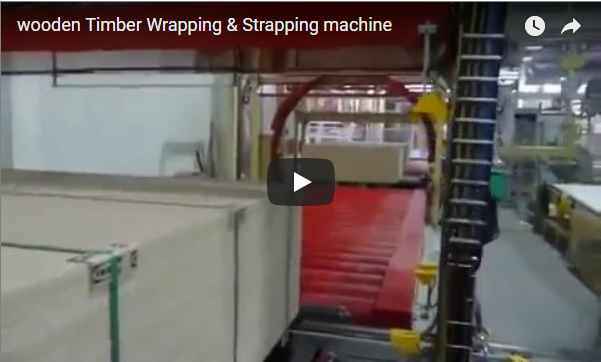
An operator stands by the infeed as a stack of grey boards waits on the roller conveyor. A tall stack of light boards then rides on a cream-coloured transfer frame towards the wrapping stations.
Further down the line a tall yellow-framed tower with mesh panels and a warning sign stands over the conveyor. This is the station that wraps the stack ends, closing the last two sides.
How six-side wrapping works
| Station | What it covers |
|---|---|
| Infeed | The stack is lined up on the roller conveyor |
| Long-side wrap | Film is wound round the top, bottom and two long sides |
| End wrap | The tower station covers the two ends |
| Outfeed | The fully closed stack runs out for lifting |
Together the stations cover all six faces, so no edge or end is left bare. That matters for boards stored outside or shipped by sea.
Planning film per stack
Illustrative example for a stack 2,400 mm long, 1,200 mm wide and 600 mm high:
| Item | Value |
|---|---|
| Long-side perimeter, 2 × (1,200 + 600) | 3,600 mm |
| Film width (illustrative) | 500 mm |
| Advance per turn at half overlap | 250 mm |
| Long-side turns, 2,400 ÷ 250 | about 10 |
| Long-side film, 10 × 3.6 m | about 36 m |
| End area, 2 × 1.2 m × 0.6 m | 1.44 m² |
The ends add only a small area, but they are where damp gets in first.
Why close all six sides
| Risk | Four-side wrap | Six-side wrap |
|---|---|---|
| Rain on the ends | Ends open | Ends sealed |
| Dust in storage | Ends collect dust | Clean all round |
| Edge knocks | Ends exposed | Ends covered |
Choose six-side wrapping when stacks are stored outside, shipped long distances or sold with clean ends.
Controls and safety
The end-wrapping tower has mesh guarding and a warning sign. Keep people out of the wrapping stations while the line runs, and stop it before anyone reaches in.
The standards that apply depend on the destination market. For CE markets, ISO 12100 sets the risk-assessment method and EN 415-10 sets general requirements for packaging machines.
Selection checklist for a six-side wrapping line
- Stack length, width and height range.
- Stacks per hour.
- Indoor or outdoor storage.
- Film on all six sides or ends only.
- How stacks reach and leave the line.
- Floor space for the stations.
Engineering FAQ
Q: What does six-side wrapping mean? A: All six faces of the stack are covered: four long sides and both ends.
Q: Why add end wrapping? A: Damp and dust get in at the ends first. Closing them protects the whole stack.
Q: How much film per stack? A: Long-side turns times perimeter, plus the ends. Our example lays about 36 m on the long sides.
Q: Is it one machine or several? A: A combined line: the stations work in sequence on the same conveyor.
Q: What products suit it? A: Board stacks, panels and other flat products shipped in stacks.
Next step
We plan your six-side wrapping line in three steps:
- Submit your layout drawing with stack sizes and output to info@fhopepack.com.
- Receive a proposal within 48 hours, with the wrap and film plan.
- Book a site survey to check the conveyor layout and floor space.
Related reading
- Video: gypsum packaging line with orbital wrapper
- Orbital stretch wrapper
- E300 horizontal stretch wrapper
Sources
- Machine content: FHOPE engineering team, 2026-10-04
- Film example: our worked example, illustrative values
- Machine in action: our video on YouTube
- Standards scope: ISO 12100:2010, EN 415-10:2014
Last reviewed: 2026-10-04