Overview
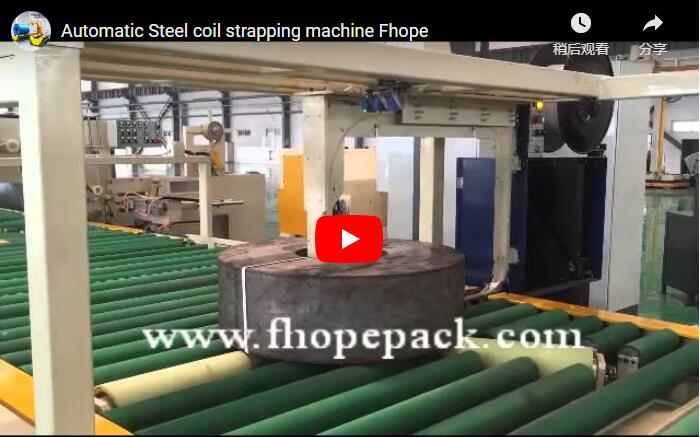
A steel coil holds its turns together only as well as the strap that binds it, and for coils that are lifted, moved or stored on edge, radial strapping is the binding pattern that keeps the pack intact. The steel coil radial strapping machine passes each strap through the coil eye and around the wall, clamping the turns together across the width. This page is written for coil mills, service centers and slitting plants deciding how to secure coils before transport. The demonstration video below shows a through-the-eye strapping cycle on a standing coil.
Radial vs Circumferential Strapping
The two coil strapping patterns secure different things, so the distinction decides which machine you need:
| Pattern | Strap path | What it holds |
|---|---|---|
| Circumferential | Around the coil’s outer diameter | The OD turns, keeping the edge in place |
| Radial (through-the-eye) | Through the coil eye and around the wall | The turns together across the width |
A radial strap runs from the coil eye across the wall to the outer edge and back, locking the inner turns to the outer ones. That is why radial strapping is the standard answer for coils that telescope or shift when lifted — the strap ties the whole cross-section, not just the edge.
How the Through-the-Eye Cycle Works
The machine guides the strap through the eye with a hinged track, so the coil itself stays upright on the machine base while the strap path is formed around it:
| Step | What happens |
|---|---|
| Position | The coil stands on the machine base with the eye at strap height |
| Track in | A guide track reaches into the coil eye and closes round the wall |
| Feed and tension | Strap runs through the track, is pulled tight against the coil |
| Seal and cut | The strap joint is sealed and the strap cut |
| Index | The track opens and the coil turns to the next band position |
In the footage the strap feeds through the track and around the coil wall, is tensioned against the pack, and the coil then indexes between bands so each radial strap lands at the correct spacing. The sequence repeats for the number of straps set for the coil.
Specifying a Radial Strapping Machine
Send the manufacturer the coil program so the machine and strap plan are matched to the actual pack:
| Input to give the manufacturer | Why it decides the setup |
|---|---|
| Coil OD, ID, width and weight | Sizes the machine base, track and strap head |
| Bands per coil and band spacing | Sets the indexing and strap program |
| Strap type and width | Confirms what the tensioner and sealer accept |
| Coils per hour | Confirms cycle time and automation level |
| How coils arrive (coil car, conveyor, crane) | Decides whether an upender or feed is needed |
The number of radial bands and their spacing are set per project and depend on coil width and wall. State your full coil range to the manufacturer; the band layout is confirmed per project rather than assumed from the video, which shows the cycle without recording coil dimensions or strap numbers.
Safety and Controls
Keep hands and tools clear of the track and the coil eye while the machine runs: the track closes with force to form the strap path, and the strap is tensioned under load. The operator panel provides the cycle, band-count and diagnostic controls. For CE markets, FHOPE uses ISO 12100 for the risk-assessment method and EN 415-10 as the general reference for packaging-machine safety; confirm the guarding and documentation for your destination.
FAQ
What does a radial strap do? It passes through the coil eye and around the wall, clamping the coil’s turns together across the width so the pack does not telescope when lifted.
Is radial strapping the same as circumferential? No. Circumferential strap runs around the outer diameter; radial strap goes through the eye — different pack, different machine.
How many bands should a coil get? Band count and spacing depend on coil width, wall and handling duty. State your coil program to the manufacturer and the layout is confirmed per project.
Does the coil rotate between straps? Yes. After each seal the track opens and the coil indexes to the next band position.
What do I need to specify? Coil OD, ID, width and weight range, bands per coil, strap type and width, coils per hour, and how coils arrive at the machine.
Next Step
Send the manufacturer your coil sizes and weights, target bands per coil and coils per hour via info@fhopepack.com; the proposal lead time depends on the scope you define. Then book a site survey to confirm coil handling and floor space.