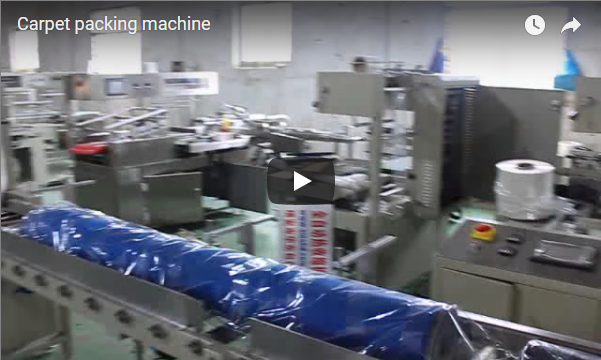
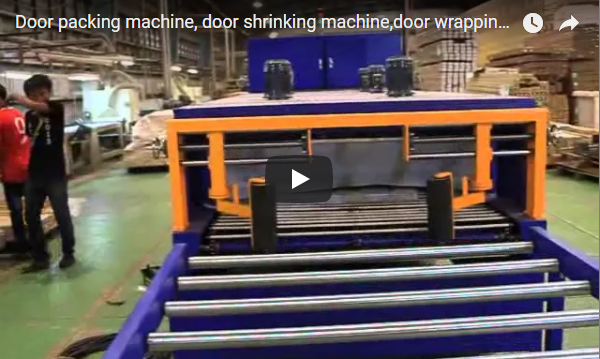
Executive summary This clip from our workshop shows our automatic sleeve shrink bundling machine packing water bottles. Bottles are grouped on the infeed, pushed into a clear PE film web, sealed into a sleeve and carried through the shrink tunnel, so each group leaves as one tight pack. For reference we give the data of our SK-060ABS sleeve bundler, rated 10–20 packs per minute. Below we set out the steps, the published data and a worked example for bottles per hour.
Table of Contents
- What the clip shows
- Sleeve pack or full enclosure
- SK-060ABS data
- Bottles per hour
- Selection checklist
- Safety
- Engineering FAQ
- Next step
- Related reading
- Sources
What the clip shows
The clip is filmed in portrait on our workshop floor.
| Step | What you see |
|---|---|
| Infeed | Upright water bottles with black caps run in on a green slat conveyor and are grouped into a block |
| Film | A clear film web hangs from an overhead roll in front of the group |
| Sleeve and seal | The group is pushed into the film and a sealing bar closes the film behind it, forming a sleeve |
| Shrink | The sleeved pack passes through red curtain doors into the shrink tunnel |
| Discharge | The pack leaves on a roller and mesh conveyor as one tight bundle, and an operator lifts it off |
The film is open at the two ends of the sleeve, so after shrinking each end shows a round “bull’s-eye” opening, which is normal for sleeve packs.
Sleeve pack or full enclosure
- Sleeve pack. Film wraps round four sides and the ends stay partly open. It uses less film and needs no under tray, which suits water and drink bottles.
- Full enclosure. Film closes all six sides, as on an L-bar sealer. It suits products that need dust protection on every face.
- With or without under support. Our sleeve machine can run bottles directly on the film or on a tray or pad, switched from the panel.
SK-060ABS data
Our SK-060ABS automatic sleeve shrink bundling machine is the reference model for bottle packs like these. Our published data:
| Item | Published value |
|---|---|
| Sealing type | Sleeve sealing |
| Pack patterns | 1×10, 2×5, 3×3, 3×4, 3×5 and others |
| Max product size | 280 (L) × 180 (W) × 150 (H) mm |
| Packing capacity | 10–20 packs/min |
| Film | PE film, max 350 mm wide, 280 mm roll OD |
| Power | Max 8 kW, 380 V 50–60 Hz 3-phase |
| Tunnel size at entrance (L × W × H) | 1,040 (L) × 355 (W) × 220 (H) mm |
| Working height | 850–900 mm |
| Air | ≤0.5 MPa (5 bar) |
| Control | Siemens PLC, conveyor speed by frequency converter |
The tunnel uses two blowers to spread heat evenly, and a cooling fan sets the film as the pack leaves.
Bottles per hour
Worked example (illustrative). At 15 packs per minute with a 3×4 pattern, the machine packs 15 × 12 = 180 bottles per minute, or 180 × 60 = 10,800 bottles per hour. At the 10 and 20 packs/min ends of the range, the same pattern gives 7,200 and 14,400 bottles per hour.
Selection checklist
- Bottle diameter, height and shape.
- Pack pattern (for example 3×4 or 3×5) and pack size against the 280 × 180 × 150 mm limit.
- Packs per minute from your filling line.
- With or without tray or pad.
- Printed film and whether you need print registration.
- Downstream palletising, such as a turntable pallet stretch wrapper for bottles.
Safety
The sealing bar and the hot tunnel are the main hazards. We guard the sealing area to the risk assessment and keep the tunnel shell and curtains between the operator and the heaters. For CE markets we apply ISO 12100:2010 for the risk assessment and EN 415-10:2014 for general packaging-machine requirements.
Engineering FAQ
Q: Which pack patterns can the machine make? A: Patterns such as 1×10, 2×5, 3×3, 3×4 and 3×5, changed with the bottle fixture and a switch on the panel.
Q: How many packs per minute? A: 10–20 packs/min, depending on pack size and pattern.
Q: What is the largest pack? A: 280 mm long, 180 mm wide and 150 mm high.
Q: What film does it use? A: PE film up to 350 mm wide on a roll up to 280 mm outer diameter.
Q: Does it need a tray under the bottles? A: No. It can pack with or without an under support.
Q: What power and air does it need? A: Up to 8 kW at 380 V 3-phase, and air at up to 0.5 MPa.
Q: Why are the pack ends open? A: It is a sleeve pack: film wraps four sides and shrinks to a round opening at each end.
Q: How is the film set after shrinking? A: A cooling fan sets the film as the pack leaves the tunnel.
Q: How is conveyor speed adjusted? A: By frequency converters, so speed can be set without steps.
Q: Which standards apply? A: For CE markets, ISO 12100 and EN 415-10.
Next step
We size a bottle shrink bundling machine in three steps:
- Submit your layout drawing with bottle sizes, pack pattern, packs per minute and your line layout, to info@fhopepack.com.
- Receive a proposal within 48 hours with the machine data and layout.
- Book a site survey so we confirm the floor space and the link to your filling line.
Related reading
- Bundle Sleeve Shrinking Machine
- Bottle Pallet Strapping Machine
- Automatic Bottle Turntable Pallet Stretch Wrapping Machine
- SK-060ABS sleeve shrink bundling machine
Sources
- Clip (our footage): the video on YouTube
- Pack patterns, sizes, capacity, film, power, tunnel, air and control data: SK-060ABS sleeve shrink bundling machine
- Bottles per hour: our worked arithmetic
- Standards scope: ISO 12100:2010; EN 415-10:2014
- Proposal timing: approved house CTA (proposal within 48 hours)
Last reviewed: 2026-10-10