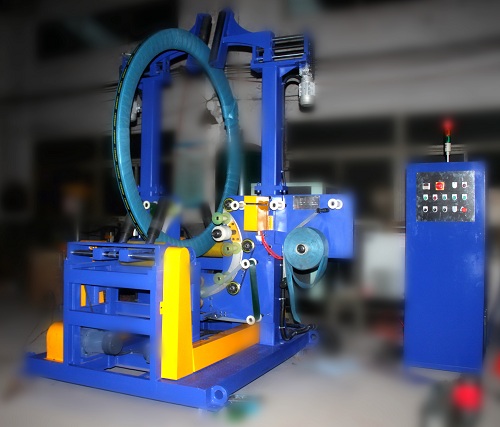
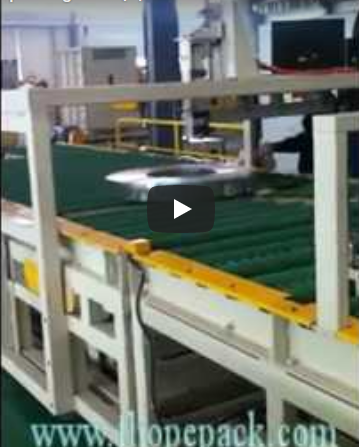
Executive summary This clip shows our horizontal spiral wrapper on large soft bales. Each bale rides a green belt conveyor through the yellow ring and is wrapped first in clear film, then in green film on later runs. When comparing spiral wrappers, the useful questions are film use per load, cycle time and how well the load is protected; below we show how to compare them on your own loads.
Table of Contents
- What the clip shows
- Points to compare
- Film per load
- What we set per load
- Selection checklist
- Safety
- Engineering FAQ
- Next step
- Related reading
- Sources
What the clip shows
| Step | What you see |
|---|---|
| Infeed | A large soft bale on a green belt conveyor |
| Ring | The yellow ring turns around the bale |
| Clear film | Bales wrapped in clear film |
| Green film | Later bales wrapped in green film |
| Outfeed | Wrapped bales leave on the belt |
Points to compare
| Point | How to compare |
|---|---|
| Film use | Metres per load at the same overlap |
| Cycle time | Seconds per load at your length |
| Protection | Ends covered, overlap even, no loose tail |
| Changeover | Time to switch film or load size |
Film per load
Worked example (illustrative).
| Item | Value |
|---|---|
| Bale length (illustrative) | 1,500 mm |
| Film width (illustrative) | 500 mm |
| Overlap (illustrative) | 50% |
| Advance per turn, 500 × 0.5 | 250 mm |
| Turns per bale, 1,500 ÷ 250 | 6 |
What we set per load
| Setting | Depends on |
|---|---|
| Ring size | Bale section |
| Film | Colour and pre-stretch |
| Overlap | Protection needed |
| Conveyor | Bale length |
Selection checklist
- Load length, width and height.
- Load weight and softness.
- Film colour.
- Loads per hour.
- End cover needed or not.
- Conveyor layout.
Safety
- Keep clear of moving stations.
- Stay outside the fence while the line runs.
- Lock out before clearing a jam.
- For CE markets, the machine is designed to ISO 12100 and EN 415-10.
Engineering FAQ
Q: What should I compare between spiral wrappers? A: Film use, cycle time, load protection and changeover time.
Q: How do I compare film use fairly? A: Measure metres per load at the same overlap.
Q: How many turns does a bale need? A: 6 spiral turns for a 1,500 mm bale in the worked example; end wraps are set per load.
Q: Can the film colour change? A: Yes, clear or coloured film as in the clip.
Q: Can soft bales be wrapped? A: Yes, the belt conveyor carries them through the ring.
Q: Which standards apply? A: For CE markets, ISO 12100 and EN 415-10.
Next step
We match a spiral wrapper in three steps:
- Submit your layout drawing with load sizes, weights and loads per hour, to info@fhopepack.com.
- Receive a proposal within 48 hours with the machine data and layout.
- Book a site survey so we confirm the conveyor line.
Related reading
- Copper Sheet Bundle Orbital Wrapping Line
- Board and Cabinet Horizontal Wrapping With Two Layers
- Horizontal Wrapper for Narrow Profiles on Rollers
- Orbital stretch wrapper
Sources
- Machine content: FHOPE engineering team, 2026-10-10
- Clip: the video on YouTube
- Film per load: our worked example, illustrative values
- Standards scope: ISO 12100:2010; EN 415-10:2014
- Proposal timing: approved house CTA (proposal within 48 hours)
Last reviewed: 2026-10-10