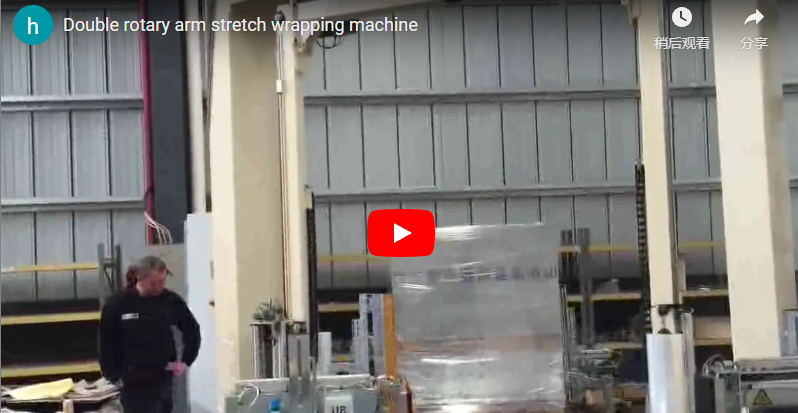
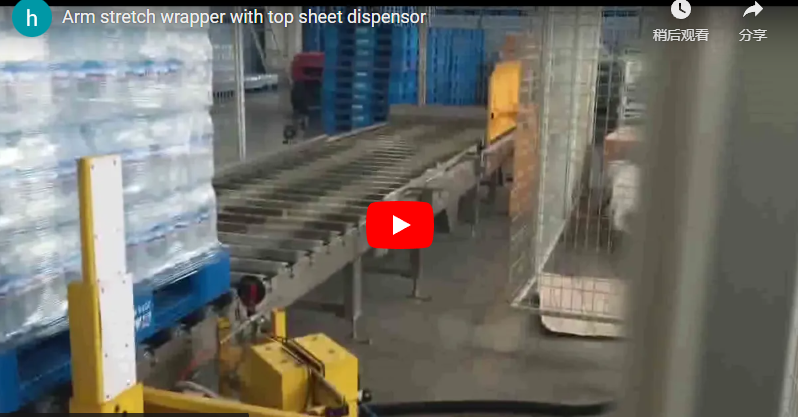
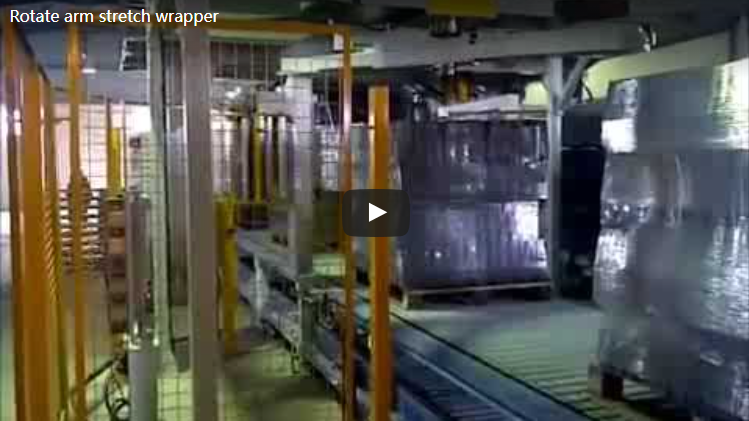
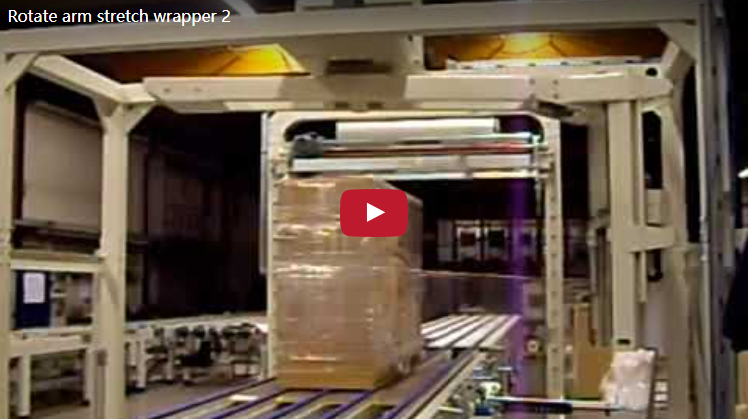
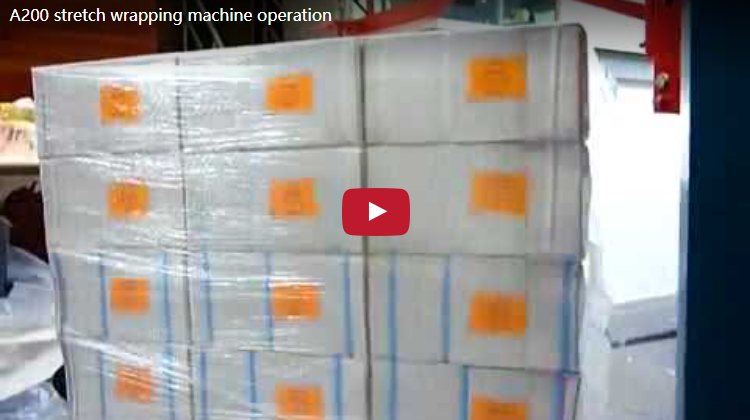
Executive summary A pallet wrapping machine for AAC and concrete blocks stretch wraps a heavy block pallet on the conveyor. A rotating arm carries the film around the load, so the pallet never has to spin. In this clip the wrap runs from about 108 s to about 144 s, ending with the film cut at the top. Our RAS100 automatic rotary arm stretch wrapper is rated for 10 to 30 pallets per hour and loads up to 1,400 × 1,400 mm, configured per project.
Table of Contents
- What the clip shows, in order
- Why block pallets suit a rotary arm wrapper
- Wrapping cycle time on the clip
- RAS100 specifications
- Takt check
- Selection checklist for a block pallet wrapping machine
- Controls and safety
- Engineering FAQ
- Next step
- Related reading
- Sources
What the clip shows, in order
The wrapper stands over a yellow conveyor: a red column frame with a cantilever beam, a silver film carriage and a blue drive unit under the beam. The load is a wooden pallet stacked about six layers high with white AAC or concrete blocks. Several visitors in hard hats watch and film the demonstration.
- 0 to about 84 s. The block pallet stands at the end of the conveyor and the machine is idle. Visitors walk around the pallet and one of them touches its edge while nothing moves. The conveyor then moves the pallet a little to the right.
- About 90 to 102 s. The pallet waits in the middle of the conveyor.
- About 108 s. The film carriage appears at the left-hand column and the machine starts.
- About 114 to 132 s. The carriage moves around the pallet and lays film onto its sides, building up several layers. The visitors stand to the right, clear of the arm.
- About 138 to 144 s. The wrap ends, the film is cut at the top and the arm returns to its start position. The pallet is covered in clear stretch film.
- About 150 to 210 s. The machine is idle again. The wrapped pallet is moved on the conveyor, and at the end two people adjust the load by hand while the machine stands still.
Why block pallets suit a rotary arm wrapper
AAC and concrete block pallets are heavy and square, and they arrive on a conveyor from the cuber or the packing line. A turntable would have to start and stop the whole pallet weight on every cycle. A rotary arm leaves the pallet on the conveyor and moves only the film carriage. The cycle then does not depend on the load weight, and the pallet is never lifted onto a turntable.
The film wrap holds the block layers together and keeps rain off the blocks in the yard. On our RAS100 the end of the cycle is automatic. A pneumatic film cut and wipe system cuts the film with an instant heating wire, wipes the tail onto the pallet with a soft brush and clamps the film for the next wrap.
| RAS100 element | Role |
|---|---|
| Rotating arm, 10 to 14 rpm | Carries the film around the still pallet |
| Film carriage, force set by a separate motor | Controls film force on the load |
| Pneumatic film cut and wipe | Cuts by heating wire, a soft brush wipes the tail on |
| Film clamp | Holds the film for the next cycle |
| Sensors and PLC | Unmanned automatic cycle |
Wrapping cycle time on the clip
| Step on the clip | Time window | Duration |
|---|---|---|
| Start, carriage to the pallet | about 108 to 114 s | about 6 s |
| Wrapping around the pallet | about 114 to 132 s | about 18 s |
| Last layers, film cut, arm home | about 132 to 144 s | about 12 s |
| Start to film cut | about 108 to 144 s | about 36 s |
A 36 s wrap sits well inside the RAS100 rating of 10 to 30 pallets per hour, which allows 120 to 360 s per pallet. The rest of the time goes to conveyor transfer in and out.
RAS100 specifications
| RAS100 automatic rotary arm stretch wrapper | Specification |
|---|---|
| Working mode | Automatic |
| Loads per hour | 10 to 30 pallets |
| Rotation speed | 10 to 14 rpm, variable by inverter |
| Max. load size | 1,400 × 1,400 mm |
| Film | LLDPE, 500 mm wide, 76 mm core |
| Wrap layers | Bottom, middle and top, 0 to 99 winds |
| Film end | Pneumatic cut and wipe, heating wire cut |
Takt check
For an illustrative block plant output of 20 pallets per hour, the takt is 3,600 ÷ 20 = 180 s. A 36 s wrap, as on the clip, leaves about 144 s for conveyor transfer, a strapping step and any top sheet. More winds for outdoor storage lengthen the wrap; set them against the takt at commissioning.
Selection checklist for a block pallet wrapping machine
- Pallet footprint within 1,400 × 1,400 mm, block stack height and weight.
- Pallets per hour from the cuber or packing line.
- Number of winds for yard storage, and whether a top sheet is needed.
- Strapping before or after the wrap.
- Conveyor height and direction, and the space for the arm’s swing.
- Fence, gate and operator position.
Controls and safety
The swing of the arm and the film carriage is the danger zone, and the conveyor adds nip points. On the clip the visitors stand clear while the arm turns; the pallet is touched and adjusted by hand only while the machine is idle. On a production line a fence keeps people out of the swing.
Stop, isolate and lock out the wrapper and the conveyor before anyone touches or adjusts the load, attaches film or works on the arm.
The standards that apply depend on the destination market. For CE markets, EN 415-6 covers pallet wrapping machines and ISO 12100 sets the risk-assessment method, which fixes guarding and the emergency-stop arrangement.
Engineering FAQ
Q: Why use a rotary arm instead of a turntable for AAC block pallets? A: The pallet stays on the conveyor and only the film carriage moves, so the heavy block load never has to spin. Our RAS100 turns at 10 to 14 rpm.
Q: How many block pallets per hour can it wrap? A: The RAS100 is rated for 10 to 30 pallets per hour, depending on the wrap programme. On the clip one wrap takes about 36 s.
Q: How is the film finished at the end of the cycle? A: A pneumatic system cuts the film with a heating wire, a soft brush wipes the tail onto the pallet, and a clamp holds the film for the next wrap.
Next step
We size a block pallet wrapping machine in three steps:
- Submit your layout drawing with the pallet footprint, stack height, weight and pallets per hour, to info@fhopepack.com.
- Receive a proposal within 48 hours, including the wrapper, the conveyor link and the cycle check against your takt.
- Book a site survey so we confirm the conveyor route, the fence layout and the power and air supply.
Related reading
- Automatic rotary arm stretch wrapper RAS100
- Rotary arm wrapping machines
- Semi-automatic rotary arm pallet stretch wrapper
- Pallet wrapping machine with top press
Sources
- Wrapper specifications and film cut system: RAS100 automatic rotary arm stretch wrapper product page
- Clip timing: frame timings taken from the clip, 6 s between frames
- Machine in action: our video on YouTube
- Standards scope: ISO 12100:2010, EN 415-6:2013
Last reviewed: 2026-10-05