Overview
Pallet stretch wrapping is the last, deciding step on a full-automatic packing line for wound cable coils: the coils are wound, wrapped, strapped and shrink-sealed, then palletized, and the loaded pallet is spiral-stretch-wrapped so the whole unit stays tight on the pallet through storage and transport. This guide explains how in-line pallet stretch wrapping works, how it fits the rest of the cable-coil packing sequence, and what to specify for a custom line. It is written for plant and production engineers and purchasing managers who decide between a manual wrap station and an in-line automatic wrapper.
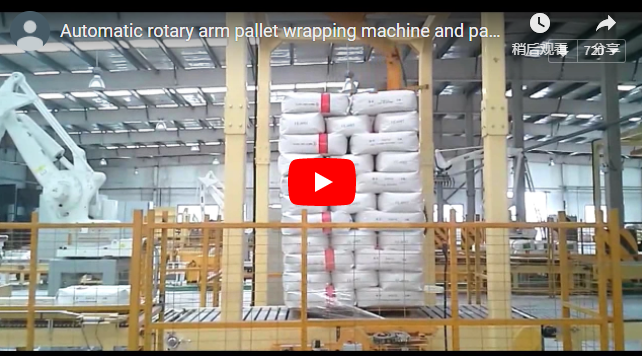
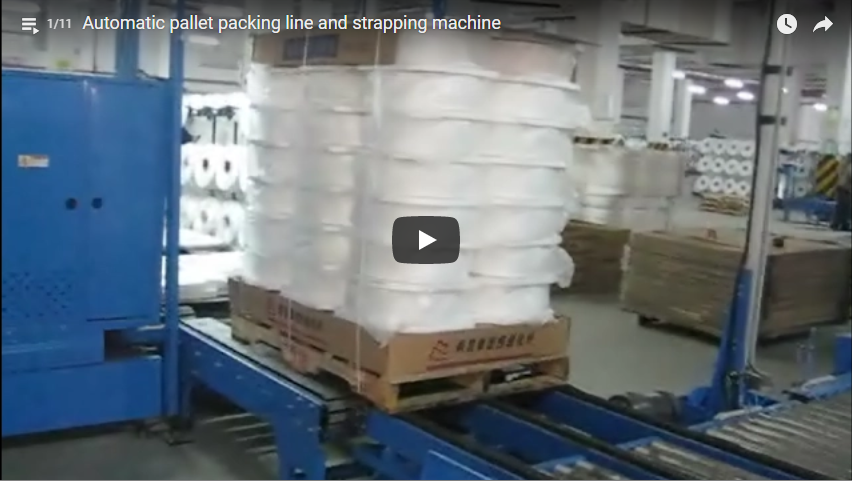
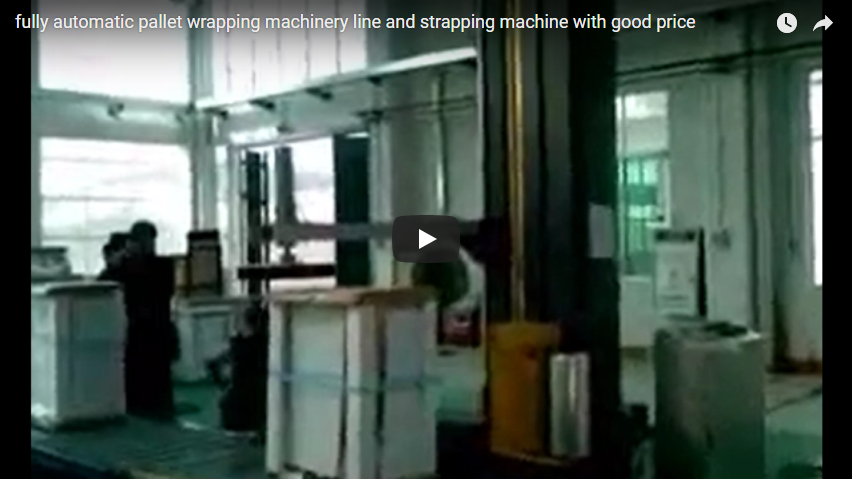
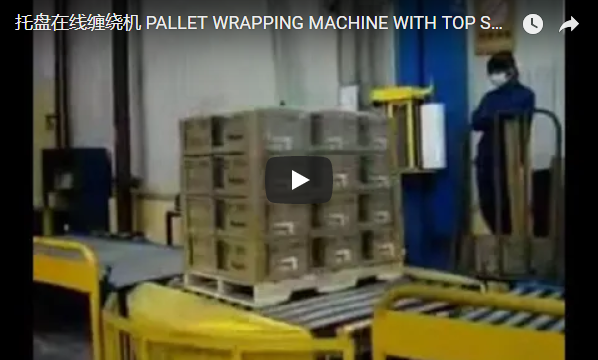
The video below shows a full-automatic online packing line where wound cable coils are wrapped on rotating stations before the loaded pallets are stretch wrapped:
The Packing Sequence Around the Pallet Wrap
Pallet stretch wrapping does not work alone on a coil line; it is fed by the stations that come before it. A full-automatic online line for cable coils runs through the sequence shown below:
| Stage | What happens |
|---|---|
| Coil winding | Cable or wire is wound into a coil on a coiling station. |
| Coil wrapping | Each coil is wrapped on a rotating wrapping station to protect its surface. |
| Strapping and sealing | Coils are strapped and, where required, shrink-sealed to keep the package stable. |
| Palletizing | A robot or gantry handler places the wrapped coils on a pallet in an approved pattern. |
| Pallet stretch wrapping | The loaded pallet enters the stretch wrapper; a film carriage rotates around it and applies several layers of pre-stretched film. |
| Discharge | The wrapped pallet leaves for storage or loading, unitized for the forklift and for transport. |
The pallet wrap is therefore the unitizing step: it turns a stack of loose coil packages into one load that can be handled, stored and shipped without re-work.
How an In-Line Pallet Stretch Wrapper Works
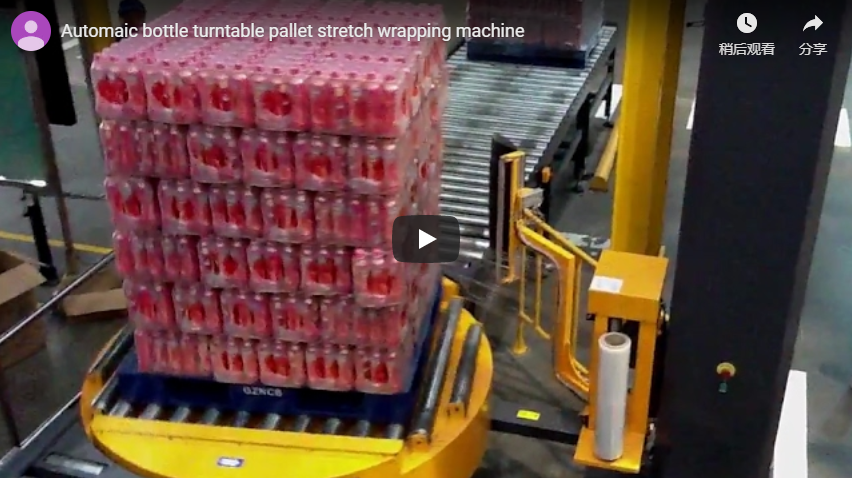
An in-line pallet stretch wrapper keeps pace with the line through a fixed automatic cycle. The key parts and their roles:
| Element | What it does |
|---|---|
| Conveyor entry | The loaded pallet is transferred into the wrapper at a fixed line height. |
| Film carriage | The film carriage carries the pre-stretch unit and the film roll. Depending on the machine type it rides on a rotating arm or ring that orbits a stationary pallet, or it is fixed on a vertical column while the pallet turns on a turntable. |
| Turntable or ring drive | The pallet is turned (or the ring orbits it) until the required number of layers covers the load sides. |
| Film clamp and cut | At the end of the cycle the film is clamped, cut and sealed to the load so the wrap does not peel. |
| Top coverage | A top sheet or additional layers can be applied for dust or weather protection. |
The result is repeatable tension and layer count per pallet, which is what manual wrapping cannot guarantee shift after shift.
What to Specify on a Custom Line
Give the manufacturer the parameters that decide the wrapper and the line:
| Input | Why it matters |
|---|---|
| Pallet size and maximum load height | Sets the wrapper opening and the film coverage pattern. |
| Pallet load weight | Sets the conveyor, turntable and motor ratings. |
| Coil size, weight and wrapping needs | Sets the earlier wrapping/strapping stations and the palletizing pattern. |
| Palletizing pattern and handler | Robot vs gantry decides the feed into the stretch wrapper. |
| Film type and prestretch | The film gauge and whether pre-stretch is used affect layer count and cost. |
| Layers per pallet and cycle time | Sets the wrapper speed so the line keeps pace with the coiler. |
| Floor space and line height | Sets the footprint and the conveyor levels. |
As with all custom machine builds, film choice, coil size and line speed requirements are confirmed per project before fabrication.
Factory Testing and Acceptance
Before a custom in-line wrapper ships, verify what was tested:
- Extended run record. Ask for a test log covering near-continuous cycling without leaks or thermal alarms. The maker’s stated pre-delivery practice on this machine family runs up to about 24 hours.
- Control and safety verification. Confirm the control system was tested for smooth, responsive operation, including the emergency stop, before delivery.
- Film-cycle test. Evidence that the stretch wrapper completed full cycles—film clamp, cut and seal—at the required layer count.
- Line handover test. Proof that the wrapped coil feeds, the palletizing and the stretch wrap pass hand over without jams.
- Commissioning scope. A clear written definition of installation, commissioning and local on-site service where available.
- Coil Upender & Industrial Turnover Solutions – Custom mechanical (≈1–60T) and hydraulic (≈1–100T) coil handlers that fit the same custom-line family.
- How 180° Turning Machines Work for Precast Components and Sheets – In-house turning machine kinematics and EN 415-10 / ISO 12100 safety references.
- Coil Packaging: Operation and Applications – The coil packing sequence for steel coils in the same product family.
On arrival, repeat the core checks on your floor—empty travel, a loaded film cycle, and the emergency stop—before bringing the line into production.
FAQ
Q: Does an in-line pallet stretch wrapper replace the whole packing line?
A: No. It is the unitizing step at the end. The coils still have to be wound, wrapped, strapped and palletized before the pallet enters the wrapper.
Q: How do you stop the film from peeling in storage?
A: The wrapper clamps, cuts and seals the film tail to the load at the end of each cycle. Top coverage can be added where shrink or dust protection is needed.
Q: Which is better, a turntable or a ring wrapper?
A: A turntable turns the pallet under a fixed film carriage; a ring orbits the carriage around a stationary pallet. The ring suits heavy or tall loads and inline flow without rotating the pallet. Your load weight, height and layout select the type.
Q: Do I need pre-stretch?
A: Pre-stretch uses the film more economically and gives more even tension. It usually pays off at continuous line speeds; confirm the film type and layer count with the manufacturer.
Q: What safety standards apply to the line?
A: The machine family is designed with EN 415-10 as the packaging-machinery safety reference and an ISO 12100 risk assessment for the moving film carriage and conveyor areas.
Next Step
Send your pallet size and load height, pallet weight, coil size and wrapping needs, palletizing method, film type and required cycle time, so the line can be sized and the pallet stretch wrapper specified on the approval drawing.