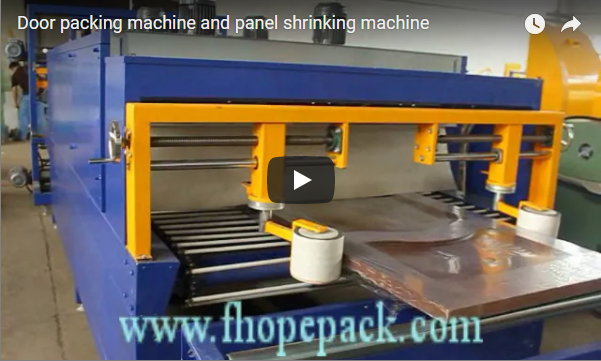
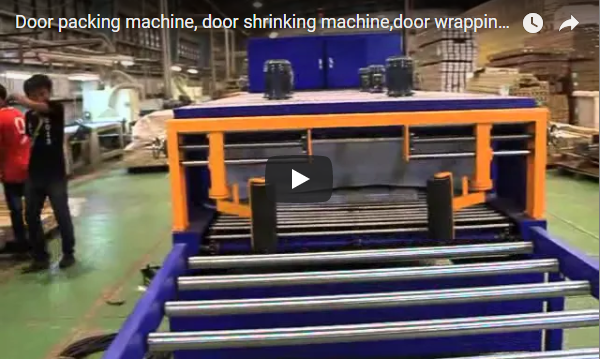
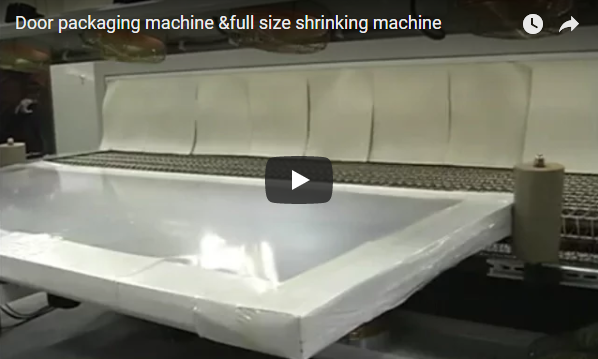
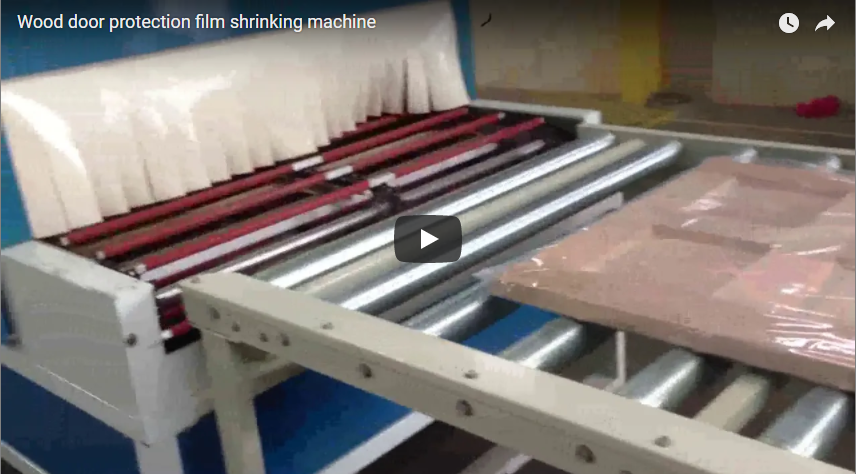
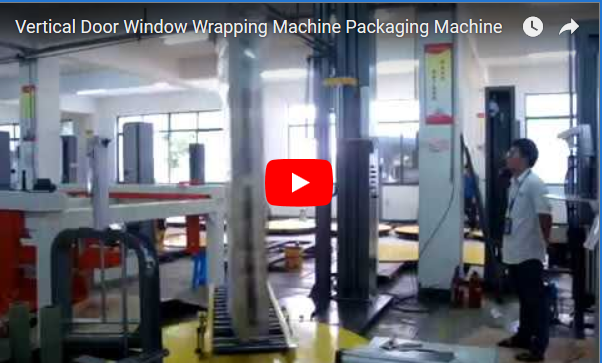
Executive summary Door makers often ship door panels and cores in stacks, so the film has to hold the stack together as well as keep it clean. Our automatic door shrinking machine in this video takes a stack of wooden door panels on a green belt, covers it in film, shrinks it, and passes it over a red roller section and a cooling roller section. Film width follows from the stack width and the stack height. We set both per project.
Table of Contents
- What the video shows
- How the door panel shrink cycle works
- Film width calculation for a panel stack
- The operator console
- Controls and safety
- Selection checklist for a door panel shrinking machine
- Engineering FAQ
- Next step
- Related reading
- Sources
What the video shows
Two workers set a stack of light wooden door panels on the green belt conveyor at the infeed. The stack travels into the machine, past the operator console with a colour touch screen, red, yellow and black buttons, and red indicator lights.
In the heating and pressing zone, clear film on the panels softens and starts to shrink. The stack then runs over a section of red rollers and on to silver rollers, where it cools. A second shot follows another stack through the red roller section to the silver rollers.
How the door panel shrink cycle works
| Stage | What happens |
|---|---|
| Infeed | The panel stack is set on the green belt |
| Film | The stack is covered in shrink film |
| Heat | Film softens and shrinks onto the stack |
| Heated rollers | The stack runs over the red roller section |
| Cooling | Silver rollers carry the stack while the film sets |
Cooling on rollers lets the film set before the stack is lifted, so the corners stay tight. For single boards and door plates, see our wooden board door plate shrinking packaging machine; for long profiles, see our automatic profile and panel bagging and shrinking line.
Film width calculation for a panel stack
The film has to cover the top and both sides of the stack with enough to close underneath. Illustrative example:
| Item | Value |
|---|---|
| Stack width (illustrative) | 800 mm |
| Stack height, 6 panels × 20 mm | 120 mm |
| Both sides, 2 × 120 | 240 mm |
| Closing allowance each side (illustrative) | 50 mm |
| Film width, 800 + 240 + 2 × 50 | 1,140 mm |
Taller stacks need wider film for the same panel width.
The operator console
| Item | What it does |
|---|---|
| Colour touch screen | Sets heat and speed |
| Start and stop buttons | Run and stop the line |
| Emergency stop | Stops the line at once |
| Indicator lights | Show heating and running states |
We set heat and speed on trial with your panels and film, then store the settings on the screen.
Controls and safety
The heating zone is hot, and the stack is still hot on the red rollers. Keep hands off the rollers and out of the heating zone while the machine runs, and clear a jam only when it has stopped and cooled.
The standards that apply depend on the destination market. For CE markets, ISO 12100 sets the risk-assessment method and EN 415-10 sets general requirements for packaging machines.
Selection checklist for a door panel shrinking machine
- Panel width, length and thickness.
- Panels per stack and stack height.
- Stacks per hour.
- Film type and thickness.
- Hand or automatic infeed.
- Floor space and power supply.
Engineering FAQ
Q: Why cool the stack on rollers? A: So the film sets before the stack is lifted and the corners stay tight.
Q: How wide should the film be? A: Stack width plus both sides plus closing allowance. Our 800 mm wide, 120 mm high stack needs about 1,140 mm.
Q: When can a jam be cleared? A: Only with the line stopped and the heating zone cooled.
Q: What is set at the touch screen? A: Heat and speed, stored after trials with your panels.
Q: How are stacks loaded? A: Two workers set them on the infeed belt in our video; automatic infeed is an option.
Next step
We plan your door shrinking machine in three steps:
- Submit your layout drawing with panel sizes, stack heights and output to info@fhopepack.com.
- Receive a proposal within 48 hours, with the film and heat plan.
- Book a site survey to check the line layout and floor space.
Related reading
- Door shrink wrap machine
- Video: door and panel shrink packaging machine
- Video: automatic door wrapping machine
Sources
- Machine content: FHOPE engineering team, 2026-10-04
- Film example: our worked example, illustrative values
- Machine in action: our video on YouTube
- Standards scope: ISO 12100:2010, EN 415-10:2014
Last reviewed: 2026-10-04