Overview
An automatic pipe and tube packing line lays rigid pipes and tubes onto a conveying track, moves them through a central bundling station where steel straps are applied, and delivers neat, stackable bundles at the outfeed — so long products stay together as one unit for lifting, storage and shipping. This complete guide covers why pipe and tube packing matters, how the line operates end to end, what to specify, and safety on the line. Pipe size, bundle dimensions and line layout are confirmed per project. It is written for plant engineers and pipe-line operators.
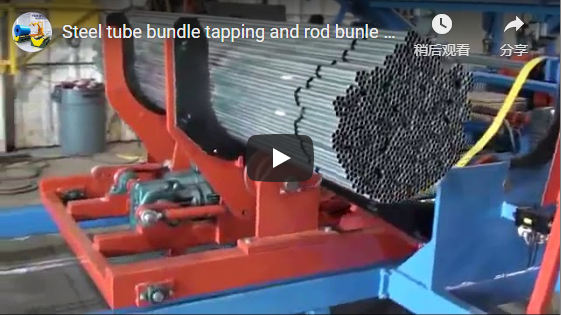
The video below shows the line in operation with operators at the feed and outfeed:
Why Bundle Pipes and Tubes
Long pipes and tubes spread out quickly on a production floor. Stacked loose, they roll, fan out at the ends and pick up surface marks before they reach the next process.
| Loose pipes on the floor | Strapped bundle |
|---|---|
| Roll and fan out at the ends | Stays together as one unit |
| Pick up surface marks before the next process | Surface stays clean and protected |
| Re-tying for each lift, store or shipment | Lifted, stored and shipped without re-tying |
The line forms the bundle in a single pass, so a run of pipes leaves the line neat without extra hand tying. Bundle size and strap pattern are confirmed per project.
How the Line Runs End to End
| Step | What happens |
|---|---|
| Infeed | Operators lay the tubes flat on the feed side of the track. |
| Convey | Rollers carry the tubes through the machine to the bundling station. |
| Bundle and strap | The bundling station forms each run into a bundle and applies the metal straps. |
| Outfeed | The finished bundle travels to the stacking section and is set down in order. |
| Control | A white cabinet with push buttons and indicator lamps starts and stops the line. |
Operators work at both ends of the line: one organizes the incoming tubes, the other checks the finished bundles. Each pass is supervised, and the operator confirms the bundle is seated before it leaves. Cycle timing and bundling settings are confirmed per project.
What to Specify
| Input | Why it matters |
|---|---|
| Pipe range | Diameter, length, wall thickness and end finish |
| Bundle | Bundle diameter, strap type, width and tension |
| Line | Feed speed, strapping dwell and stacking height |
| Material handling | Soft or flexible pipe is buffered before strapping so the band does not cut the wall |
| Control and guarding | Panel layout and guarding around the line |
| Site | Floor space and access at both ends; electrical supply on site |
Rigid plastic and PVC pipe runs can be processed with the matching guide and strapping tooling. Everything is confirmed per project with your batch details.
Factory Testing and Acceptance
- Full-cycle evidence. Ask for a test log of complete bundle-and-strap passes at the required strap pattern.
- Extended run. The vendor’s stated practice on this machine family includes near-continuous pre-delivery testing (up to about 24 hours where stated).
- Control and safety. Confirm smooth, responsive control, a verified emergency stop, and guarding around the rollers and the bundling station.
- Bundle integrity. Evidence that the straps hold the bundle without cutting soft pipe walls during testing.
- Commissioning. Written installation, commissioning and on-site service scope.
- Hose Coil Wrapping and Strapping: Solutions for Industry – Wrapping and strapping flexible hose in the same family.
- Partial Film Wrapping and Packing by Orbital Wrapper – Film wrapping of long bundles where a cover is needed.
On arrival repeat: empty pass, loaded pass, emergency stop.
FAQ
Q: What does the line do?
A: It feeds pipes and tubes through the line, forms each run into a bundle and applies metal straps before the bundle leaves the outfeed.
Q: Do we load each pipe by hand?
A: Operators position the tubes by hand on the infeed; the machine conveys, bundles and straps them automatically.
Q: How is the bundle strapped?
A: Each tube run is formed into a bundle as it passes through the bundling station, and the straps are applied in the same step.
Q: What products can it process?
A: Rigid plastic tubes such as PVC, PE and PP run with the matching guide and strapping tooling; softer or flexible pipe is buffered before strapping. The tube family, diameter and wall thickness are confirmed per project.
Q: What safety standards apply?
A: The machine family is designed with EN 415-10 as the packaging-machinery safety reference and an ISO 12100 risk assessment for the conveying and bundling station. Certification and drawing-level compliance are verified items at FAT, not pre-issued certificates of this unit.
Next Step
Send pipe and tube diameter, length, wall thickness and end finish, plus your bundle and line requirements, for a packing line proposal and line layout confirmation.