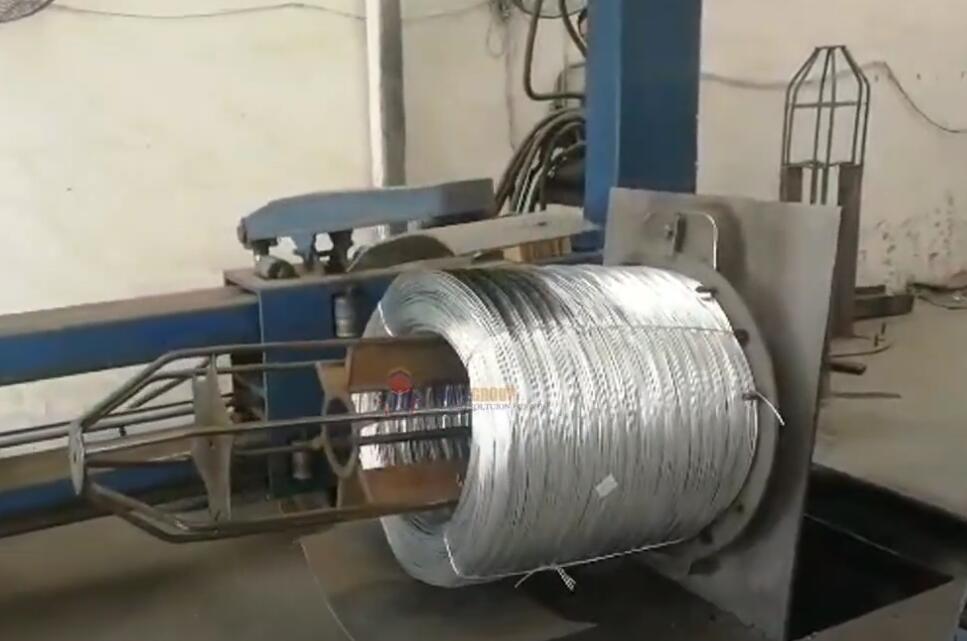
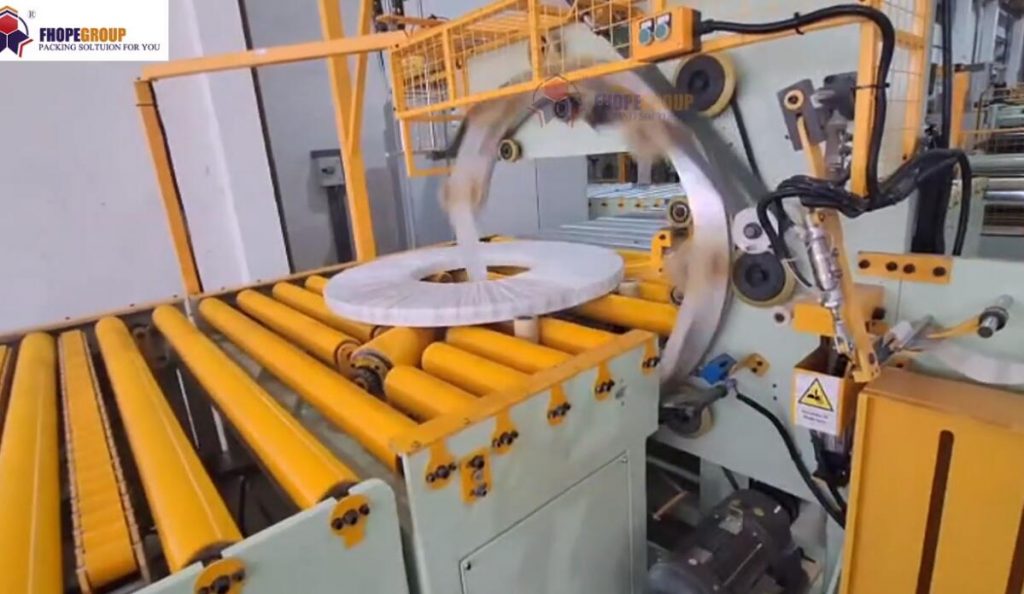
A ring-type tape banding machine secures cartons and small bundles by winding self-adhesive tape bands around the product inside a turning ring, eliminating the need for metal seals or welded joints. This method is designed for hand-presented operations where an operator positions the carton, allowing the machine to apply crossing bands for stability. The configuration is not a fixed off-the-shelf product but is matched to your specific carton dimensions, weight, and tape requirements per project.
Overview
This guide explains how ring-type tape banding works for manual packing stations. It details the mechanical action, the advantages over traditional strapping, and the specific data required to configure a machine for your production line.
How the Ring-Type Banding Process Works
The core mechanism involves a grey upright ring mounted on a compact frame, with the tape roll positioned at the base. The process begins with an operator holding a carton or small bundle inside the ring. The ring then rotates, winding a tape band around the product. Once the first band is complete, the machine cuts the tape. The operator then shifts the carton or rotates it, and the ring adds a second band in the perpendicular direction. This cycle repeats until the required number of bands is applied. The result is a carton that leaves with several crossing tape bands.
Why Choose Tape Bands Over Traditional Strapping?
Selecting tape bands over steel or plastic strapping offers distinct operational advantages for cartonized goods.
No Seals or Welds Required
Traditional strapping often requires metal seals or heat-welded joints to secure the strap. Tape bands hold themselves through adhesion, removing the need for these additional components. This simplifies the hardware and reduces the risk of loose seals becoming debris in the packing area.
Gentle on Cardboard
Flat tape bands distribute holding force across a wider surface area compared to narrow strapping. This prevents the band from cutting into the cardboard edges or crushing delicate packaging. For high-value or fragile goods, this gentle pressure maintains the integrity of the carton during transit.
Fast Changeover
In a hand-presented setup, changing the band position is immediate. The operator simply moves the carton to the desired location within the ring.
Compact Footprint
The ring-type machine sits on a small frame that can be placed directly next to the packing table. This minimizes the space required in the packing station, keeping the workflow efficient without requiring large dedicated machinery zones.
Tape Consumption and Calculations
Tape usage is determined by the carton dimensions and the number of bands applied. The source text provides an illustrative calculation for a carton measuring 400 × 300 × 250 mm. This example is arithmetic and not a measured performance result of a specific machine.
| Item | Value |
|---|---|
| Carton (illustrative) | 400 × 300 × 250 mm |
| Band round the length, 2 × (400 + 250) | 1,300 mm |
| Band round the width, 2 × (300 + 250) | 1,100 mm |
| Two bands each way, 2 × 1,300 + 2 × 1,100 | 4,800 mm, about 4.8 m of tape plus the end overlap of each band |
The total tape length includes the girth of the carton multiplied by the number of bands, plus an overlap at the end of each band to ensure adhesion. Actual consumption will vary based on the specific carton size and the number of bands required for stability.
Configuration Parameters Set Per Project
The machine is not a single fixed model. Instead, the configuration is tailored to your specific production needs. The following parameters are set per job:
- Ring Size: Determined by the largest carton or bundle section that needs to pass through the ring.
- Tape Type: Selected based on whether paper or film tape is preferred, and whether printed or plain tape is required.
- Bands per Carton: Determined by the carton weight and handling requirements. Heavier items may require more bands or specific banding patterns.
- Loading Method: The machine can accommodate hand-held loading or table-fed loading through the ring.
Selection Checklist for Buyers
To receive a valid configuration proposal, you must provide the following data points. Without this information, a specific machine cannot be defined.
- Largest and smallest carton or bundle section dimensions.
- Carton weight range.
- Required number of bands per carton and their directions.
- Preference for paper or film tape, and whether printed tape is needed.
- Target cartons per hour (throughput requirement).
- Available space at the packing table.
Safety and Design Standards
Safety is a primary consideration in the design and operation of ring-type banding machines.
Operational Safety
Operators should hold the carton by its outer faces and keep fingers clear of the ring path while it turns. For heavier items, a support table should be used through the ring to reduce strain. Loose sleeves and gloves must be kept away from the rotating ring to prevent entanglement. The machine should be stopped before changing the tape roll.
Design Standards
For markets requiring CE compliance, the machine is designed to ISO 12100 and EN 415-10. ISO 12100 provides the framework for risk assessment, while EN 415-10 covers safety requirements for packaging machines. It is important to note that these are design references. Certification of a delivered machine is confirmed in the project ordering agreement; the supplier does not claim a certificate independently.
Engineering FAQ
What does a tape banding machine do?
It winds a tape band round a carton or small bundle held inside a turning ring.
Does it need seals or a strapping head?
No. The band holds by itself, with no metal seal or welded joint.
How much tape does a carton use?
Carton girth times the number of bands, plus an overlap per band. For example, two bands each way on a 400 × 300 × 250 mm carton take about 4.8 m plus overlaps in the worked example.
Can it band in two directions?
Yes. The operator turns the carton and the ring adds bands across the other way.
Which tapes can it use?
Paper or film tape, set per job.
Which standards apply?
For CE markets, ISO 12100 and EN 415-10 are used as design references.
Next Step
To obtain a real configuration for your packing line, you must provide specific technical data. We reply with a proposal after we confirm the details.
Please send the following information to info@fhopepack.com:
- Layout drawing of your packing table.
- Carton or bundle sizes (largest and smallest).
- Carton weights.
- Required cartons per hour.
- Preferred tape type (paper or film).
Once these details are confirmed, the engineering team assesses how the ring-type unit integrates with the edge of your packing table, using the layout drawing and the carton dimensions you supply, and then issues a machine data sheet together with a station layout proposal.