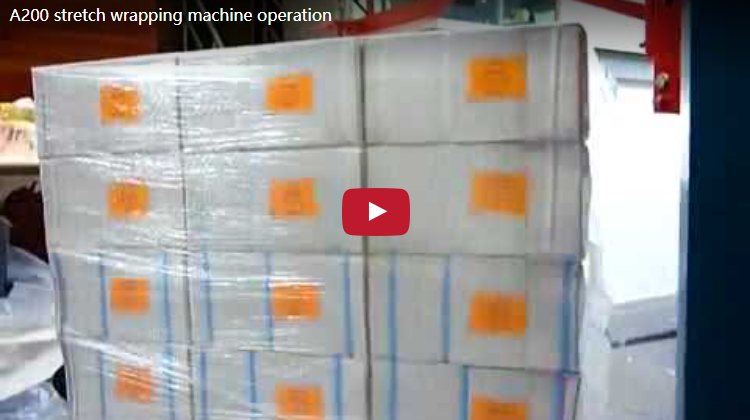
Executive summary Bottled drinks shift on a pallet in transport unless the layers are held tight with film. Our turntable wrapper in this video takes full beverage pallets in on a yellow roller turntable, spirals film round them and sends them out on the conveyor. Film per load follows from the load perimeter times the turns, and the turns from the load height.
Table of Contents
- What the video shows
- How a beverage pallet is wrapped
- Film per load
- Controls and safety
- Selection checklist for a beverage pallet wrapper
- Engineering FAQ
- Next step
- Related reading
- Sources
What the video shows
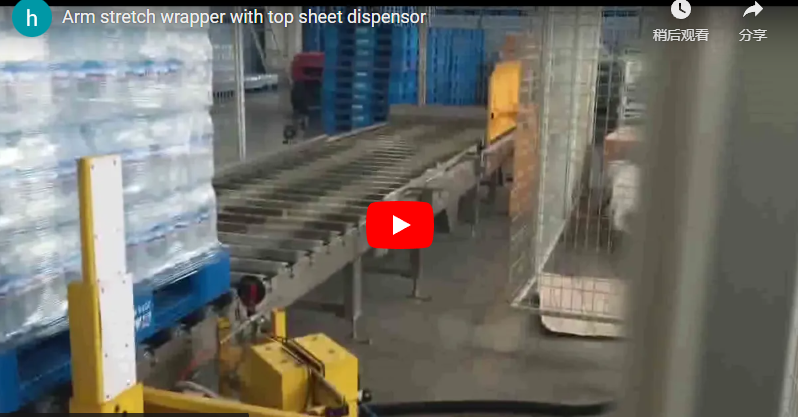
Pallets of bottled drinks arrive on the roller conveyor and stop on the yellow roller turntable. A yellow column with a white film roll stands beside it, and a yellow guard rail runs round the work area.
In the first part of the video the turntable turns with the column waiting while staff walk the line and a forklift passes in the background. In the second part a pallet comes in, the turntable turns and the carriage lays film round the load in a spiral, and the wrapped pallet is carried off onto the outfeed conveyor. A large display screen stands to the left.
How a beverage pallet is wrapped
Times are read from the video timestamps, second part of the video.
| Step | What happens | Video time |
|---|---|---|
| Infeed | A full pallet arrives at the turntable centre | about 60–76 s |
| Ready | The turntable waits for the wrap to start | about 76–84 s |
| Wrap | The turntable turns and film is laid in a spiral | about 84–96 s |
| Outfeed | The wrapped pallet leaves on the conveyor | about 96–104 s |
In the video one pallet takes about 44 s from arrival to exit, 60 to 104 s. The roller turntable is part of the conveyor line, so pallets pass straight through.
Film per load
Illustrative example:
| Item | Value |
|---|---|
| Load footprint (illustrative) | 1,200 × 1,000 mm |
| Perimeter, 2 × (1,200 + 1,000) | 4,400 mm |
| Load height (illustrative) | 1,500 mm |
| Film advance per turn (illustrative) | 250 mm |
| Spiral turns, 1,500 ÷ 250 | 6 |
| Extra turns: 1 top + 2 bottom (illustrative) | 3 |
| Film laid, 9 × 4.4 m | about 39.6 m |
That is film laid on the load; pre-stretch means the roll pays out less.
Controls and safety
The turntable turns a full pallet and pallets move on powered conveyors. Keep outside the yellow guard rail while the machine runs, and step in only when the cycle has stopped. For pallet wrapping machines, EN 415-6 adds the specific safety requirements.
The standards that apply depend on the destination market. For CE markets, ISO 12100 sets the risk-assessment method and EN 415-10 sets general requirements for packaging machines.
Selection checklist for a beverage pallet wrapper
- Pallet size, load height and heaviest load.
- Film plan: turns, top and bottom wraps.
- Pallets per hour from the filling line.
- Conveyor height and flow direction.
- Top sheet for dust or rain.
- Label or scanner after wrapping.
Engineering FAQ
Q: Why wrap beverage pallets? A: Film holds the bottle layers together so they do not shift in transport.
Q: How much film does a pallet take? A: Turns times perimeter: 9 × 4.4 m gives about 39.6 m laid in our example.
Q: How many spiral turns are needed? A: Load height over film advance per turn: 1,500 ÷ 250 mm gives 6, plus top and bottom turns.
Q: Which safety standard applies? A: For CE markets, EN 415-6 covers pallet wrapping machines.
Q: Can it keep up with my filling line? A: Send the pallets per hour and load sizes and we size the wrapper and conveyors.
Next step
We plan your beverage pallet wrapper in three steps:
- Submit your layout drawing with pallet sizes, heights and weights to info@fhopepack.com.
- Receive a proposal within 48 hours, with film plan and pallets per hour.
- Book a site survey to check conveyor layout and links.
Related reading
- Automatic pallet wrapping machine
- Video: automatic bottle turntable pallet stretch wrapping machine
- Video: bottle pallet strapping machine
Sources
- Machine content: FHOPE engineering team, 2026-10-04
- Pallet wrapper safety: EN 415-6
- Film example: our worked example, illustrative values
- Machine in action: our video on YouTube
- Standards scope: ISO 12100:2010, EN 415-10:2014
Last reviewed: 2026-10-04