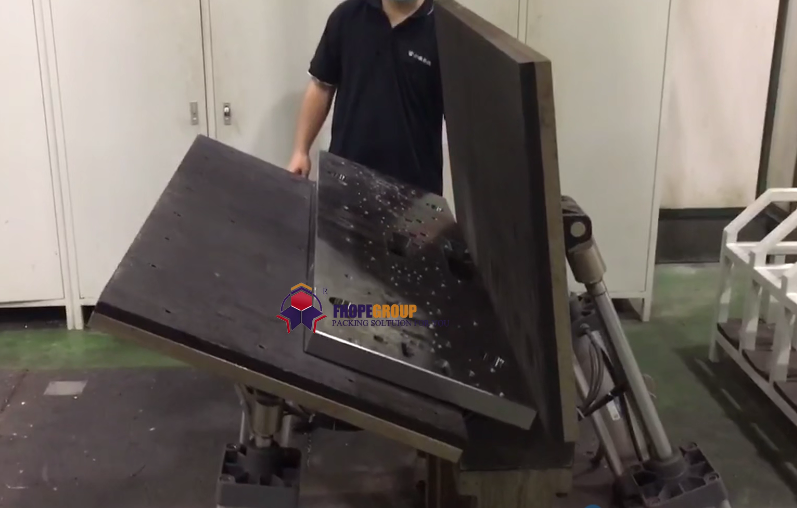
Executive summary: This roughly 138-second factory clip follows a heavy steel plate through an automatic plate turnover machine: the plate is clamped upright, tilted through a flip, and set down flat on the machine’s yellow turnover platform, while workers stay close to the machine. That machine-driven flip of a heavy steel plate is what the footage actually shows. What the clip does not prove is the equipment’s rated load capacity, the exact rotation angle (90° or 180°), clamping force, positioning accuracy, or any safety benefit over crane rigging — confirm those numbers with the manufacturer before you specify this machine.
This guide is written for plant engineers, safety officers, and procurement teams evaluating an automatic plate turnover machine to replace manual or crane-assisted flipping of heavy steel plates. It walks through what the video shows frame by frame, what it does not show, and the exact questions to put to the manufacturer before committing to an equipment decision.
What the video shows
The footage is a single static demo of an automatic plate turnover machine in a workshop. The frames below were sampled every 4 seconds from the 138-second clip, so each timestamp range below maps to a phase of the recorded sequence.
- ≈0–64 s (f_001–f_016): upright clamping holds the plate. A large steel plate stands clamped in the machine’s C-frame, roughly vertical, held firmly between clamping faces. The machine is red and black with an arc-shaped clamp section, and a yellow turnover platform sits below. Blue plastic pallet trays holding metal coils, rings, and cylinders are scattered nearby, along with loose tools and material.
- ≈64–100 s (f_017–f_025): the plate is tilted through the flip. The clamped plate is no longer vertical; it is captured at an intermediate tilted angle, mid-turn, between the upright position and the horizontal. This is the only place in the clip where the “turnover” action is actually visible.
- ≈100–136 s (f_026–f_034): the plate is set down flat. The red plate settles onto the yellow turnover platform in a horizontal position, still in one piece and under mechanical control.
- ≈137 s (final frame): finished state. The heavy plate rests flat on the yellow platform and workers are visible near the machine in the workshop.
The repeatable message of the footage is that a machine clamps, tilts, and lays down a heavy steel plate under power. Every quantity attached to that action — angle, weight, speed, cycle time, safety ratings — is absent from the visible material.
Direct observation notes
These points stay close to the visual evidence, with only light editing:
- The machine is turnover-type equipment: a clamp/C-frame section that holds the plate plus a tilting steering mechanism and a yellow turnover platform. Structure reads vary slightly between frames (C-frame versus platform views); treat it as a turnover-type plate flipper, not a specific catalog model.
- Branding on the machine body reads FHOPE GROUP across the early and middle frames (spelled out F-H-O-P-E-G-R-O-U-P clearly in several frames); the final frames only show the “GROUP” portion. Other letter variants seen in single frames are the same name read at lower resolution and are not treated as separate brands.
- The workpiece is a large metal plate with a red-toned surface, clamped in one orientation and flipped; no dimensions, weights, or grade markings are readable anywhere in the footage.
- Every sampled frame is static: each shows the machine and plate stationary. A still frame cannot on its own prove smooth, continuous, or high-speed rotation.
- Workers appear near the machine in several frames (white workwear; occasionally red gloves) but are never shown performing the flip by hand — the flip itself is machine-driven.
- No control panel or HMI readout is legible at video resolution, and no numeric nameplate appears.
- Wall banners carry Chinese safety phrases (for example, “注意安全” meaning “be careful / pay attention to safety”). These are wall décor, not equipment claims, and are not treated as facts.
What the title promises vs what the footage proves
| Claim (title / manufacturer block) | Visible in footage? | Verdict |
|---|---|---|
| Automatic plate turnover machine | FHOPE GROUP-branded flipper clamps, tilts, and lays the plate down | Supported by the clip |
| Flips heavy steel plates | A large steel plate is flipped under machine power | Supported by the clip (single-plate demo) |
| Secure plate clamping (prevents slipping) | The plate is visibly clamped while upright and while tilted | Clamping witnessed; anti-slip performance verified with manufacturer |
| Controlled turnover at 90° or 180° | Tilt is visible; the exact angle is not measurable in stills | Verify with manufacturer |
| Heavy load capacity, continuous industrial use | One plate is handled on camera; no ratings shown | Verify with manufacturer |
| Reduced crane dependence (replaces rigging and crane flipping) | The machine, not a crane, performs the flip | Mechanism witnessed; the saving is verified with manufacturer |
| Stable positioning (stops at the required angle) | Plate ends up flat on the platform | End state witnessed; accuracy verified with manufacturer |
| Improved operator safety | Workers still stand beside the machine; no guard/interlock visible | Verify with manufacturer |
The video convincingly demonstrates the physical flip. It does not demonstrate the engineering numbers behind the promises, which is exactly where purchasing teams should press for data.
What the video does not show
For a safe specification decision, the following are not observable in the footage and must be confirmed with the manufacturer:
| Missing information | Why it matters |
|---|---|
| Exact rotation angle (90°/180°) and how it is configured | Determines whether the machine fits your required plate orientation change |
| Clamping force and anti-slip design | Whether heavy, slippery plates can be held without shifting mid-flip |
| Plate size and weight range (max/min) | Whether the clamp and platform match your plate mix |
| Rated load capacity and duty rating | Continuous-use capability for production, not just a demo |
| Cycle time per flip | Throughput planning for your line |
| Quantified reduction in crane/mannual rigging usage | The basis of the “reduced crane dependence” claim |
| Positioning accuracy and end-stop control | Repeatability for downstream machining or stacking steps |
| Safety interlocks, guarding, and certifications | The real content of the “improved operator safety” claim |
| Control system and HMI details | Integration with existing line controls |
| Floor space, clearance, and installation requirements | Building and layout constraints |
The clip never shows a second flip in sequence, a different plate size, or the machine under load beyond the single visible piece. Treat the footage as a demonstration, not a production audit.
How the automatic plate turnover machine works, as filmed
Watching the sampled frames in order, the sequence is: the plate stands clamped in the machine’s clamp section; the machine tilts the clamped plate from the upright toward the horizontal; and the plate ends lying flat on the yellow turnover platform at the end of the clip. There is no hand involvement in the flip and no visible sling or crane during the turnover itself.
Because every frame is a still, the video demonstrates the end states of each step rather than the smoothness or speed of motion. Ask the manufacturer for the drive, tilt-cylinder/gear mechanism, and positional feedback details, and request a live demonstration with a plate close to your own specification to confirm the motion quality the stills cannot show.
Where operator safety stands in the footage
The title frames the machine around “safely,” so it is worth being precise about what the footage can and cannot support. The workers seen beside the machine are present but are not shown operating a control console, and the flip motion itself is machine-driven, which is consistent with reduced manual handling. However, no safety guarding, no interlock, and no protected operator zone is visible in any frame, and the wall slogans are decoration rather than engineering. The actual safety case — interlocks, guarding, emergency stop, load-monitoring, and risk assessment — has to come from the manufacturer’s documentation, and it should be reviewed before any comparison with crane-based flipping is accepted.
Buyer’s verification checklist
Use this as a short pre-order checklist:
- Confirm the plate size and weight range (max/min) the machine accepts.
- Confirm the rotation angle (90° or 180°) and how it is set for each job.
- Ask for clamping force figures and the anti-slip design for slick plates.
- Request rated load capacity and duty rating for continuous operation.
- Ask for measured cycle time per flip.
- Request the quantified reduction in crane and manual rigging usage.
- Confirm positioning accuracy and end-stop control for downstream steps.
- Review safety interlocks, guarding, and certification documents.
- Request the control system and HMI documentation for line integration.
- Ask for a trial or demo with plates matching your own dimensions.
FAQ
Does the video prove 90°/180° rotation? No. The clip shows the plate being tilted through a flip, but it is impossible to measure the exact rotation angle from still frames. Confirm the angle and its adjustment range with the manufacturer.
What plate sizes and weights can it handle? No dimensions, weights, or load ratings are readable in the footage. Provide your plate sizes and weights to the manufacturer for a capacity check.
Is the flip fully automatic? The clamp-tilt-laydown sequence is machine-driven on camera. Whether controls, positioning, and safety interlocks are fully automatic in the configuration you order must be confirmed with the manufacturer.
Does it completely replace crane flipping? The machine performs the flip itself in the footage, which supports reduced manual rigging. The extent of the saving and any remaining material-handling steps must be confirmed with the manufacturer’s figures.
Is it safe to operate? The footage does not demonstrate safety engineering — no guarding or interlock is visible. Request the interlock, guarding, emergency-stop, and certification documentation before finalizing a decision.
Where can I confirm the specifications and get a quote? Use the contact page below and send your plate dimensions, weight range, and target cycle time so the manufacturer can supply the load, angle, positioning, and safety data that the video does not show.
Related reading
- Coil upender
- Stationary pallet inverter
- Mobile pallet inverter
- Mold upender
- Mold flipper
- Hydraulic handling equipment
Next step
If an automatic plate turnover machine matches your plate-handling requirements, the fastest next step is a short technical exchange: send your plate dimensions, weight range, and target flip angle or cycle time, and ask specifically for the load, positioning, and safety data this video does not show. Visit the contact page to start the conversation or to arrange a live demonstration with plates close to your own.
Published: 2026-09-16