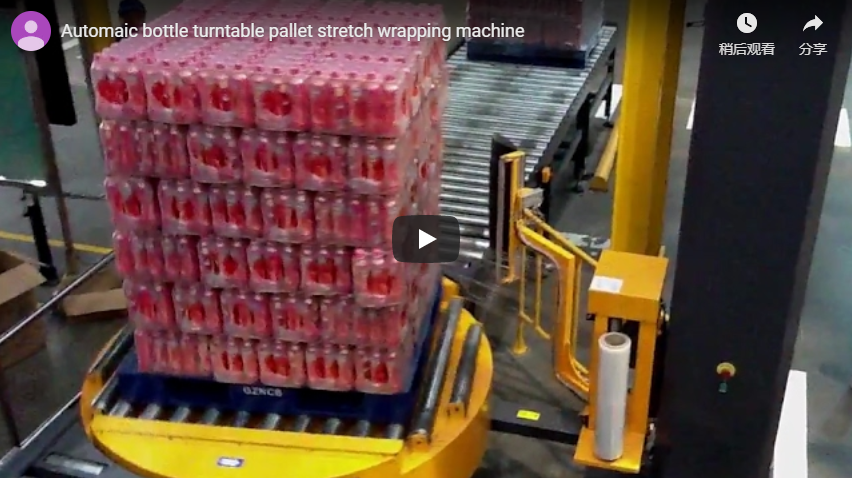
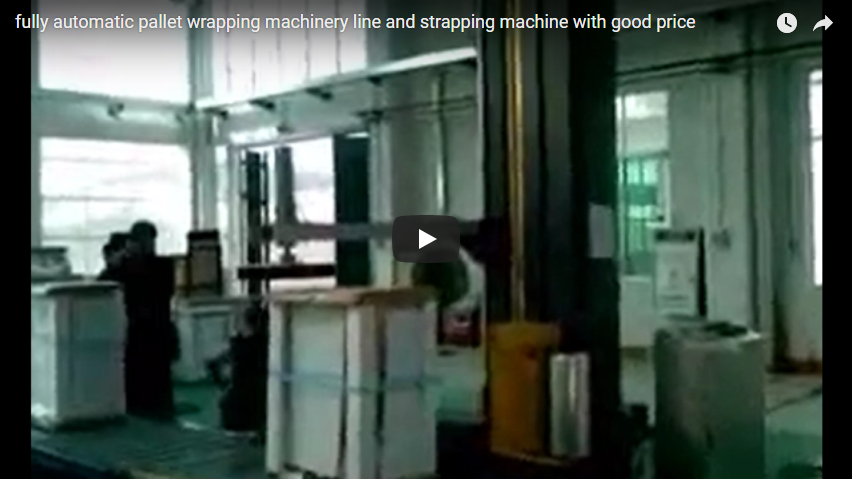
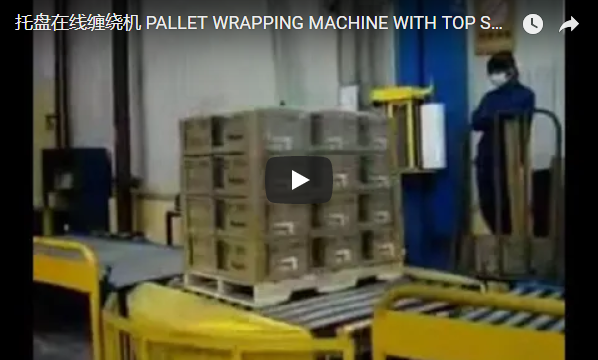
> **Executive summary** — The video shows a semi-automatic turntable pallet wrapping machine with a mast film carriage and a top press wrapping a stack of brown cartons on a wooden pallet. The load turns on a yellow platform while the carriage travels up and down a white mast. We build this class of machine in our A600 and A200 range, specified per project. Below: how the wrap is built up, the specified ranges of our A200 semi-automatic range, film and roll math, safety notes and a selection checklist.
Table of Contents
- How the wrap is built up
- What the top press does
- Specified ranges, configured per project
- Film and roll math
- Controls and safety
- Selection checklist
- Engineering FAQ
- Next step
- Related reading
- Sources
How the wrap is built up
The recording opens with close-ups of a gloved hand holding a tape measure upright against cartons that are already under clear stretch film. Film is already on the load when the recording opens, so the first layers of the wrap are already in place when the sequence begins.
This is a semi-automatic station rather than an automated cell. A semi-automatic station relies on the operator to start each cycle close to the machine; nobody stays on the operator side after the turntable starts rotating.
Through the main sequence the load turns on the yellow platform and the film carriage travels up and down the white mast. The carton stack shows a different face from frame to frame and the carriage sits at a different height each time, which is how film goes on in an even spiral. Late in the recording the carriage is still travelling on the mast.
One detail worth knowing about this machine class: the load turns and the carriage travels, and film per revolution follows the perimeter of the stack rather than the length of one side.
What the top press does
For most of the sequence a dark device sits on top of the load in the top-press position. A top press holds a light, tall or unstable load from above while the table turns, so the stack is steadier while film goes on and is less likely to shift or tip.
On our A600 the top press device can be driven by either motor or pneumatic cylinder, configured per project; the drive choice is part of the order specification, not something the recording settles.
Specified ranges, configured per project
Our A200 semi-automatic range is rated for the values below, configured per project, and they are not a rating of the filmed unit.
| Item | Our A200 semi-automatic range (configured per project) |
|---|---|
| Stretch film | 500 mm wide, 0.025 mm thick, 15 kg per roll |
| Pre-stretch | 250% (optional 100% to 300%) |
| Turntable speed | 13 r/min, adjustable |
| Max load height | 1800 mm |
| Max load size | 1500 x 1500 mm |
| Max load weight | 1800 kg, heavier configuration 2000 kg |
| Packing efficiency | 20-40 loads/hour |
Our A600 pallet stretch wrapper with top press device is the same class of machine. The A200 covers the basic turntable specifications in the table, and the A600 denotes the configuration with an integrated top press device. See the [A600 page](https://www.fhopepack.com/Semi-auto-pallet-wrapping-machine/Pallet-wrapping-machine-A600.html) for what we ask for with your layout drawing.
Film and roll math
Worked example, illustrative only. One revolution around a 1200 x 1000 mm load lays down 4400 mm of film, because the film follows the perimeter of the stack. At 250% pre-stretch, the 4400 mm laid on the load comes from about 1257 mm of film pulled off the roll; pre-stretch is available from 100% to 300%, so the roll drawn per turn moves with that setting.
With 30% band overlap, covering a 1800 mm stack with 500 mm film takes about 5.14 revolutions of the table. Less overlap means fewer turns for the same height, and more overlap adds security at the cost of film.
Cycle time drives output the same way: as an illustrative example, a 90 s wrap cycle works out to 40 loads per hour, and our A200 range is rated for 20-40 loads/hour of packing efficiency. On a semi-automatic station the loading and unloading time and film-tail handling time adds to the total operational cycle.
Controls and safety
The standards that apply depend on the destination market. For CE markets, EN 415-6 covers stretch film pallet wrapping machines and ISO 12100 sets the risk-assessment method.
Before reaching to the load, the film carriage or the film itself, stop the machine and isolate it. The emergency stop is a red mushroom-head button, and the electrical disconnect is lockable. A film-loading safety shut-off cuts power while the operator loads the film roll.
Selection checklist
- **Load.** Footprint, height and weight of the heaviest stack; the A200 range values above are a reference point, configured per project.
- **Film.** Width, thickness and roll weight; the 500 mm and 0.025 mm values above are a common starting point.
- **Pre-stretch.** 250% is the specified level, with a 100% to 300% option range.
- **Turntable speed.** 13 r/min is the specified value, adjustable per recipe.
- **Top press.** Needed for light, tall or unstable stacks; choose motor or pneumatic drive with the order.
- **Safety.** Emergency stop placement, lockable disconnect and the film-loading shut-off.
Engineering FAQ
Q: What load size and weight can this wrapper take?
A: Our A200 range is specified for stacks up to 1800 mm tall with a 1500 x 1500 mm footprint; load weight is specified at 1800 kg with a heavier configuration at 2000 kg, always configured per project.
Q: How much film does one pass around the load use?
A: A single turn around a 1200 x 1000 mm footprint puts 4400 mm of film on the stack; at the specified 250% pre-stretch, that length is drawn from roughly 1257 mm of the roll.
Q: How fast does the turntable spin, and what output does that give?
A: The turntable is specified at 13 r/min (adjustable), and packing efficiency is specified at 20-40 loads/hour in our A200 range.
Q: Which standards apply to a pallet wrapping machine?
A: Machines for CE markets are covered by EN 415-6, and the design work follows ISO 12100; which additional rules apply depends on the destination market.
Next step
1. Submit your layout drawing, including stack size, weight and film spec.
2. Receive a machine proposal within 48 hours.
3. Book a site survey with our engineers, or write to info@fhopepack.com.
Related reading
- [Stretch Wrapping Machine with Top Press Fixture](https://www.fhopepack.com/videos/stretch-wrapping-machine-with-top-press-fixture/)
- [Pallet Wrapper A200: Stretch Wrapping Machine Operation](https://www.fhopepack.com/videos/pallet-wrapper-a200/)
- [Turntable Stretch Wrapper B200: Inline Roller Turntable with Pneumatic Top Plate](https://www.fhopepack.com/videos/turntable-stretch-wrapper-b200/)
Sources
- Video: [Pallet wrapping machine in production environment, Fhopepack channel](https://www.youtube.com/watch?v=Z9RClMUwd-E)
- [A600 product page](https://www.fhopepack.com/Semi-auto-pallet-wrapping-machine/Pallet-wrapping-machine-A600.html)
- [A200 product page](https://www.fhopepack.com/Semi-auto-pallet-wrapping-machine/Pallet-wrapping-machine-A200.html)
Last reviewed: 2026-10-05