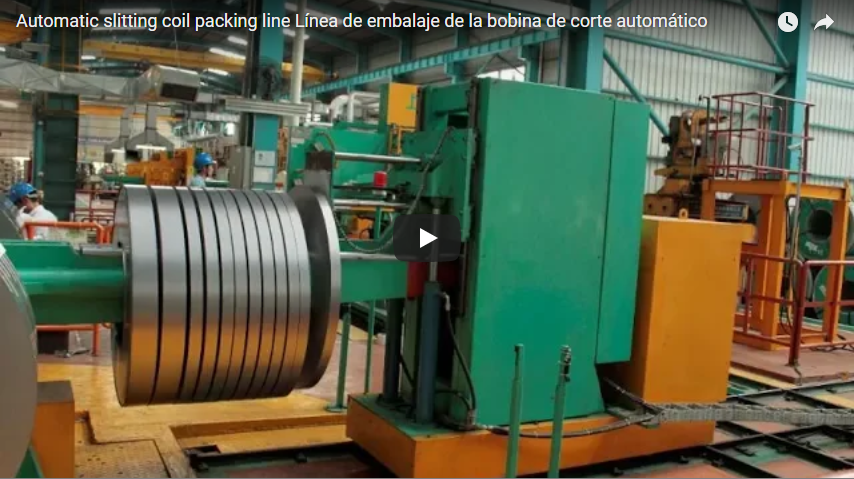
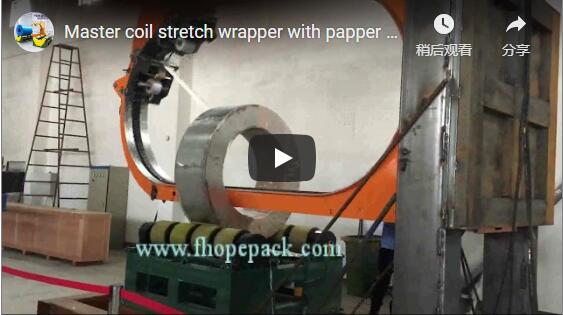
La maquina de línea automática de envasado de bobinas (an automatic coil packing line with a bobbin stacking system).
Executive summary
A heavy steel coil arrives in the horizontal position and has to stand up, be wrapped and be stacked before it can ship. This automatic automatic coil packing line turns the coil upright on a tilting stand, sets it onto a roller line, wraps it with stretch film from an overhead arm while the coil rotates, then sends the wrapped coil to the stacking system. The operator runs the line from a control station. Coil range and wrap pattern are confirmed per project.
Table of Contents
- Why a complete coil line
- What the line does
- Tilting stand
- Roller line, wrap and stack
- What the footage shows
- Typical configuration
- Selection checklist
- Operation and safety
- Engineering FAQ
- Next step
- Related reading
- Sources and standards
Why a complete coil line
A steel coil leaves the line horizontal and needs to stand upright for the wrap, then stack for storage. Doing these steps in one line removes separate crane moves.
Each station hands the coil to the next one automatically. Coil range is confirmed per project.
What the line does
The line upends, wraps and stacks steel coils. A tilting stand turns the horizontal coil upright. The roller line carries it to a wrap station where an overhead arm applies stretch film while the coil rotates, and the wrapped coil moves on toward the stacking system.
The operator runs the line from a control station. Coil range and wrap pattern are confirmed per project.
Tilting stand
The horizontal coil is set on a tilting stand that rotates the coil from the lying position to vertical, with the eye aligned to the roller line. The stand lowers the standing coil onto the conveyor.
Turning the coil on the stand keeps it close to the line so the transfer is short. Stand travel and coil weight are confirmed per project.
Roller line, wrap and stack
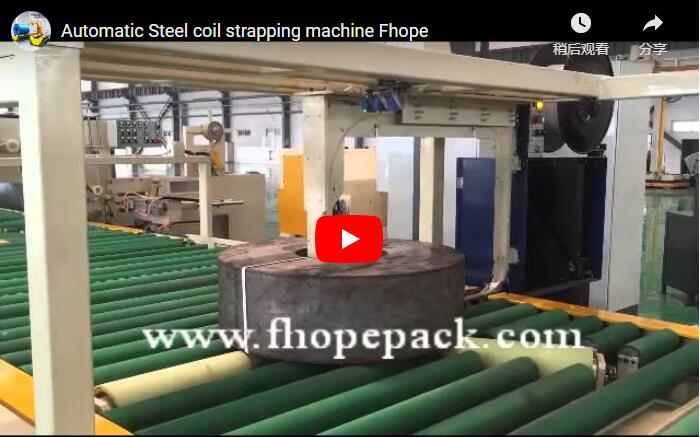
The standing coil moves along yellow roller conveyors to the wrap station. There, an overhead arm feeds stretch film while the coil rotates on the rollers, so the film covers the outer surface evenly, and rotation on the rollers brings the full surface under the arm.
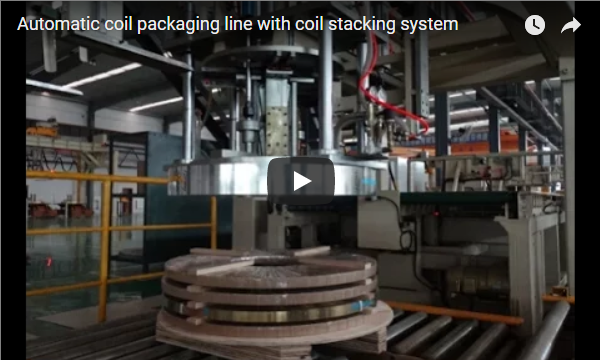
The wrapped coil continues on the line toward the stacking side, where the packed coils are set one above the other for storage or shipment, keeping the line tidy and square.
Coil rotation, film tension, stack height and layer handling are confirmed per project.
What the footage shows
Our footage shows a coil being turned upright on the tilting stand, moving along the roller line, being wrapped by the overhead arm, and continuing toward the stacking side of the line. It is a general demonstration, so your coil range and wrap pattern are confirmed with us per project.
Typical configuration
Figures below list functional design boundaries rather than numeric values, and are confirmed per project.
| Parameter | Typical range, confirmed per project |
|---|---|
| Load | steel coil |
| Upend | tilting stand |
| Wrap | overhead arm, stretch film |
| Conveyor | roller line |
| Stack | automatic stacking system |
| Electrical supply | 380 V three phase 50 Hz, or 220 V single phase for light machines, selected per project |
Selection checklist
| Question | Confirm per project |
|---|---|
| Coil range | OD, width, weight |
| Upend | stand travel, cycle |
| Wrap | film type, pattern |
| Conveyor | roller spacing, height |
| Stack | layers, height |
| Electrical supply | voltage, phase and frequency on site |
Operation and safety
Set the cycle and place a horizontal coil on the tilting stand; the line upends it, rolls it to the wrap station, wraps it and moves it to the stacking system while the operator supervises. Keep clear of the stand, the rollers and the arm while the line runs.
Routine checks cover the tilting stand, the roller line, the wrap arm and the stacking system, per the machine manual. Confirm the coil is seated before each upend.
Engineering FAQ
Q: What does this line do? A: It turns steel coils upright, wraps them and stacks the wrapped coils.
Q: Why upend the coil first? A: A standing coil aligns to the roller line and wrap station for the pack.
Q: How is the coil wrapped? A: An overhead arm applies stretch film while the coil rotates on the rollers.
Q: What happens after wrapping? A: The wrapped coil moves on to the stacking system on the line.
Q: What does it suit? A: Steel coils that need upending, wrapping and stacking in one flow.
Next step
- Email us at info@fhopepack.com with your coil size and output.
- We send a packing line proposal and a layout drawing within 48 hours.
- We confirm the upend travel and stack height against your coil range.
Related reading
- Automatic coil packing line with stacking system
- Automatic steel coil packing and stacking system
- Roller packing and stacking machine
- FHOPE packing machinery product lines
Sources and standards
- ISO 12100:2010 Safety of machinery, general principles for design and risk assessment
- EN 415-10:2014 Safety of packaging machines, general requirements
- EN ISO 13849-1:2023 Safety of machinery, safety-related parts of control systems
FHOPE automatic coil packing line with stacking system demonstration video. Reviewed as a general demonstration; coil range and wrap pattern confirmed per project.
Last reviewed: 2026-10-11