Executive summary
Packing the steel wire automatically starts from a formed wire coil that moves through an automatic packing line; the machine conveys the coil, wraps it in film or paper, and stacks the finished coils for delivery. The steps are handled by the line while operators supervise the run. A fully automatic line packs steel wire coils with a consistent cover every cycle. Coil size, wrap grade and stacking plan are confirmed per project.
Table of Contents
- Why pack steel wire automatically
- How an automatic wire packing line works
- Conveying, lifting and wrapping units
- Stacking and output cycle
- What the footage shows
- Typical configuration
- Selection checklist
- Operation and safety
- Engineering FAQ
- Next step
- Related reading
- Sources and standards
Why pack steel wire automatically
Steel wire is coiled in dense rings that are heavy and easy to damage at the edges. Automatic packing replaces repeated manual handling with a fixed sequence: convey, lift, wrap and stack.
The line keeps the coil moving and gives every coil the same protective cover, so labor and handling damage both fall. Line layout and coil range are confirmed per project.
How an automatic wire packing line works
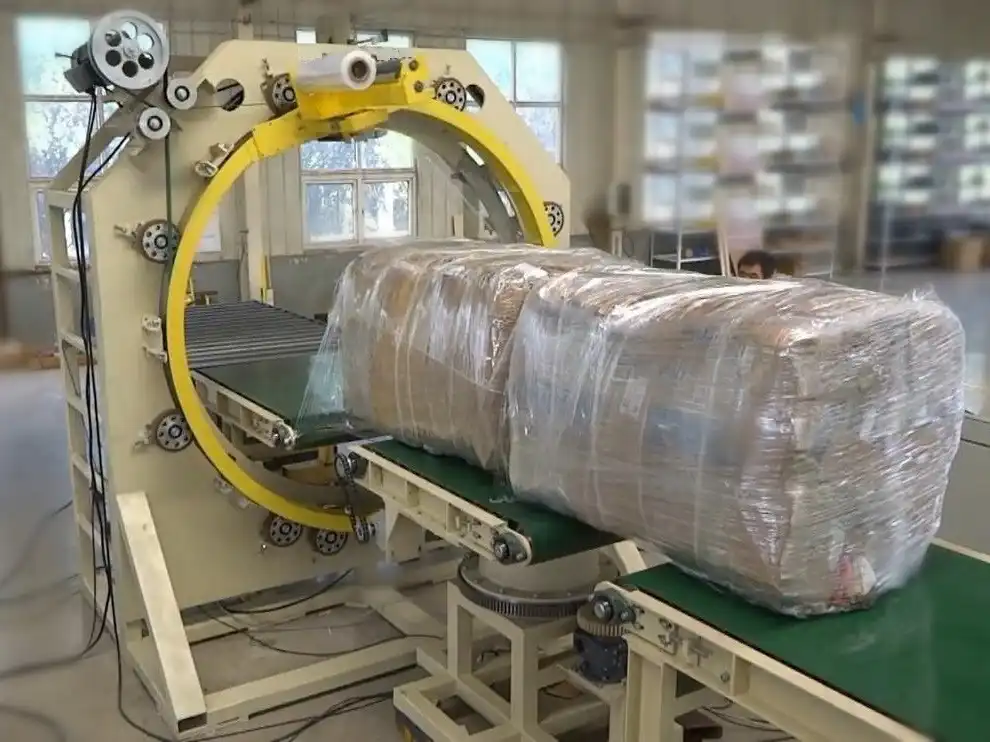
An automatic wire packing line takes a formed wire coil from a conveyor, lifts it with an arm, wraps it in film or paper, and moves the wrapped coil to a stacking station. Each station hands the coil to the next one, so the line runs without stopping between steps.
The coil travels on chain conveyors between stations. Coil size and cycle time are confirmed per project.
Conveying, lifting and wrapping units
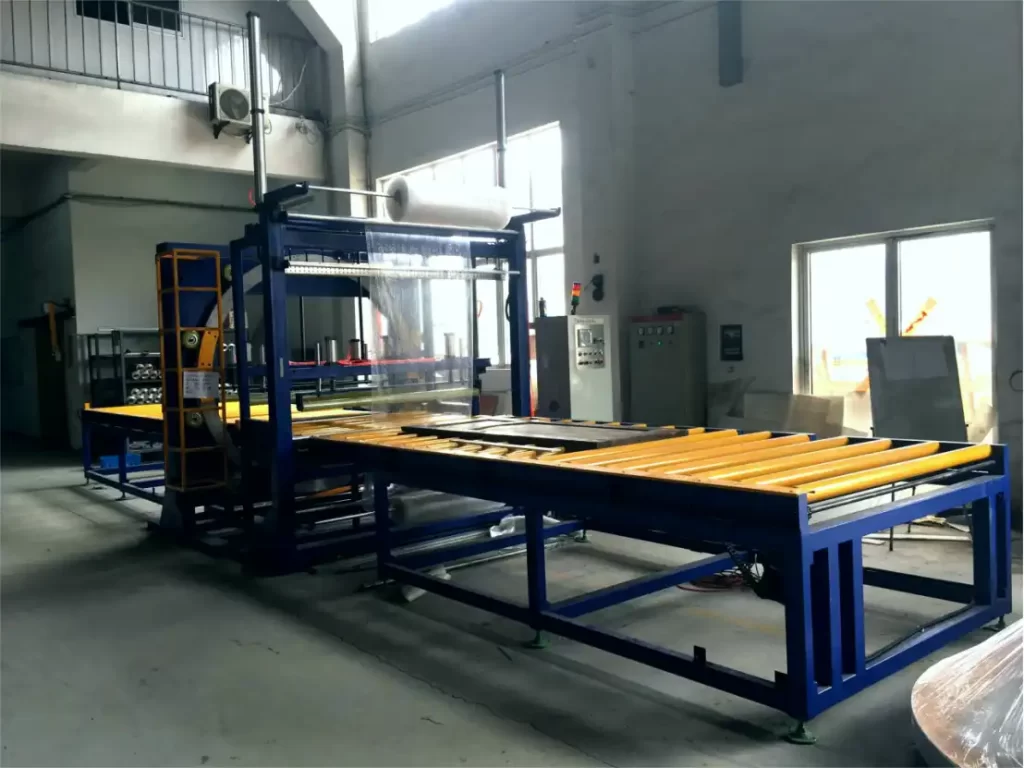
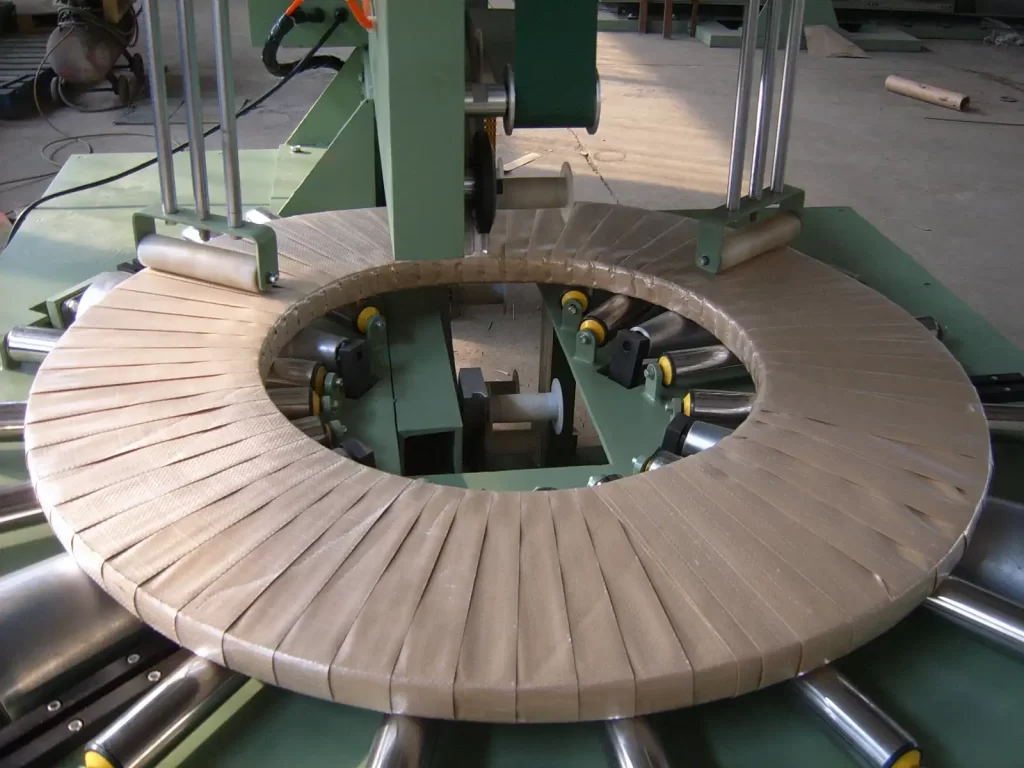
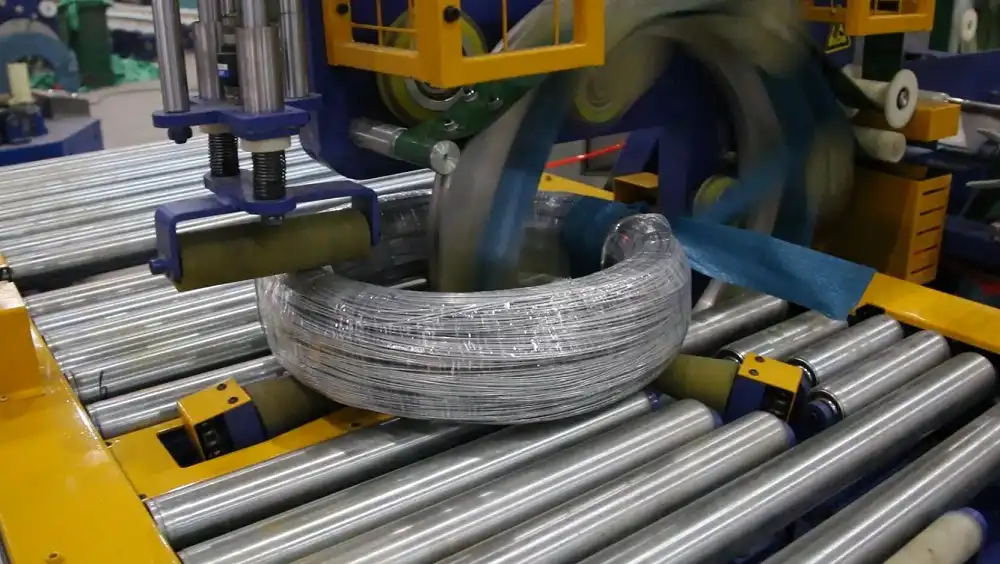
A chain conveyor with perforated links carries the coil between the stations, and a U-shaped lifting arm with buffer pads takes hold of the coil from the top so it is moved without being crushed. At the wrap station, film or paper feed rolls stand beside the coil, and the wrapping layer is applied around the coil while it is held in position.
Conveyor length and wrap feed are confirmed per project.
Stacking and output cycle
After wrapping, the line delivers the finished coil to a stacking station where it is placed onto a pallet in an even pattern. A robot arm may take over the final placement, keeping the operator clear of the heavy coil.
The stacked pallet is then ready for strapping or dispatch. Stacking pattern and pallet size are confirmed per project.
What the footage shows
Our footage shows an automatic steel wire packing line handling black steel wire coils. A chain conveyor brings the coil to a rotary station, a U-shaped arm with buffer pads lifts it, and film and paper rolls stand ready at the wrap stage. A robot arm places wrapped coils onto wooden pallets.
A mesh safety fence and a red perimeter rope mark the work area. It is a general demonstration, so your coil size, wrap grade and stacking plan are confirmed with us per project.
Typical configuration
Figures below list functional design boundaries rather than numeric values, and are confirmed per project.
| Parameter | Typical range, confirmed per project |
|---|---|
| Load | formed steel wire coil on the chain conveyor |
| Coil geometry | outer diameter in mm and coil height |
| Conveying | chain conveyor with perforated links between stations |
| Lift | U-shaped arm with buffer pads lifts the coil |
| Wrap | film or paper feed rolls at the wrap station |
| Stacking | robot arm places wrapped coils onto pallets |
| Guarding | mesh safety fence and perimeter marking |
| Electrical supply | 380 V three phase 50 Hz, or 220 V single phase for light machines, selected per project |
Selection checklist
| Question | Confirm per project |
|---|---|
| Coil range | outer diameter, height and weight of the coils |
| Wrapping material | film or paper grade selected per project |
| Wrap plan | film or paper passes around the coil |
| Stacking | pallet size and stack pattern per layer |
| Line layout | conveyor length for the available floor space |
| Electrical supply | voltage, phase and frequency on site |
Operation and safety
Start the line, let the conveyor feed each coil to the lift station, and supervise the wrap and stacking steps from the control area. Keep clear of the conveyor, the lifting arm and the robot travel while the line runs.
Routine checks cover the conveyor, the arm buffers and the safety fence, per the machine manual. Confirm the coil size suits the stations before the run begins.
Engineering FAQ
Q: How does the line move a wire coil between stations? A: Chain conveyors carry the coil, and a U-shaped arm with buffer pads lifts it between steps.
Q: What wraps the coil on an automatic line? A: Film or paper feed rolls at the wrap station cover the coil while it is held in position; the grade is confirmed per project.
Q: How are the finished coils stacked? A: A robot arm places each wrapped coil onto a pallet in an even pattern, ready for strapping or dispatch.
Q: Can the line handle different coil sizes? A: The line suits a defined coil range; your outer diameter and height are confirmed when you send your details.
Q: What electrical supply does it need? A: The machine runs on 380 V three phase 50 Hz as standard, and light machines can be arranged for 220 V single phase, selected per project.
Next step
- Email us at info@fhopepack.com with your coil size and production rate.
- We send an automatic wire packing line proposal within 48 hours.
- We confirm the wrap grade and stacking plan for your coils.
Related reading
- how to packing the steel wire by automatic machine?
- Automatic Steel Wire Coil Rewinding and Compacting Line
- Automatic Steel Wire Coil Compacting and Strapping Machine
- FHOPE packing machinery product lines
Sources and standards
- ISO 12100:2010 Safety of machinery, general principles for design and risk assessment
- EN 415-10:2014 Safety of packaging machines, general requirements
- EN ISO 13849-1:2023 Safety of machinery, safety-related parts of control systems
FHOPE automatic steel wire packing line demonstration video. Reviewed as a general demonstration; coil size, wrap grade and stacking plan confirmed per project.
Last reviewed: 2026-10-12