Executive summary
Packaging equipment on a steel coil line moves a heavy coil from the storage rack through wrapping and strapping without manual lifting, which reduces crane dependency and prevents edge damage during handling, then carries the finished package out for dispatch. It runs under operator supervision, with an emergency stop on the console. The equipment applies film and strapping around the coil with every cycle. Coil size, film grade and strapping plan are confirmed per project.
Table of Contents
- Packaging equipment in the coil line
- What the equipment does
- Coil rack, arm and conveyor
- Wrap and strap cycle
- What the footage shows
- Typical configuration
- Selection checklist
- Operation and safety
- Engineering FAQ
- Next step
- Related reading
- Sources and standards
Packaging equipment in the coil line
A steel coil packaging line uses a set of machines working in sequence. A storage rack holds the coil, an arm pulls it out, conveyor rollers move it, and a wrap unit plus a strapping unit close the package. Each machine has its own role, and they run as one line under operator supervision.
This equipment is built around the coil so the heavy steel is handled without manual lifting. Line layout is confirmed per project.
What the equipment does
The equipment demonstrated here takes a steel coil from an inclined support rack. An arm transfers the coil to the wrap station, wraps film around it, and straps the coil before it is carried to the output area.
A yellow console with an emergency stop gives the operator control of the line. Coil size and line speed are confirmed per project.
Coil rack, arm and conveyor
A swingable support rack holds the coil with vertical posts, and tilts to release a new coil when the line is ready. A large arm grips the coil and pulls it out horizontally, then places it onto a roller conveyor.
The conveyor carries the coil between the wrap, strap and output stations. Rack size and conveyor length are confirmed per project.
Wrap and strap cycle
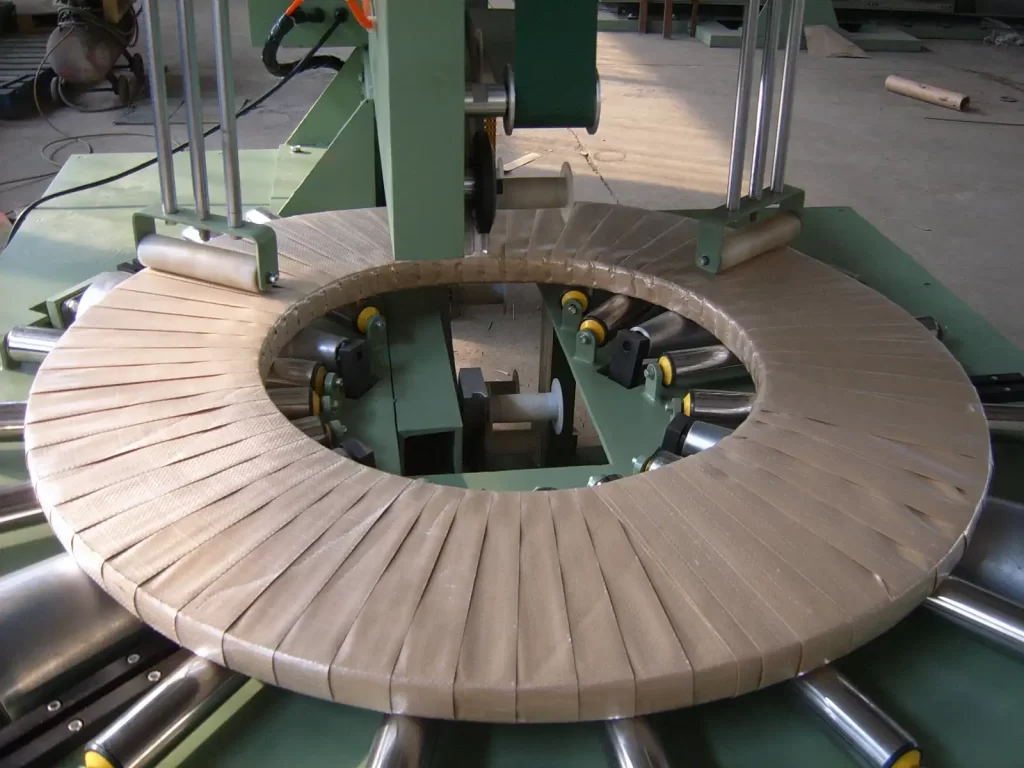
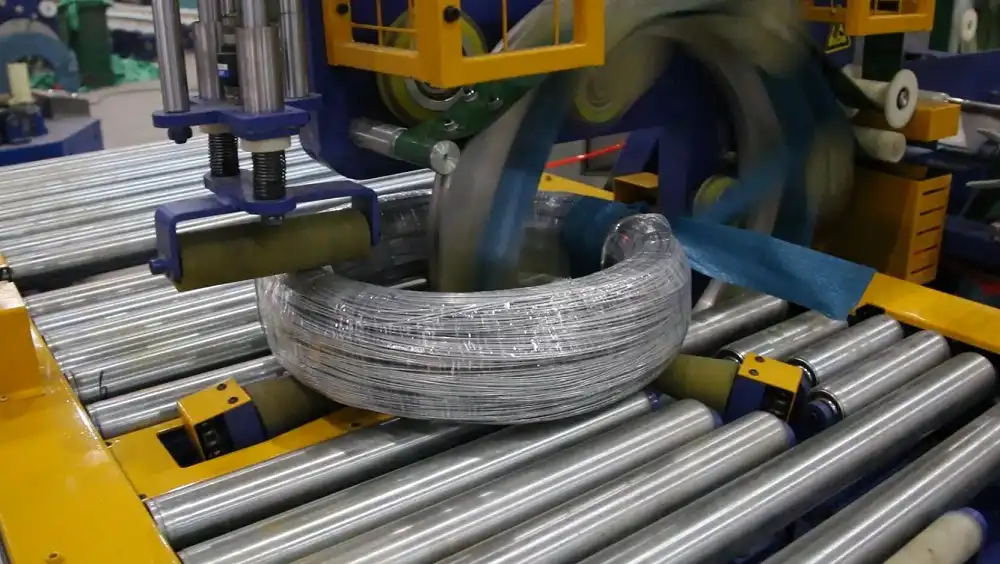
At the wrap station, a vertical unit with a stretch film roll covers the coil, then the strapping unit feeds strapping bands around the coil and tensions them into a tight ring.
A digital display on the control cabinet shows the running figure during the cycle. Wrap passes and the number of straps are confirmed per project.
What the footage shows
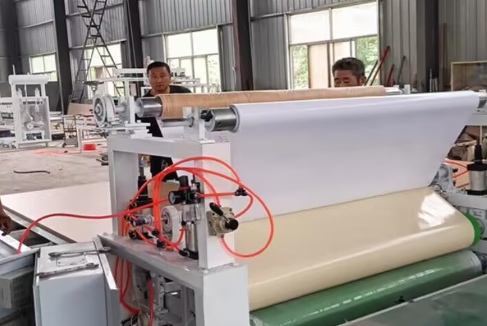
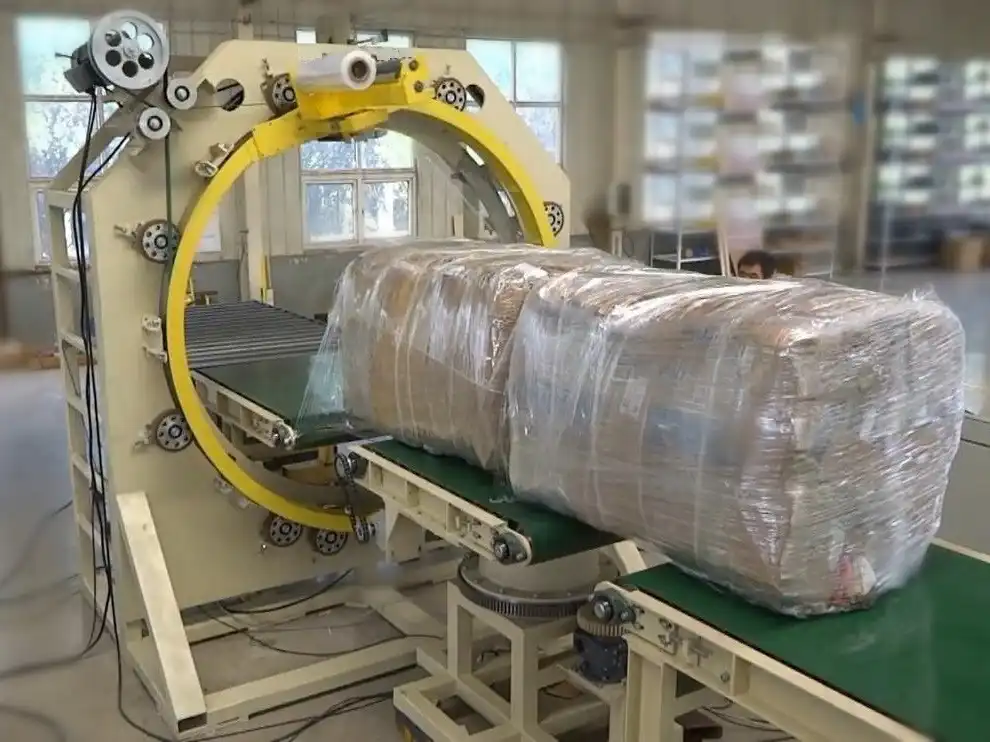
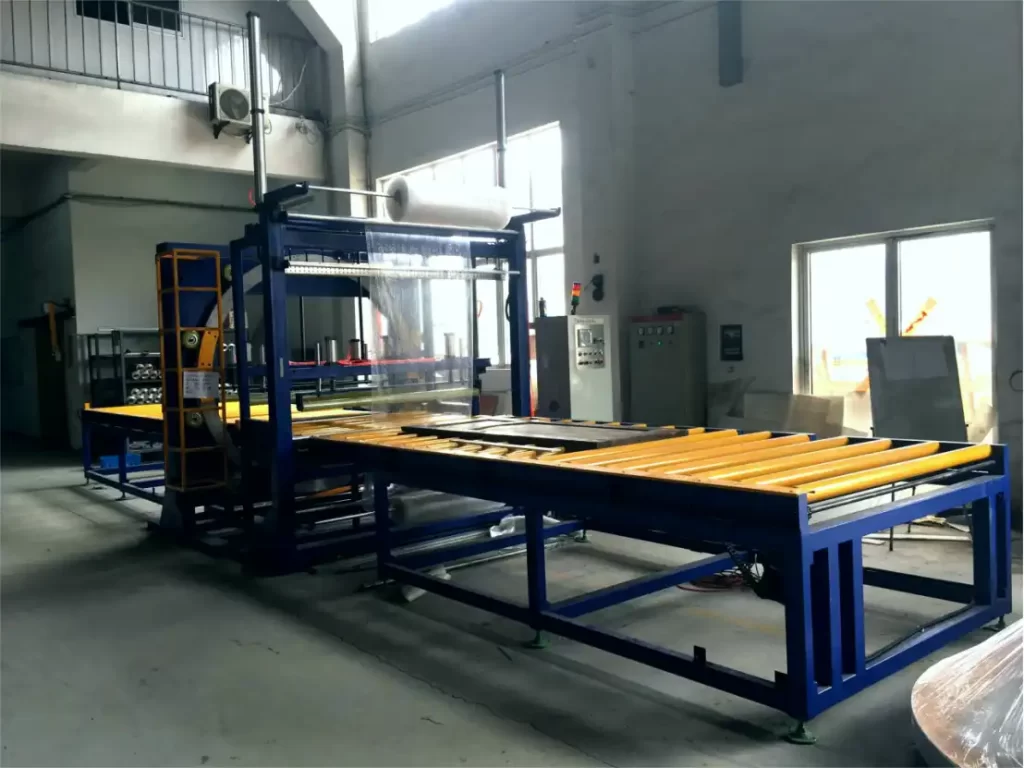
Our footage shows a steel coil held on an inclined support rack and pulled out by a large arm onto a roller conveyor. The heavy coil is transferred to the wrap station without manual lifting, where a stretch film roll stands ready. A strapping unit applies strapping bands around the coil, and the finished coil continues toward the output area.
A yellow console with an emergency stop and a control cabinet with a digital display sit beside the line. It is a general demonstration, so your coil size, film grade and strapping plan are confirmed with us per project.
Typical configuration
Figures below list functional design boundaries rather than numeric values, and are confirmed per project.
| Parameter | Typical range, confirmed per project |
|---|---|
| Load | steel coil held on the inclined support rack |
| Coil geometry | outer diameter in mm, width and bore size |
| Transfer | arm pulls the coil onto the roller conveyor |
| Wrap | vertical unit with stretch film roll covers the coil |
| Strapping | strap feed and tension around the coil edge |
| Output | conveyor carries the packed coil to dispatch |
| Control | console with emergency stop and digital display |
| Electrical supply | 380 V three phase 50 Hz, or 220 V single phase for light machines, selected per project |
Selection checklist
| Question | Confirm per project |
|---|---|
| Coil range | outer diameter, width and bore of the coils |
| Film | stretch film grade and width |
| Wrap plan | film passes around the coil |
| Strapping | number of straps and strap material per coil |
| Output | dispatch conveyor and storage layout |
| Electrical supply | voltage, phase and frequency on site |
Operation and safety
Start the line, feed a coil from the rack, and supervise the wrap, strap and output steps from the control area. Keep clear of the arm travel, the rotating coil and the strapping path while the machine runs.
Routine checks cover the rack, the arm, the strapping unit and the emergency stop, per the machine manual. Confirm the coil sits on the rack and in the conveyor before the cycle starts.
Engineering FAQ
Q: How is the coil taken from the rack? A: A large arm grips the coil and pulls it out horizontally, while the rack tilts to release the coil onto the conveyor.
Q: What happens at the wrap station? A: A vertical unit with a stretch film roll covers the coil before it moves to the strapping station.
Q: How is the coil strapped? A: The strapping unit feeds bands around the coil and tensions them into a tight ring; strap count is confirmed per project.
Q: Where does the packed coil go? A: The conveyor carries the finished coil to the output area for storage or dispatch.
Q: What electrical supply does it need? A: The machine runs on 380 V three phase 50 Hz as standard, and light machines can be arranged for 220 V single phase, selected per project.
Next step
- Email us at info@fhopepack.com with your coil size and daily output.
- We send a packaging equipment proposal within 48 hours.
- We confirm the film grade, strap count and layout for your line.
Related reading
- Packaging Equipment: Operation and Applications
- Automatic Steel Coil Packing Line: Gripping, Down Ender and Wrapping Station
- Steel Coil Packaging Line with Tilting Rack, Wrapping and Press Station
- FHOPE packing machinery product lines
Sources and standards
- ISO 12100:2010 Safety of machinery, general principles for design and risk assessment
- EN 415-10:2014 Safety of packaging machines, general requirements
- EN ISO 13849-1:2023 Safety of machinery, safety-related parts of control systems
FHOPE steel coil packaging equipment demonstration video. Reviewed as a general demonstration; coil size, film grade and strapping plan confirmed per project.
Last reviewed: 2026-10-12