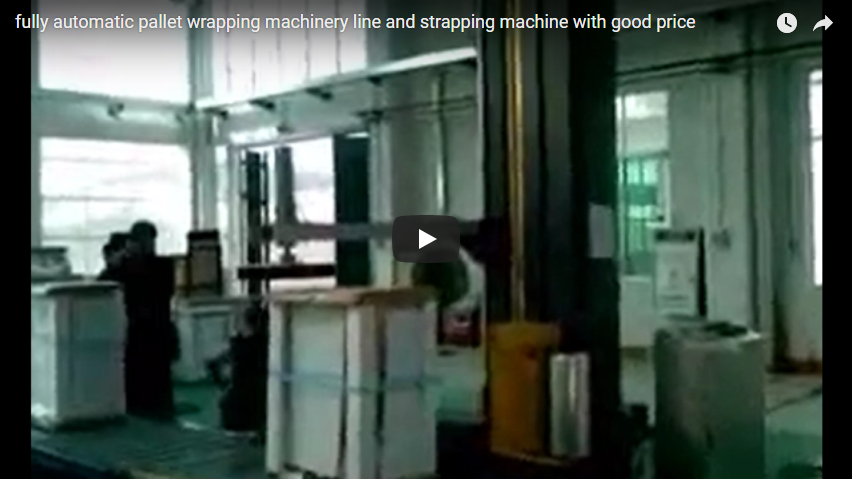
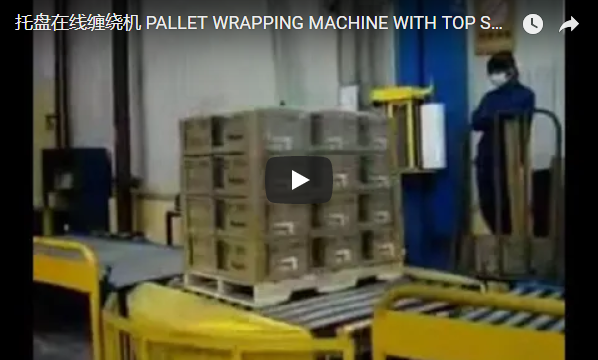
Executive summary Our automatic turntable wrapping line takes pallets from the palletizer on conveyors, wraps them and sends them out with no manual work. It is rated at a minimum of 24 loads per hour for loads up to 1,800 kg. A film covering unit can lay a PE sheet over the top before wrapping. Powered pre-stretch keeps tension even on soft, light bag stacks.
Table of Contents
- Line layout
- Specifications
- Matching the palletizer
- Wrapping bag stacks
- Top film covering
- Film handling and cutting
- Controls and utilities
- Selection checklist
- Engineering FAQ
- Next step
- Related reading
- Sources
Line layout: palletizer to wrapper to outfeed
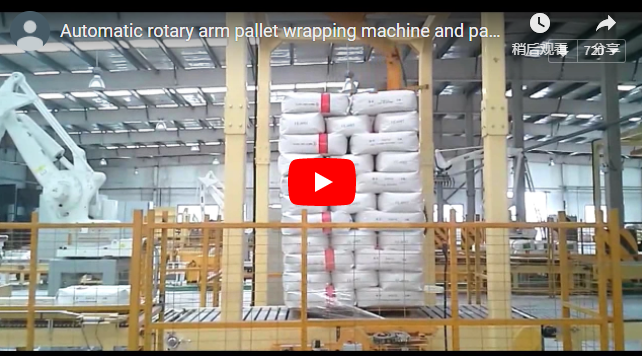
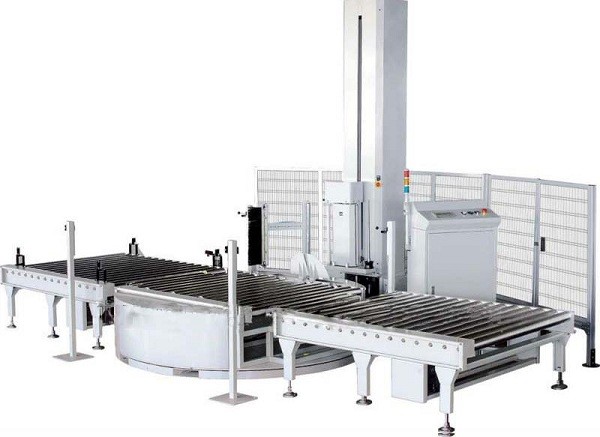
We designed this line so full pallets go from the palletizer to the wrapper on conveyors, with no forklift between them. In this installation, an upstream robot palletizer feeds bag pallets to our turntable wrapper. The line has four sections:
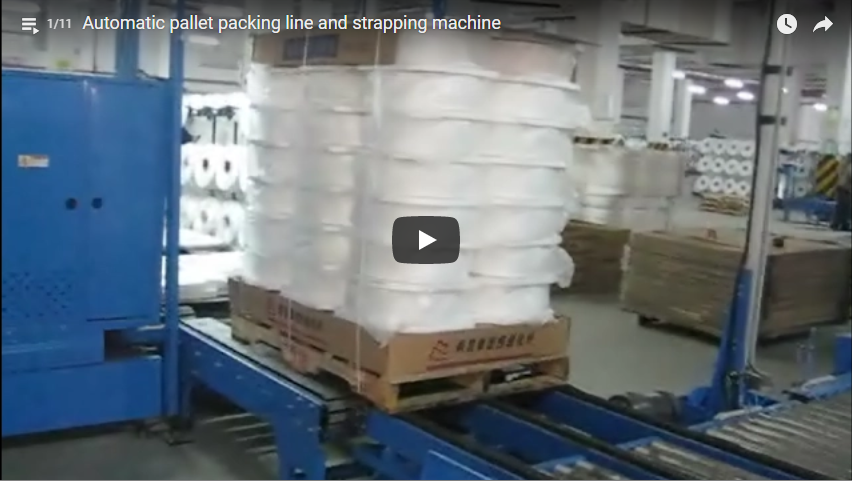
- Infeed conveyor. The stacked pallet arrives on a motorized conveyor from the palletizer, or is placed there by forklift.
- Film covering, when fitted. As the pallet moves forward, the covering unit lays a PE sheet or foam over the top.
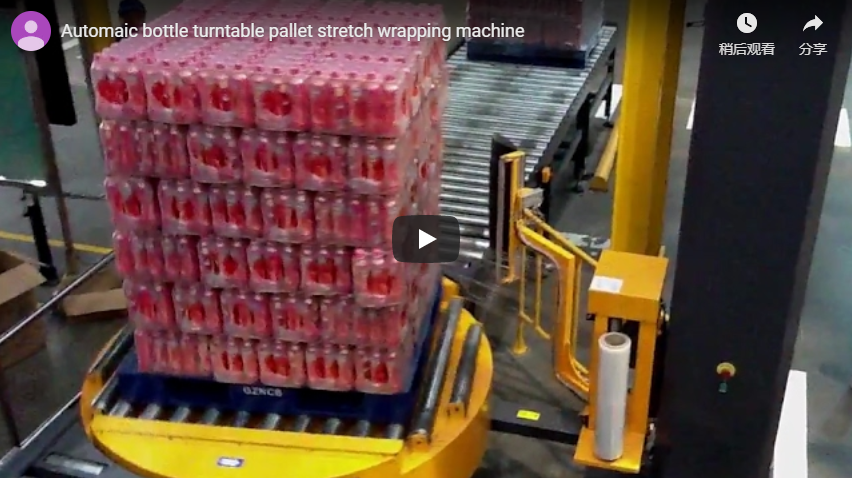
- Roller turntable wrapper. The pallet stops on the turntable roller conveyor and is wrapped with LLDPE stretch film.
- Outfeed conveyor. The wrapped pallet moves out for forklift pick-up.
The central control runs the whole process, so no one assists the wrapper between loads.
Automatic turntable wrapping line specifications
| Parameter | Value |
|---|---|
| Output | min. 24 loads per hour |
| Max load weight | 1,800 kg (turntable rated 2,000 kg) |
| Turntable | 2,200 mm diameter, max. 12 rpm |
| Film | LLDPE, 500 mm wide, 0.025 mm thick |
| Pre-stretch | 250% (100–300% optional) |
| Film carriage speed | 2.9 m/min |
| Wrap layers | bottom, middle, top: 0–99 winds each |
Infeed and outfeed conveyors are optional, so the wrapper can also be loaded by forklift.
Matching the wrapper to the palletizer
The wrapper has to clear each pallet before the palletizer finishes the next one. A quick check:
- Time per load. 24 loads per hour means 3600 ÷ 24 = 150 s per pallet.
- Bags per hour. With an illustrative 50 bags per pallet, 24 loads per hour handles 1,200 bags per hour.
- Check. If your palletizer builds pallets faster than 150 s each, we plan a buffer conveyor or a faster wrap pattern.
We run this check with your bag count per pallet and palletizer speed before we fix the layout.
Wrapping bag stacks: tension and wind pattern
Bags are soft, and their stack shifts more easily than cartons. Two features help:
- Powered pre-stretch. Motor-driven rollers deliver the right amount of film, and an electronic system measures the speed to keep tension constant over the whole pallet. This lets us wrap light and unsteady pallets that friction-brake systems cannot wrap well.
- Wind pattern. Bottom, middle and top layers are each set from 0 to 99 winds. More bottom winds tie the bag stack to the pallet.
The re-wrap function, overwrap and overlap are also adjustable, and the photocell sensor finds the stack height.
Top film covering for dust and moisture
Our film covering unit lays a piece of PE film or plastic foam over the load top before wrapping. The stretch film then holds it in place, so the pallet is closed on all sides.
This matters for bagged food, powders and other goods stored in dusty or damp places. For beverage and frozen food, the fully closed pallet also keeps the product clean.
Film handling and cutting
The automatic mechanical hand makes the line unmanned:
- Clamp. Scissors-like gripper bars hold the film tail, ready for the next load.
- Cut. An instant heating wire cuts the film at the end of the cycle.
- Wipe. A soft brush presses the film tail onto the pallet.
Sensors and the PLC program control each step, so the operator only changes film rolls and other consumables.
Controls and utilities
The line runs on a PLC with a pre-stretch controller, separate buttons and an HMI. Plan these utilities:
| Utility | Requirement |
|---|---|
| Power | AC 380 V, 3 phase, 50 Hz |
| Motors | turntable 0.75 kW, rollers 0.75 kW, carriage 0.37 kW, pre-stretch 0.37 kW |
| Air | 6–8 kgf/cm² supply pressure |
Safety includes a red mushroom-head emergency stop and a lockable electrical disconnect. The standards that apply depend on the destination market. For CE markets, ISO 12100 sets the risk-assessment method and EN 415-10 sets general requirements for packaging machines.
Selection checklist for a bag pallet wrapping line
- Pallet size, stack height and weight.
- Bags per pallet and palletizer speed.
- Infeed and outfeed: conveyor or forklift.
- Top film covering needed for dust or moisture.
- Wind pattern for bottom, middle and top.
- Power supply and compressed air (pressure and flow) at the wrapper.
Engineering FAQ
Q: How many bag pallets per hour can the line wrap? A: At least 24 loads per hour, which gives 150 s per pallet.
Q: Can the line take pallets straight from a robot palletizer? A: Yes. The motorized infeed conveyor takes the pallet from the palletizer and moves it to the turntable, so no forklift is needed in between.
Q: How do you keep a soft bag stack from shifting? A: By powered pre-stretch at constant tension, and by setting extra bottom winds from the 0–99 range.
Q: What does the top film covering do? A: It uses the conveyor movement to lay a PE sheet or foam on the load top before wrapping, so dust and moisture cannot enter from above.
Q: What air supply does the line need? A: A supply at 6–8 kgf/cm² for the pneumatic film clamp and cutting system. We size the air flow with you for your cycle rate.
Next step
We plan the wrapping line around your palletizer in three steps:
- Submit your layout drawing with pallet size, bags per pallet and palletizer speed to info@fhopepack.com.
- Receive a line proposal within 48 hours, with conveyors, wrapper and layout.
- Book a site survey to fit the line to your end-of-line floor.
Related reading
- Automatic pallet wrapping machine B300 with film covering
- Automatic pallet wrapping machines
- Video: turntable pallet wrapping machine and top sheet covering
- Video: pallet wrapping machine with conveyors
- Video: inline turntable pallet wrapper
Sources
- Line process, specifications, film covering, film handling, utilities: B300 automatic pallet wrapping machine page
- Powered pre-stretch description: B100 automatic pallet wrapping machine page
- Line in action: our automatic turntable pallet wrapping line video on YouTube
- Standards scope: ISO 12100:2010, EN 415-10:2014
Last reviewed: 2026-10-03