Executive summary
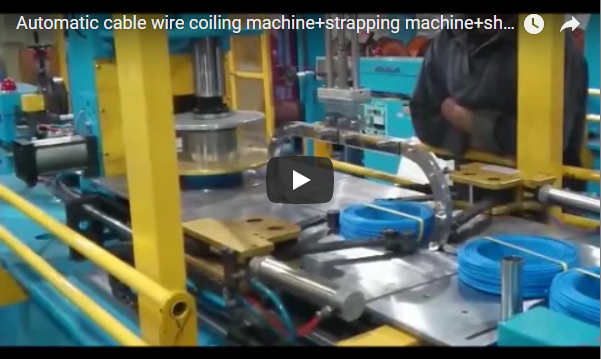
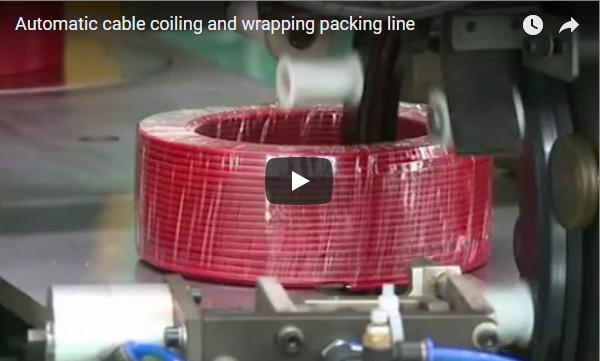
Cable and wire are made on large drums but sold in small coils of set length or weight. Re-winding by hand gives coils of uneven length and shape, and loose coils open before they are strapped. A re-winding and strapping line pays the cable off the bulk drum, measures it, winds it into a coil on a servo-driven head, straps it and moves it out on rollers. This page covers the stations, sourced coiler data and how to work out length per coil.
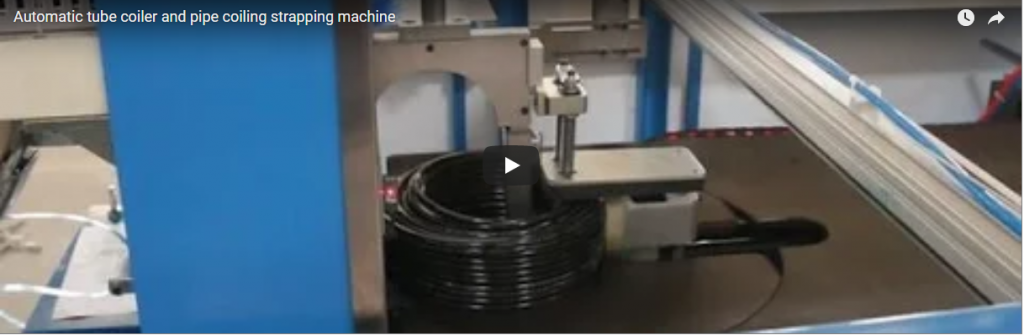
Black cable runs from a pay-off through a guide and traverse on a blue frame into a coiling head with a gold-coloured flange plate. The finished coil is pushed onto a roller conveyor and passes into a strapping arch, which straps it radially through the eye at several points. A guarded measuring and cutting unit sits at the front of the line.
Table of Contents
- What a re-winding line does
- Line stations
- Coiler data
- Length and weight per coil
- Selection checklist
- Safety
- Engineering FAQ
- Next step
- Related reading
- Sources
What a re-winding line does
Bulk drums hold hundreds or thousands of metres. A distributor or installer wants 50 m or 100 m coils, or coils of a set weight, all the same size so they stack in a carton or on a pallet. On one wire project, 1,000 kg bulk coils had to be split into 9 kg, 25 kg and 30 kg packs. The line measures and cuts each coil to the set length or weight and straps it before it can open.
Line stations
- Pay-off: the bulk drum turns under tension control.
- Measure and cut: a meter counter measures the cable, and the cutter cuts at the set length.
- Traverse and coil: a traverse guide lays the cable evenly across the coil width while the servo head winds it.
- Push out: the coil is released from the head onto the roller conveyor.
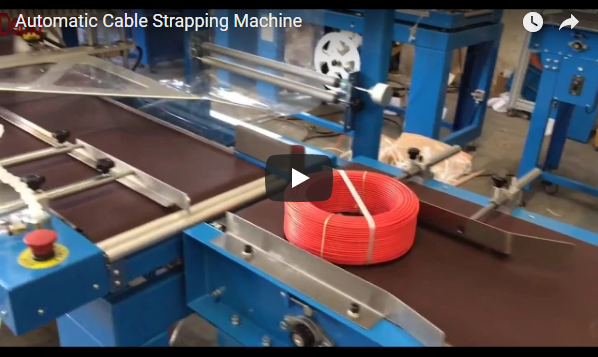
- Strap: the strapping arch indexes the coil and applies radial straps through the coil eye at set positions.
- Outfeed: coils move on to wrapping, labelling or boxing.
The PLC holds the length, coil size and strap positions for each product.
Coiler data
| Item | FHOPE FCL-800 automatic coiler |
|---|---|
| Coil OD | 500–800 mm |
| Coil ID | 200–300, 250–500 or 300–600 mm |
| Coil height | 80–200 or 100–300 mm |
| Product OD | 5–16, 10–20 or 15–30 mm |
| Speed | up to 80 m/min |
| Drive | servo |
Smaller cables use the FCL-600; cable range and pay-off size are confirmed at quote.
Length and weight per coil
Length ≈ π × mean diameter × turns per layer × layers; weight = length × cable weight per metre. For 10 mm cable in a coil 100 mm high, there are 10 turns per layer. With ID 300 mm and 5 layers, the OD is 300 + 2 × 5 × 10 = 400 mm and the mean diameter 0.35 m, so length ≈ 3.14 × 0.35 × 10 × 5 = 55 m (example only). The meter counter cuts at the exact length; this formula tells you the coil size it needs.
Selection checklist
- Cable OD range and weight per metre?
- Coil length or weight, and coil ID, OD and height?
- Bulk drum size and weight?
- Strap points per coil?
- Wrap, label or box after strapping?
- Output per shift?
Safety
We design coiling lines to EN ISO 12100:2010 for risk assessment, EN 415-10 for packaging machine safety and EN 60204-1 for electrical equipment. The cutter and coiling head are guarded, and the pay-off has tension control and an E-stop.
Engineering FAQ
Q: Can it cut by weight instead of length? A: Yes, with a weighing unit; length is the standard setting.
Q: How is the coil kept tidy? A: The traverse lays each turn next to the last across the coil height.
Q: How many strap points? A: Set per coil size; each strap passes through the coil eye.
Q: Can one line run several cable sizes? A: Yes, within the coiler range, using a recipe per product.
Next step
- Send your cable OD, coil length and drum size to info@fhopepack.com.
- We size the pay-off, coiler and strapping arch.
- We reply within 24 hours with a proposal and quotation.
Related reading
- Automatic pipe winding machine FCL-800 (product)
- Automatic hose coiling machine FCL-600 (product)
- Wire and cable rewinding and strapping machine (video)
- Automatic cable coiling, strapping and shrink packaging machine (video)
- Automatic cable wire coil winding, strapping and packing machine (video)
Sources
- FHOPE product pages: FCL-800 and FCL-600 coilers
- FHOPE project correspondence on re-winding bulk coils into packs
- EN ISO 12100:2010; EN 415-10; EN 60204-1
- The re-winding line shown above
Last reviewed: 2026-10-20