Executive summary An automated storage system often needs loads on its own pallet type, so loads arriving on other pallets must be moved across. Our pallet changer in this video takes a forklift-fed load of boxed goods, tilts it on its platform, and clamps and presses it while the pallet is changed. How many loads it handles follows from the cycle per load and your feed rate. We size both per project.
Table of Contents
- What the video shows
- How the pallet change works
- Loads per shift
- What an ASRS feed needs
- Controls and safety
- Selection checklist for a pallet changer for ASRS feeding
- Engineering FAQ
- Next step
- Related reading
- Sources
What the video shows
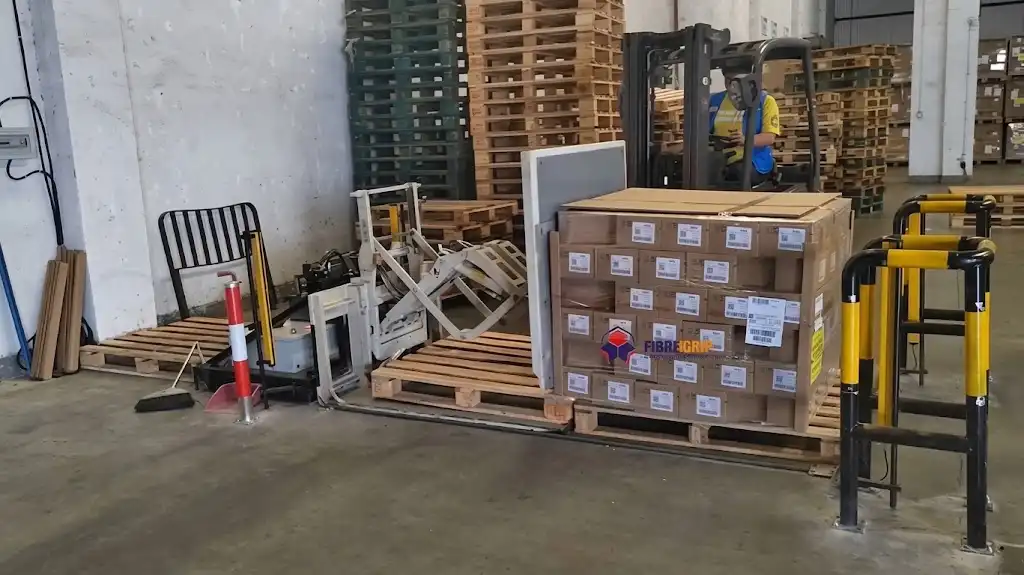
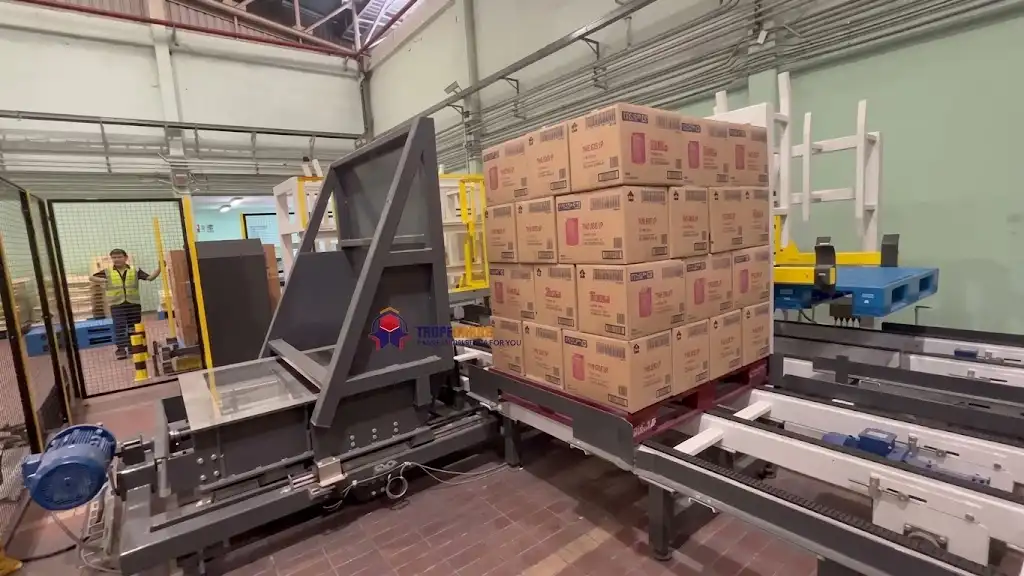
In a high-bay warehouse with tall racks, a forklift brings a pallet of boxed goods to our blue-framed pallet changer, which stands on a concrete floor with yellow lane markings. A control cabinet with a screen and buttons stands to its right.
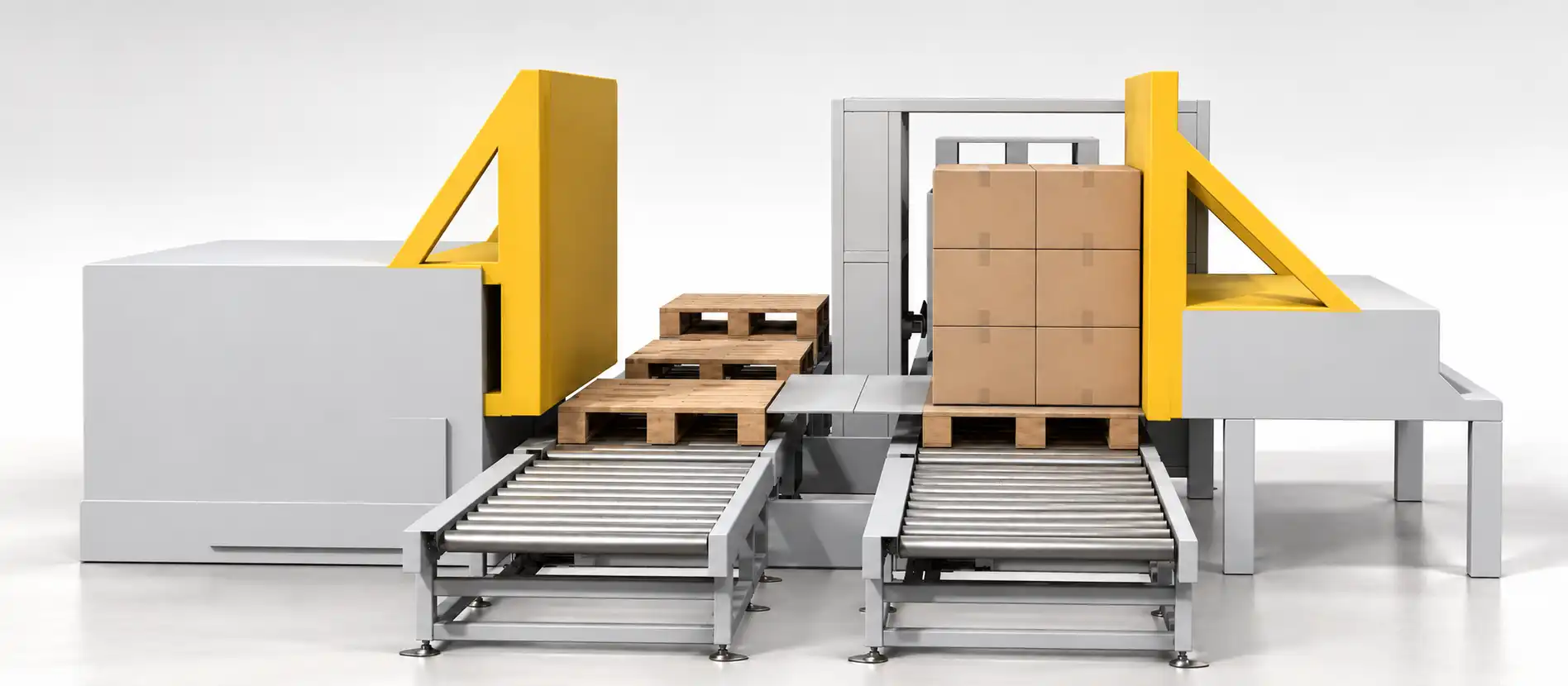
The load is captured on the tilting platform and tilted up from horizontal toward vertical. In another shot the frame closes round a load, a vertical press bears down on it and the arms clamp round it. In the last shot a forklift lines up with the next stack. A banner on screen reads “pallet changer: saves time, labour, pallets and packaging film”, and FHOPE GROUP lettering shows on the machine.
How the pallet change works
| Step | What happens |
|---|---|
| Feed | A forklift sets the load on the machine |
| Clamp and press | Arms clamp the load and a press holds it from above |
| Tilt | The platform tilts the load toward vertical |
| Change | The pallet under the load is changed |
| Out | A forklift takes the load to the storage feed |
Clamping and pressing hold the stack as one block while it tilts, so boxes do not shift or fall.
Loads per shift
Illustrative example:
| Item | Value |
|---|---|
| Shift length (illustrative) | 8 h |
| Seconds per shift, 8 × 3,600 | 28,800 s |
| Loads per shift | 28,800 ÷ cycle per load in seconds |
Forklift travel usually sets the real pace, so we look at your feed route as well as the machine.
What an ASRS feed needs
| Need | Why it matters |
|---|---|
| Pallet type for storage | Sets the pallet the load goes onto |
| Load height and weight | Sets the tilt, clamp and press |
| Box stack stability | Sets the clamp and press force |
| Feed rate into storage | Sets the cycle we design for |
Keeping the customer’s or supplier’s pallets out of the storage system means one pallet standard inside it. For loads that should not tilt, see our push-type pallet changer.
Controls and safety
The platform tilts a full load and the press and arms close on it. Keep people clear of the machine and the forklift path while it runs, and approach only with it stopped and isolated.
The standards that apply depend on the destination market. For CE markets, ISO 12100 sets the risk-assessment method and EN 415-10 sets general requirements for packaging machines.
Selection checklist for a pallet changer for ASRS feeding
- Incoming and storage pallet types and sizes.
- Load height and weight.
- Box stacking pattern.
- Loads per hour into storage.
- Forklift route and floor markings.
- Floor space beside the storage feed.
Engineering FAQ
Q: Why change pallets before an ASRS? A: So the storage system only handles its own pallet type.
Q: How is the load held while it tilts? A: Arms clamp it and a press holds it from above.
Q: How many loads per shift? A: 28,800 s in an 8 h shift divided by the cycle per load in seconds; forklift travel often sets the pace.
Q: What sets the real throughput besides the machine cycle? A: Forklift travel and the feed route into storage.
Q: How are loads fed? A: By forklift, onto the machine platform.
Q: What should I send for a quote? A: Both pallet types, load size and weight, and the feed rate into storage.
Next step
We plan your pallet changer in three steps:
- Submit your layout drawing with pallet types, loads and feed rate to info@fhopepack.com.
- Receive a proposal within 48 hours, with the tilt, clamp and press plan.
- Book a site survey to check the forklift route and floor space.
Related reading
- Pallet inverter
- Video: V-shape pallet changer
- Video: C-type 180-degree pallet turnover and pallet inverter
Sources
- Machine content: FHOPE engineering team, 2026-10-04
- Shift example: our worked example, illustrative values
- Machine in action: our video on YouTube
- Standards scope: ISO 12100:2010, EN 415-10:2014
Last reviewed: 2026-10-04