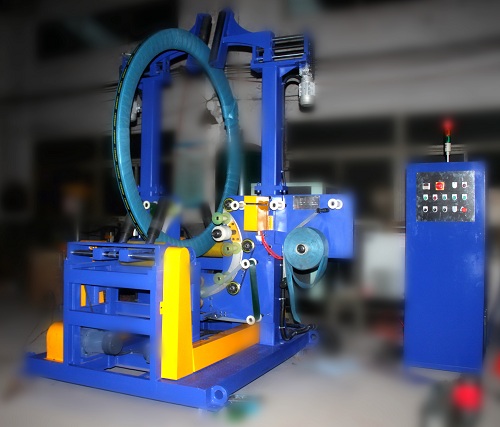
Executive summary A steel master coil leaves the mill heavy and wide, and it needs a full cover of film through the eye before storage or shipping. Our coil wrapper passes an orange ring through the eye while the coil turns on rollers, inside an orange safety fence, and wraps it in blue film. Ring turns and film use follow from the coil OD and the coil wall and width. All are set per project.
Table of Contents
- What the video shows
- Operation process step by step
- Ring turns and film per master coil
- Why master coils need eye-through wrapping
- Controls and safety
- Selection checklist for a master coil wrapper
- Engineering FAQ
- Next step
- Related reading
- Sources
What the video shows
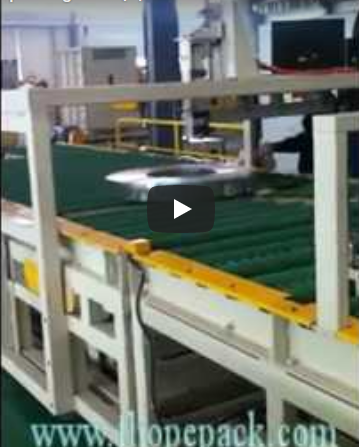
Two large steel coils already wrapped in blue film stand on red saddles in the workshop. Inside an orange safety fence, a grey coil sits on yellow and black support rollers, and the orange ring of our wrapper passes through its eye from the blue main frame.
The ring turns and lays blue film through the eye and round the wall, while the rollers turn the coil until it is fully covered. A second coil follows. The FHOPE GROUP mark shows in the corner.
Operation process step by step
| Step | What happens |
|---|---|
| 1. Load | A crane or coil car sets the coil on the support rollers |
| 2. Position | The coil is centred so the ring can pass through the eye |
| 3. Wrap and turn | At the same time, the ring carries film through the eye and the rollers turn the coil, so each pass lands beside the last |
| 4. Finish | The film is cut and the tail fixed |
| 5. Unload | The wrapped coil is lifted to a saddle |
The coil turns slowly while the ring turns fast. Their speed ratio sets the overlap. For lines that add a downender and stacking, see our buyer’s guide to stretch wrapping and downender stacking for heavy steel coils.
Ring turns and film per master coil
Size the cover at the outside diameter, where passes sit furthest apart. Illustrative example for a coil of 1,800 mm OD, 508 mm ID and 1,500 mm wide, with 250 mm film at half overlap:
| Item | Value |
|---|---|
| Outer circumference, π × 1,800 | about 5,655 mm |
| Advance per pass, half of 250 mm | 125 mm |
| Ring turns, 5,655 ÷ 125 | about 45 |
| Wall, (1,800 − 508) ÷ 2 | 646 mm |
| Film per turn, 2 × (1,500 + 646) | about 4.3 m |
| Film laid, 45 × 4.3 m | about 194 m |
The inside of the eye gets more overlap than the outside, so it is fully covered too. The figure is film laid on the coil; pre-stretch means the roll pays out less.
Why master coils need eye-through wrapping
| Risk | How the wrap helps |
|---|---|
| Damp in storage | Film closes the eye and both faces |
| Edge damage in transit | Film adds a layer over the edges |
| Dust | Full cover keeps the surface clean |
Coloured film, like the blue in our video, also makes wrapped coils easy to tell apart in the yard.
Controls and safety
The ring turns at speed through the coil eye inside the orange safety fence. Keep people outside the fence while it runs, and stop the machine before loading, unloading or fixing film.
The standards that apply depend on the destination market. For CE markets, ISO 12100 sets the risk-assessment method and EN 415-10 sets general requirements for packaging machines.
Selection checklist for a master coil wrapper
- Coil OD, ID, width and weight, smallest to largest.
- Coils per shift.
- Film type and colour.
- Overlap or number of layers.
- Loading by crane or coil car.
- Floor space for the fence and saddles.
Engineering FAQ
Q: What is the operation process? A: Load, centre, wrap through the eye while the rollers turn the coil, cut the film and unload.
Q: How many ring turns does a master coil need? A: About 45 for a 1,800 mm OD coil with 250 mm film at half overlap in our example.
Q: How much film per coil? A: About 194 m laid for a 1,800 mm OD, 508 mm ID, 1,500 mm wide coil in our example.
Q: Why size the cover at the outside? A: Passes sit furthest apart there; the inside gets more overlap.
Q: Why does the eye get more film than the outside? A: The inner circumference is smaller, so the same advance per pass gives more overlap inside.
Q: Is the machine guarded? A: Yes. An orange safety fence surrounds the wrapping zone.
Next step
We plan your master coil wrapper in three steps:
- Submit your layout drawing with coil sizes, weights and output to info@fhopepack.com.
- Receive a proposal within 48 hours, with the ring size and film plan.
- Book a site survey to check the loading method and floor space.
Related reading
- Video: steel coil, copper coil packaging machine for eye-through film wrapping
- Video: packing machine for wire coil, steel coil and pipe coil
- Video: master steel coil stretch wrapper with paper
- Steel coil packing line
Sources
- Machine content: FHOPE engineering team, 2026-10-04
- Ring turns and film example: our worked example, illustrative values
- Machine in action: our video on YouTube
- Standards scope: ISO 12100:2010, EN 415-10:2014
Last reviewed: 2026-10-04