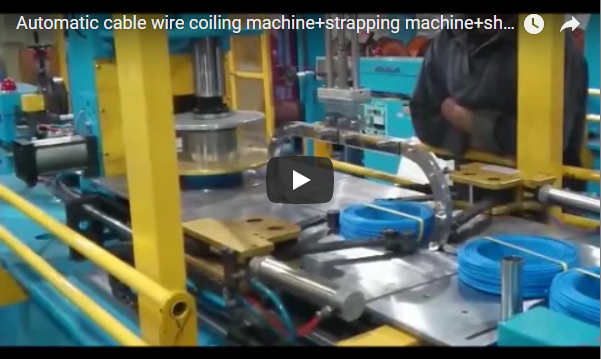
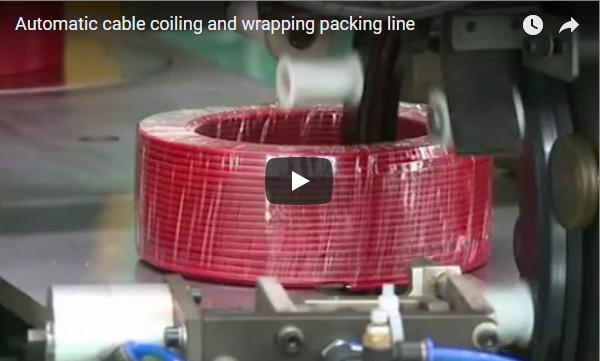
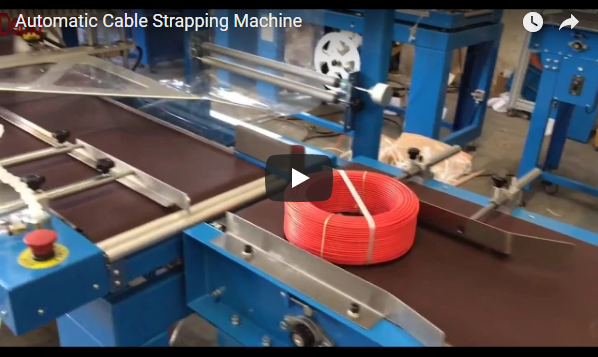
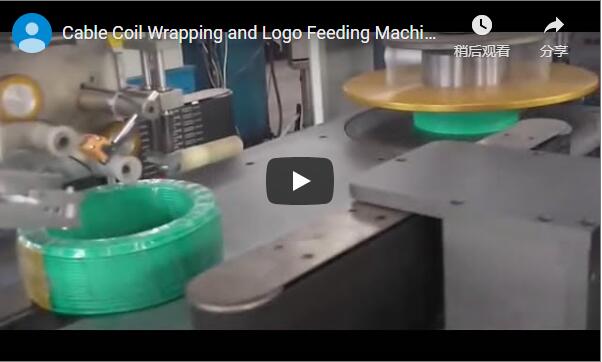
Auto cable coiling&wrapping with film

In modern cable manufacturing and distribution, efficiency, consistency, and product protection are paramount. Manual coiling and wrapping processes are often labor-intensive, prone to inconsistencies, and can pose ergonomic challenges. Addressing these issues requires advanced automation solutions. This article provides a technical overview of automatic cable coiling and wrapping machines that utilize PVC/PE film, focusing on their design, operational capabilities, key components, and benefits, aligning with the rigorous standards expected in industrial machine design.

1. Operational Flexibility: Online vs. Offline Integration

A key design consideration for automated cable packaging systems is their integration into the production workflow. This machine type typically offers two primary operational modes:

  • Online Integration: The machine is installed directly in line with the cable extrusion or production line. As the cable is produced, it feeds directly into the coiling machine, enabling a continuous, seamless process from manufacturing to packaging. This minimizes handling and buffer storage requirements.
  • Offline Operation: The machine functions as a standalone unit. Pre-produced cable, often stored on reels or in drums, is fed into the machine for coiling and wrapping. This mode offers flexibility, allowing manufacturers to package various cable types or handle overflow production without disrupting the main extrusion line.

The choice between online and offline integration depends heavily on production volume, factory layout, and the diversity of cable products being handled.

automatic cable coiling2

2. Core Functionality: The Coiling and Wrapping Process

The machine executes a precise sequence of operations to transform continuous cable into neatly wrapped coils:

  1. Cable Feeding & Measurement: The cable is drawn into the machine, often through an accumulator or dancer arm that maintains consistent tension. A precision measuring device (typically an encoder wheel) accurately tracks the cable length according to pre-set parameters defined via the Human-Machine Interface (HMI).
  2. Automatic Coiling: Once the target length is reached, the cable is guided onto a rotating coiling head or mandrel. The coiling process is carefully controlled to ensure a uniform coil shape and density, preventing kinks or damage. Coiling parameters like inner diameter, outer diameter, and traverse width are adjustable.
  3. Cutting & Holding: Upon completion of the coil, an integrated cutting mechanism cleanly severs the cable. The trailing end is typically secured automatically to prevent the coil from unraveling.
  4. Coil Transfer: The finished coil is automatically ejected from the coiling head and transferred to the wrapping station. This is often achieved using pneumatic pushers, robotic arms, or conveyor systems, depending on the machine’s configuration and level of automation.
  5. Film Wrapping: At the wrapping station, the coil is tightly wrapped with a protective layer of PVC or PE film. The film provides protection against dust, moisture, and physical abrasion during transport and storage. The wrapping process usually involves rotating the coil while dispensing and sealing the film.

3. Design Philosophy and Structural Integrity

Reflecting the demands of industrial environments, these machines are engineered for robustness and reliability:

  • Construction: Typically feature a heavy-duty welded steel frame to ensure stability and minimize vibration during high-speed operation. Critical components are precision-machined for accuracy and longevity.
  • Component Quality: Utilize high-quality bearings, motors, sensors, and pneumatic/hydraulic components from reputable manufacturers to ensure consistent performance and reduce downtime.
  • Modularity: Modern designs often incorporate modularity, allowing for easier maintenance, potential upgrades, or customization to specific cable types or packaging requirements.
  • Compliance: Designed and built in accordance with relevant international standards, including CE guidelines for safety and electrical compatibility within the European Economic Area.

4. Key System Components Breakdown

Understanding the core components provides insight into the machine’s operation:

  • Cable Infeed & Tension Control: Accumulators or dancer systems manage cable slack and ensure consistent tension for accurate measurement and coiling.
  • Length Measuring Unit: High-resolution rotary encoder coupled with a calibrated measuring wheel. Accuracy is critical for consistent product delivery.
  • Coiling Head Assembly: Includes the driven mandrel, adjustable guide arms, and traverse mechanism responsible for forming the coil structure. Often designed for quick changeovers for different coil sizes.
  • Cutting Mechanism: Pneumatic or servo-driven shear designed for clean, reliable cutting of various cable diameters and constructions.
  • Coil Handling System: Mechanisms (pushers, conveyors, robotic arms) to move the coil from the coiler to the wrapper.
  • Film Wrapping Station: Comprises film roll holder, dispensing system with tension control, stretching elements (if applicable), and a sealing mechanism (heat seal, adhesive).
  • Control System: Typically based on a Programmable Logic Controller (PLC) for robust process control, coupled with an HMI touchscreen for operator interaction, parameter setting (coil length, diameter, wrap cycles), recipe storage, and diagnostics.
  • Safety Systems: Comprehensive guarding, safety interlocks on access doors, emergency stop buttons, and light curtains (optional) to ensure operator safety during operation and maintenance.
    automatic cable coiling
    automatic cable coiling

    5. Technical Specifications Overview

While specifications vary significantly between models and manufacturers, typical parameter ranges include:

Parameter Typical Specification Range Notes
Applicable Cable Diameter 2 mm – 25 mm Dependent on machine model and tooling
Max. Coiling Speed 100 – 300 m/min Influenced by cable type and coil size
Coil Inner Diameter (ID) 100 mm – 400 mm (Adjustable) Requires appropriate mandrel tooling
Coil Outer Diameter (OD) Up to 600 mm Machine frame and capacity limit
Coil Width / Height 50 mm – 200 mm (Adjustable) Set via coiling head guides
Length Measurement Accuracy ± 0.1% – 0.5% Dependent on encoder resolution & calibration
Wrapping Film Material PVC / PE / Stretch Film Specify type and thickness range
Film Width 50 mm – 100 mm Matched to wrapping station design
Control System PLC (e.g., Siemens, Allen-Bradley) HMI Touchscreen (e.g., 7-12 inches)
Power Supply 380V/415V/480V, 3-Phase, 50/60Hz Specify total power consumption (kW)
Compressed Air Requirement 6 – 8 bar (0.6 – 0.8 MPa) Clean, dry air required for pneumatics

Note: These are representative values. Always refer to specific manufacturer datasheets for exact specifications.

6. Personal User Experience and Operational Insights

From an operational standpoint, interacting with these machines typically highlights several key areas:

  • Ease of Use: Modern HMIs with graphical interfaces simplify setup and operation. Recipe management allows operators to quickly load pre-saved parameters for different cable products, minimizing changeover time.
  • Changeover Efficiency: Designs often focus on tool-less or quick-change adjustments for coiling mandrels and guide arms to accommodate different coil sizes rapidly.
  • Maintenance Access: Thoughtful design includes accessible maintenance points for lubrication, sensor checks, and component replacement. Clear labeling and diagnostic screens on the HMI aid troubleshooting.
  • Reliability: When properly maintained, these industrial machines offer high uptime. The automation eliminates variability inherent in manual processes, leading to consistent output.
  • Integration: For online systems, seamless communication with the upstream extrusion line control (e.g., for line speed synchronization or stop/start signals) is crucial and typically well-supported through standard industrial communication protocols.

7. Benefits of Automated Cable Coiling and Wrapping

Investing in this automation technology yields significant advantages:

  • Increased Throughput: Machines operate continuously at high speeds, drastically increasing packaging output compared to manual methods.
  • Consistent Quality: Automated control ensures every coil meets precise length, dimension, and wrapping specifications, enhancing product uniformity.
  • Enhanced Protection: Tightly wrapped film shields the cable from environmental factors and handling damage, reducing scrap and returns.
  • Labor Optimization: Reduces the need for manual labor in repetitive coiling and wrapping tasks, freeing up personnel for higher-value activities.
  • Improved Safety: Eliminates ergonomic risks associated with manual coiling and lifting, creating a safer work environment.
  • Reduced Material Waste: Optimized film usage and precise cutting minimize material consumption. automatic cable wire coiling machine

    8. Conclusion: A Strategic Investment for Cable Handling

Automatic cable coiling and film wrapping machines represent a significant advancement over manual processes. By integrating precise measurement, controlled coiling, automated transfer, and protective film wrapping into a single, efficient system, they offer manufacturers substantial benefits in productivity, quality, safety, and cost-effectiveness. Adherence to design standards like CE ensures they meet rigorous industrial requirements. Whether implemented as an inline or offline solution, this technology is a strategic investment for any operation looking to optimize its cable packaging workflow.


For detailed specifications, customization options, or quotations regarding automatic cable coiling and wrapping solutions, please contact the specialists:

Website: www.fhopepack.comEmail: coiler@fhopepack.com