Overview
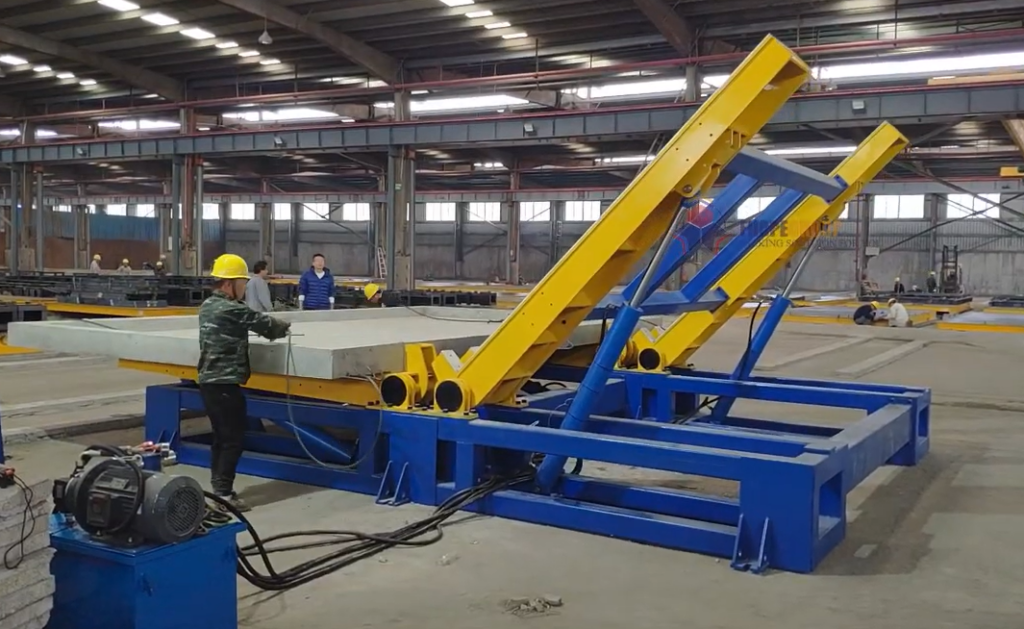
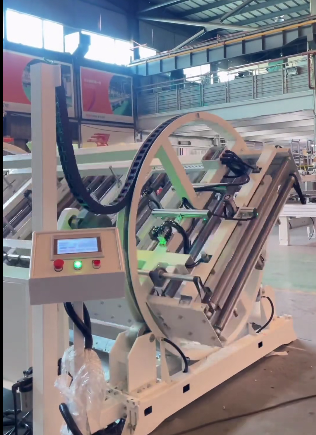
A thick steel plate is one of the hardest loads to turn safely: it is heavy, its edge takes the full force at the pivot, and if control is lost the result is dangerous. A heavy duty 180° plate turnover machine feeds the plate in on roller conveyors, grips it inside a large rotating ring, and turns it in place, so the thick plate is never swung on a crane and the edge never carries the load unsupported. This guide explains how a ring-type heavy duty turnover machine handles thick plate, what limits the rating, and what to verify before accepting delivery.
The video below shows a heavy duty 180° plate turnover machine flipping thick steel plate:
What Makes a Plate Turn "Heavy Duty"
"Thick" and "heavy" change the engineering of the machine, not just the numbers:
| Factor | Why it scales up the design |
|---|---|
| Plate weight | Sets the flipping-load rating, the ring drive rating, and the structural steel sizing. |
| Plate thickness | Makes the plate stiff and heavy for its area, so the ring and cradle must carry it without flexing. |
| Edge load at the pivot | The edge that takes the weight at the start of the turn must be supported, not left to carry the load on a hard point. |
| Turn speed and stopping | A heavy plate has more momentum; the machine must drive and stop the turn under control rather than coast. |
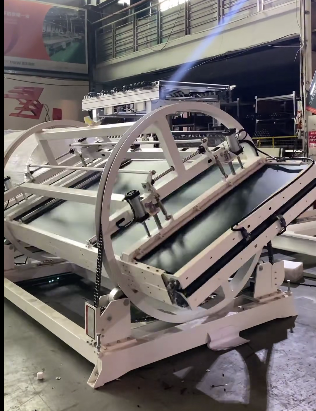
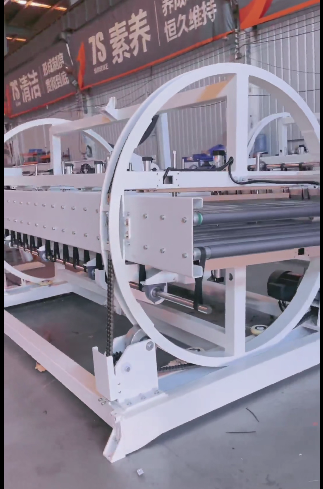
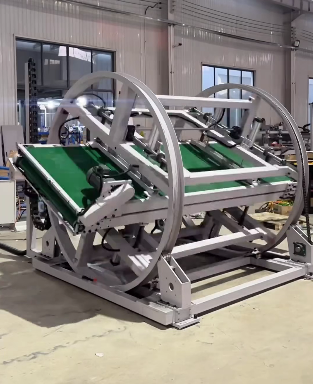
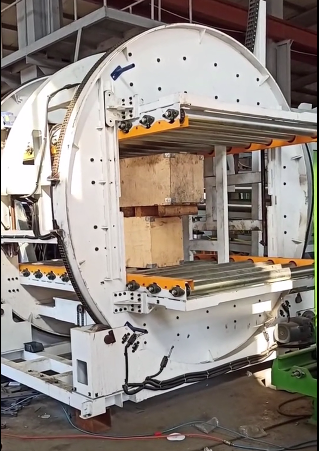
Heavy duty construction shows in the machine itself: deep welded base beams, thick side plates and gussets, large-diameter ring or hoop members, and robust roller supports carrying the weight.
How a Ring-Type Heavy Duty Machine Handles Thick Plate
The machine is built around a large open ring or hoop frame on a substantial fabricated base. The thick plate is carried into and out of the machine on roller-conveyor sections, supported on the rollers inside the cradle, and held against the cradle while the ring rotates it 180° about a horizontal axis. Three behaviours matter most for thick plate:
| Behaviour | Why it matters for thick plate |
|---|---|
| Drive and hold at angle | The heavy plate is driven through the turn and can be held at the required angle, so it does not over-run due to its own momentum. |
| Supported cradle | The plate is supported on rollers and held against the cradle for the whole turn, so the edge is not forced onto a bare hard point. |
| Safe stop on power loss | If electric power fails, the machine's safety design stops and holds the ring in position instead of letting the plate drop or slip. |
The result is a thick plate that turns under control at every stage, with the edge supported through the pivot rather than carrying the full load on a bare corner.
Rating a Heavy Duty Turnover Machine
The rating is selected from your heavy plate, not from a stock frame:
| Input | Why it matters |
|---|---|
| Heaviest plate weight | Sets the flipping-load rating. This machine family builds mechanical upenders (product-line range roughly 1–60 tonnes) and heavy-duty hydraulic configurations (product-line range roughly 1–100 tonnes). |
| Plate size and thickness | Sets the ring opening, roller spacing and cradle supports. |
| Working pressure | On the 180° reference build in this family the hydraulic circuit is rated up to 15 MPa working pressure, with 20 MPa as the maximum design allowance. |
| Turn requirement | Full 180°, or a stop at an intermediate angle for inspection. |
| Infeed/outfeed method | Forklift, crane or roller conveyor changes the access height and the cycle. |
| Floor space and pit | Sets the machine footprint and any required floor preparation. |
The manufacturer confirms the final configuration on an engineering approval drawing after design.
Factory Testing and Acceptance for Heavy Duty
A heavy duty turnover machine should be proven under load before it ships:
- Extended run record. A test log covering near-continuous cycling (the maker's stated protocol for this machine family runs up to about 24 hours), stated as unloaded or under load.
- Rated-load proof. Evidence the machine turned a load at its rated flipping load through the full arc, not just an empty cycle.
- Drive and hold record. Proof the machine rotated to the required angle and held the load without drift.
- Safety device verification. Sign-off that the guards, safety interlocks and the emergency stop work as designed.
- Power-loss behaviour. Confirmation that a simulated power loss stopped and held the ring safely without dropping the test plate.
- Compliance documentation. Confirmation of the safety references used for this machine family (EN 415-10 as reference and an ISO 12100 risk assessment covering the swept area of the moving ring).
On arrival, repeat the core checks on your floor—empty rotation, a rated-weight turn, the emergency stop, and the power-loss stop—before bringing the machine into production.
FAQ
Q: How heavy a plate can a heavy duty turnover machine flip? A: This machine family covers mechanical upenders from about 1 to 60 tonnes and heavy-duty hydraulic configurations from about 1 to 100 tonnes. Your heaviest plate weight selects the rating.
Q: What if the plate must stop at 90° instead of 180°? A: The machine can drive to and hold a set angle. State the turn requirement so the control and stop positions are set for your angle.
Q: What happens if power fails with a thick plate in the machine? A: The machine's safety design stops and holds the ring in position; when power is restored the control system resumes safely rather than dropping the plate.
Q: How does a thick plate enter and leave the machine? A: In a roller-fed ring machine the plate is carried in and out on roller-conveyor sections and supported on rollers inside the cradle during the turn. Confirm the roller height with your line.
Q: Does a thick plate need special floor preparation? A: The machine footprint and load dictate the floor requirements. Confirm the floor and any pit preparation with the manufacturer before delivery.
Next Step
Send your heaviest plate weight and size, the turn requirement (180° or a set angle), the infeed/outfeed method, and your floor space, so the heavy duty turnover machine can be rated, specified on the approval drawing, and tested to an agreed load list before shipment.
Related Resources
- Coil Upender & Industrial Turnover Solutions – Custom mechanical (≈1–60T) and hydraulic (≈1–100T) turnover equipment.
- Hydraulic Upender and Tilter Solutions – Manufacturer's declared pre-delivery testing practice and control/safety verification.
- How 180° Turning Machines Work for Precast Components and Sheets – 180° turning machine kinematics and EN 415-10 / ISO 12100 safety references.